
· Digital Footprint Check · Content Marketing · 13 min read
GDPR Compliance Guide: a Practical Checklist for 2026
Learn how to build a working GDPR compliance guide for your organization: data mapping, lawful bases, DPIAs, breach response and recordkeeping.

More than $16.6 billion in reported losses accompanied internet-crime complaints in the FBI's 2024 Internet Crime Report, which identifies personal-data breaches among the leading complaint categories, according to the FBI's Internet Crime Complaint Center. Exposed information isn't just embarrassing. Someone can use it to impersonate an employee, target a job seeker, or make a dating scam sound convincing.
A useful GDPR compliance guide starts with what your team does with personal information, including information anyone can find online. Your privacy notice matters, but so do your matching rules, vendor access, deletion routines, and decisions about reusing public profiles.
The GDPR Obligations Checklist You Need
Does your organization collect, store, analyze, or share personal data about people in the EU? Start there, then establish whether your activities fall within the GDPR's territorial scope. A business outside the EU can be covered when it offers goods or services to people there or monitors their behavior.
The regulation became applicable on 25 May 2018, and the European Parliament's GDPR overview explains its rights-based framework and international reach. This isn't just a cybersecurity standard. You must justify processing, explain it, limit it, and enable people to exercise their rights.
For the most serious infringements, penalties can reach €20 million or 4% of total worldwide annual turnover, whichever is higher; the European Commission also reports that 22 EU/EEA authorities issued 785 fines between May 2018 and November 2019. A policy document alone isn't evidence that your team meets its obligations.
GDPR core obligations and the evidence each one needs
| Obligation | Article | What You Must Have on File |
|---|---|---|
| Lawful basis | Art. 6 | Documented lawful basis for each processing activity |
| Transparency notice | Arts. 12-14 | Privacy notice explaining purposes, recipients, and rights |
| Records of processing | Art. 30 | Register of processing activities, purposes, recipients, and retention |
| Data protection impact assessment | Art. 35 | Written DPIA for processing likely to create high risk |
| Data subject rights | Arts. 15-22 | Request log containing dates, decisions, and responses |
| Breach notification | Arts. 33-34 | Breach register recording facts, effects, and remedial action |
| Processor contracts | Art. 28 | Signed data processing agreement with each processor |
| Security and accountability | Arts. 5(2) and 32 | Documented safeguards and evidence of review |
Treat the register as a practical baseline even if a specific recordkeeping exemption might apply. A small team still needs to know what information it holds to answer requests or investigate an incident.
Practical rule: Evidence should show what your team does, not merely what a policy says it intends to do.
Begin your triage with these actions:
- Mark applicability. Identify which obligations your processing triggers.
- Expose missing evidence. Flag unsigned contracts, untested procedures, and undocumented decisions.
- Assign the inventory owner. Start the records of processing before trying to repair every policy at once.
How to Map Your Personal Data and Build Records
List activities, not just applications. A shared Google Drive folder might support recruitment, customer support, and incident investigations, each with different purposes and retention rules.
Use this workflow to build the inventory.
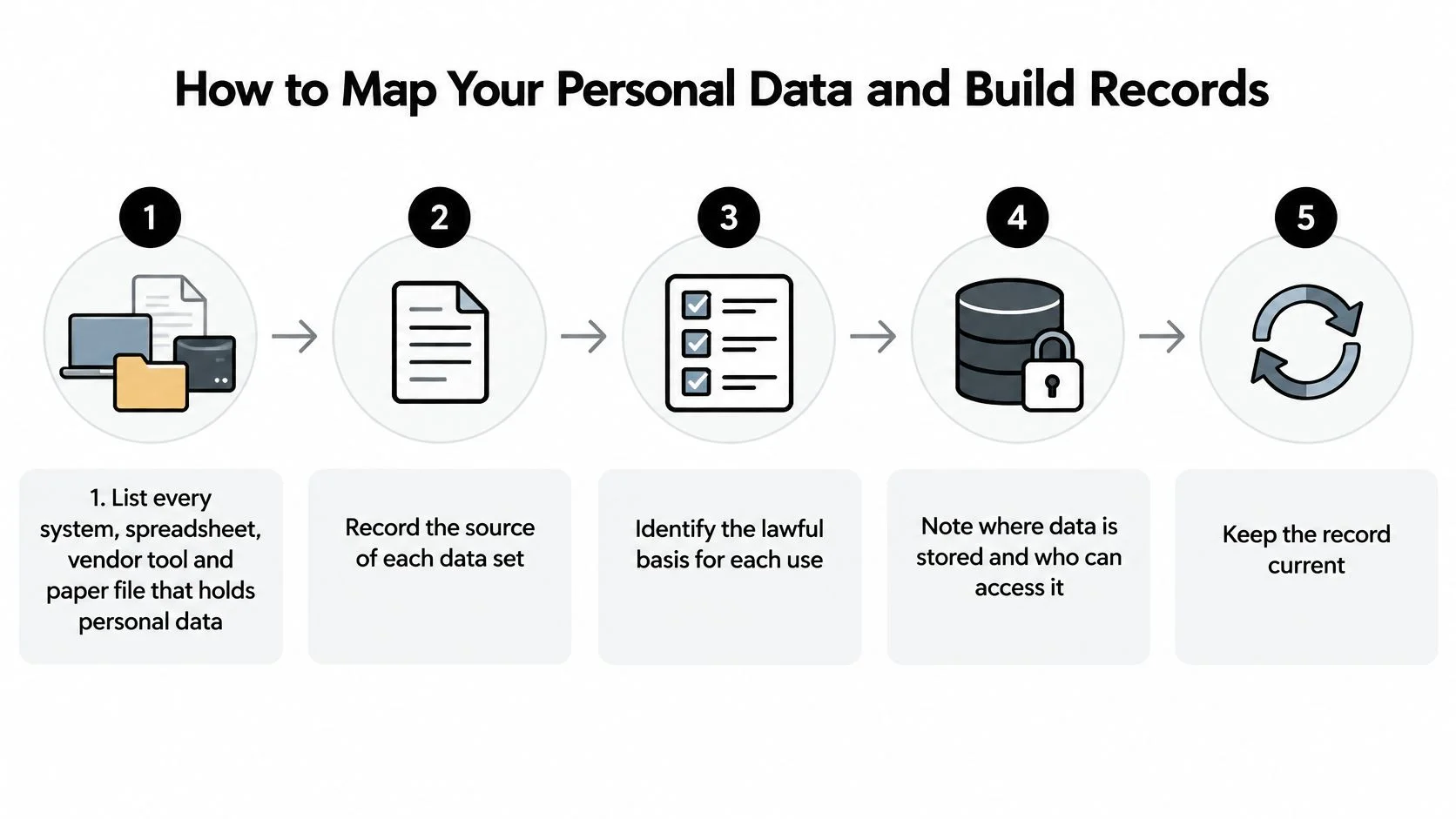
- Find every repository. Include spreadsheets, CRM tools, paper files, exported reports, and staff inboxes. Our explanation of what personally identifiable information means can help staff recognize identifiers beyond names.
- Record the source. Distinguish customer submissions, job applications, public websites, and licensed lists. For teams assessing commercial data sources, data licensing industries at SourceX offers context for identifying relevant licensing arrangements, not proof that a particular reuse is lawful.
- Write the purpose. Use a concrete sentence, such as assessing applicants for an advertised vacancy. Attach the proposed lawful basis and explain why each field is needed.
- Name recipients. Record processors, subprocessors, internal teams, and independent recipients. Don't hide them under a category called partners.
- Map access and geography. Include storage, support, enrichment, backups, and remote administration. Identify onward transfers as well as the initial destination.
- Set deletion triggers. Tie retention to an event, such as closing an application, and assign someone to verify deletion.
EU hosting isn't the whole transfer assessment
Ireland's Data Protection Commission imposed a EUR 530 million penalty in April 2025 over infringements involving transfers to China, as described in DLA Piper's GDPR fines and data breach survey. Lawful collection doesn't settle whether a subsequent international transfer is lawful.
Check remote administrator access, overseas support teams, government-access risks, and vendor onward transfers. Document the applicable transfer mechanism, any necessary transfer-impact assessment, supplementary safeguards, and an exit plan.
For cookie providers based outside the European Economic Area, we use EU-US Data Privacy Framework participation, Standard Contractual Clauses, or European Commission adequacy decisions as safeguards.
Your minimum viable record is a spreadsheet with a row per activity. Include controller details, purposes, categories of people and data, recipients, transfers, retention, and security measures, then update it when operations change.
Choosing a Lawful Basis for Each Activity
A lawful basis is a legal key for a specific purpose. A key that permits delivering an order doesn't automatically permit building a marketing profile from the customer's social accounts.
Article 6 lawful bases at a glance
| Lawful Basis | Article | Use When | Example |
|---|---|---|---|
| Consent | Art. 6(1)(a) | A person freely agrees to a specific purpose and can withdraw | Newsletter opt-in |
| Contract | Art. 6(1)(b) | Processing is necessary for a requested service | Shipping address for an order |
| Legal obligation | Art. 6(1)(c) | Applicable law requires processing | Tax and payroll records |
| Vital interests | Art. 6(1)(d) | Processing is necessary to protect life | Emergency medical information |
| Public task | Art. 6(1)(e) | Processing supports a legally established public task | Council licensing register |
| Legitimate interests | Art. 6(1)(f) | Necessary processing passes a rights-balancing assessment | Proportionate account fraud checks |
The CNIL guidance discussed in Simmons & Simmons' privacy analysis emphasizes a three-part legitimate interests test: a lawful purpose, necessary processing, and an impact that isn't disproportionate. Document your reasoning and safeguards before processing begins.
A tightly scoped fraud check may be a strong candidate. Scraping public social profiles for sales outreach isn't justified merely because the profiles are visible. Consider expectations, intrusive aggregation, objections, and less invasive alternatives.
Public visibility isn't permission to aggregate, infer, and reuse information for any purpose.
Separate service delivery from optional uses
A retailer assessing BonusQR points rewards for retailers should distinguish administering earned rewards from optional promotional messages. Describe each activity separately before choosing its basis.
The same distinction matters in online identity protection. A person checking their own footprint isn't equivalent to an employer investigating an applicant. Employment screening needs its own necessity assessment, transparency arrangements, retention limits, and safeguards against irrelevant or mistaken matches.
Consent must be affirmative, specific, freely given, and easy to withdraw. Don't use it as a fallback for processing already required by law or necessary for a contract. At Digital Footprint Check, analytics cookies use visitor consent; our cookie policy explains the controls.
For routine commercial activities, check contract necessity and legal obligations first. Assess legitimate interests where appropriate, and use consent for optional marketing when required, alongside the applicable electronic-marketing rules.
Processor Contracts, Special Categories and the DPO
The controller decides why and how personal data is processed. A processor handles it on the controller's behalf. A vendor can hold different roles for different activities, so classify the service rather than relying on its label.
Use a processor checklist:
- Document instructions. The Article 28 agreement should identify subject matter, duration, nature, purpose, data types, and categories of people.
- Control subcontracting. Require written authorization arrangements and equivalent obligations for subprocessors.
- Plan the ending. Specify return or deletion, including how the supplier handles retained copies.
Our data processing agreement guide provides context for reviewing these terms. Administrative support, including services such as lathire virtual legal assistants, may help organize agreements, but legal approval and controller accountability remain with the responsible organization.
Sensitive information needs additional analysis
Article 9 special-category data includes health information and biometric data used for unique identification. Processing generally requires an Article 9 condition in addition to an Article 6 basis.
Criminal-conviction data falls under Article 10, not automatically Article 9. Its processing requires the relevant official-authority or legal authorization and safeguards. Legitimate interests alone isn't sufficient.
A data protection officer is mandatory for public authorities, subject to the judicial exception, and where core activities meet the large-scale monitoring or sensitive/criminal-data triggers under Article 37. Otherwise, appointment can be voluntary.
The DPO needs independence, resources, access to the highest management level, and freedom from conflicting duties. Record your assessment of whether appointment is required.
When a DPIA Is Required and What It Covers
A data protection impact assessment, or DPIA, is required when processing is likely to create high risk for individuals. The European Data Protection Board's DPIA guidance highlights large-scale sensitive or criminal-data processing, systematic and extensive profiling with significant effects, and large-scale monitoring of publicly accessible areas.
A useful assessment connects processing decisions to potential harm.
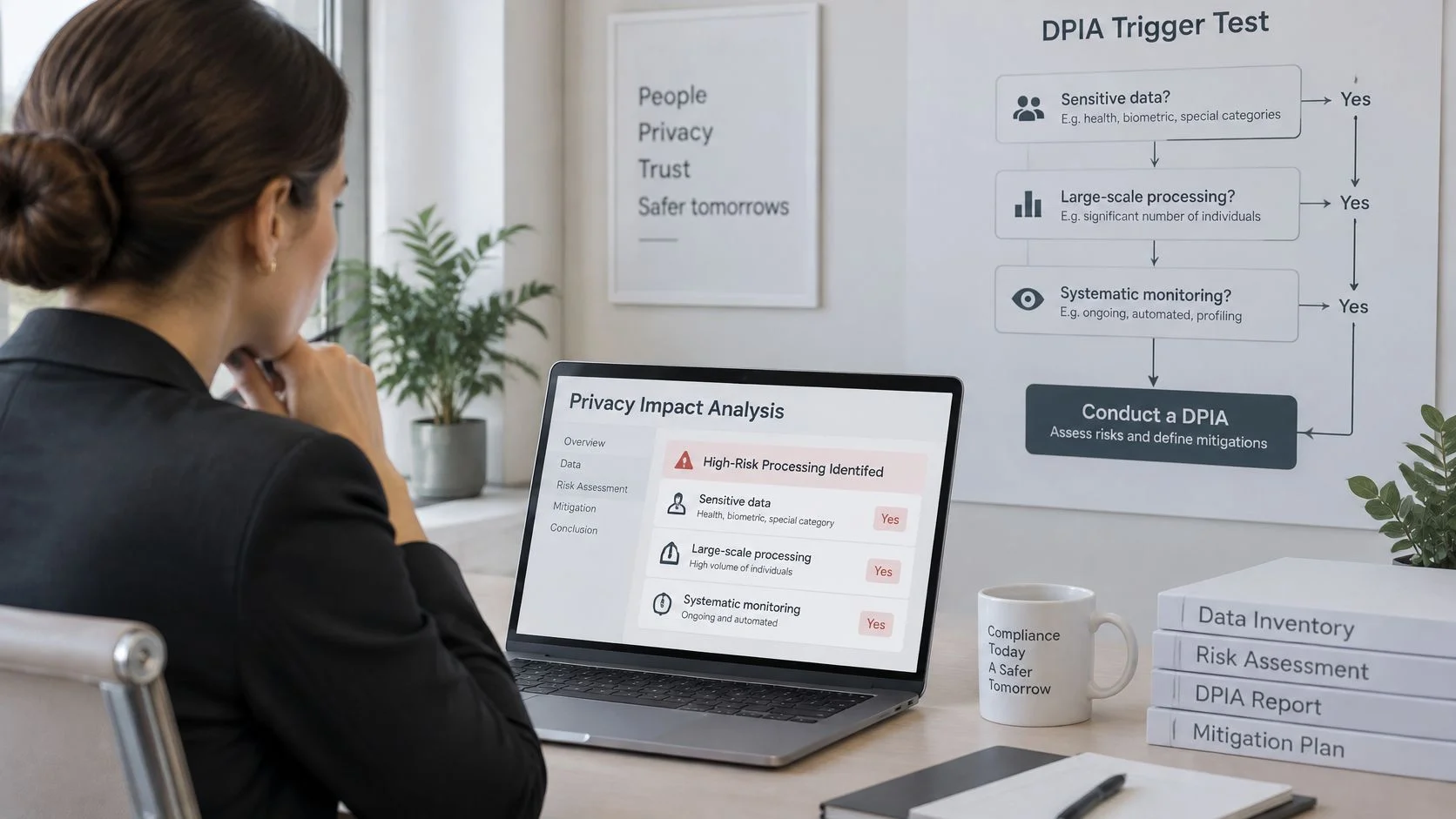
Say an OSINT background-check service combines usernames, public professional profiles, and breach indicators. A shared username could connect an applicant to someone else's gaming account, damaging job prospects despite weak evidence.
The assessment should map each purpose, data category, source, lawful basis, retention period, recipient, and international transfer. Then evaluate necessity, proportionality, and risks from the affected person's perspective.
Match each threat to a testable control
| Threat | Practical control | Evidence to retain |
|---|---|---|
| Mistaken identity | Confidence thresholds and human review before harmful matches are released | Matching criteria and review records |
| Unauthorized disclosure | Role-based access and report-access logging | Permissions and audit logs |
| Discriminatory profiling | Exclude irrelevant sensitive inferences and assess outcomes | Field exclusions and review decisions |
| Account takeover | Handle breach-derived credentials separately and restrict exposure | Access rules and security tests |
| Persistent inaccurate results | Suppression and correction workflows | Suppression tests and case records |
Source-quality scoring should distinguish a reliable record from an unverified claim. Matching a username isn't the same as verifying identity, and neither proves that a dating profile is trustworthy or that someone has committed fraud.
Use the video alongside the written assessment when briefing colleagues.
Complete the DPIA before launching or materially expanding high-risk processing. If high risk remains despite mitigation, consult the supervisory authority before proceeding. Revisit the assessment when sources, matching methods, purposes, or recipients change.
Answering Data Subject Requests on Time
The default response deadline is one month. Complex or numerous requests may justify two further months, but you must explain the extension within the initial month.
Data subject rights and response deadlines
| Right | Article | What You Must Do | Deadline |
|---|---|---|---|
| Access | Art. 15 | Provide a copy and information about its use | One month, Art. 12(3) |
| Rectification | Art. 16 | Correct inaccurate or incomplete data | One month |
| Erasure | Art. 17 | Delete where a legal ground applies | One month |
| Restriction | Art. 18 | Restrict processing where conditions apply | One month |
| Portability | Art. 20 | Supply qualifying data in structured, machine-readable form | One month |
| Objection | Art. 21 | Stop direct marketing; assess other objections under the applicable test | One month |
These are response deadlines, not permission to postpone urgent corrections or continue objected-to direct marketing. Rights have conditions and exemptions, so record the reasoning rather than promising unconditional deletion.
Build a reliable intake route
Verify identity proportionately. An account-based request may need less additional evidence than a request for a sensitive screening report; don't routinely demand identity documents you don't need.
Log receipt, assign an owner, and search every relevant system in the inventory. Review third-party information for redaction, then securely provide the response or explain any lawful refusal. Our guide to what a DSAR is explains the access-request process.
Operational safeguard: The deadline runs from receipt of the request, not from the day an employee gets around to reading it.
If an applicant emails for pre-employment screening results, route the message promptly rather than requiring a special form. Escalate requests connected with disputes or regulator correspondence to the DPO or compliance lead the same day.
Your notice should explain rights, withdrawal of consent, submission routes, and complaints to the relevant authority. Our users can request access, correction, objection to certain processing such as direct marketing, and deletion of personal data we hold.
EEA visitors can also withdraw cookie consent at any time, request access to or erasure of cookie data, object to marketing processing, and complain to their local authority. Send privacy and cookie questions or requests to info@digitalfootprintcheck.com.
Breach Notification Deadlines and Response Steps
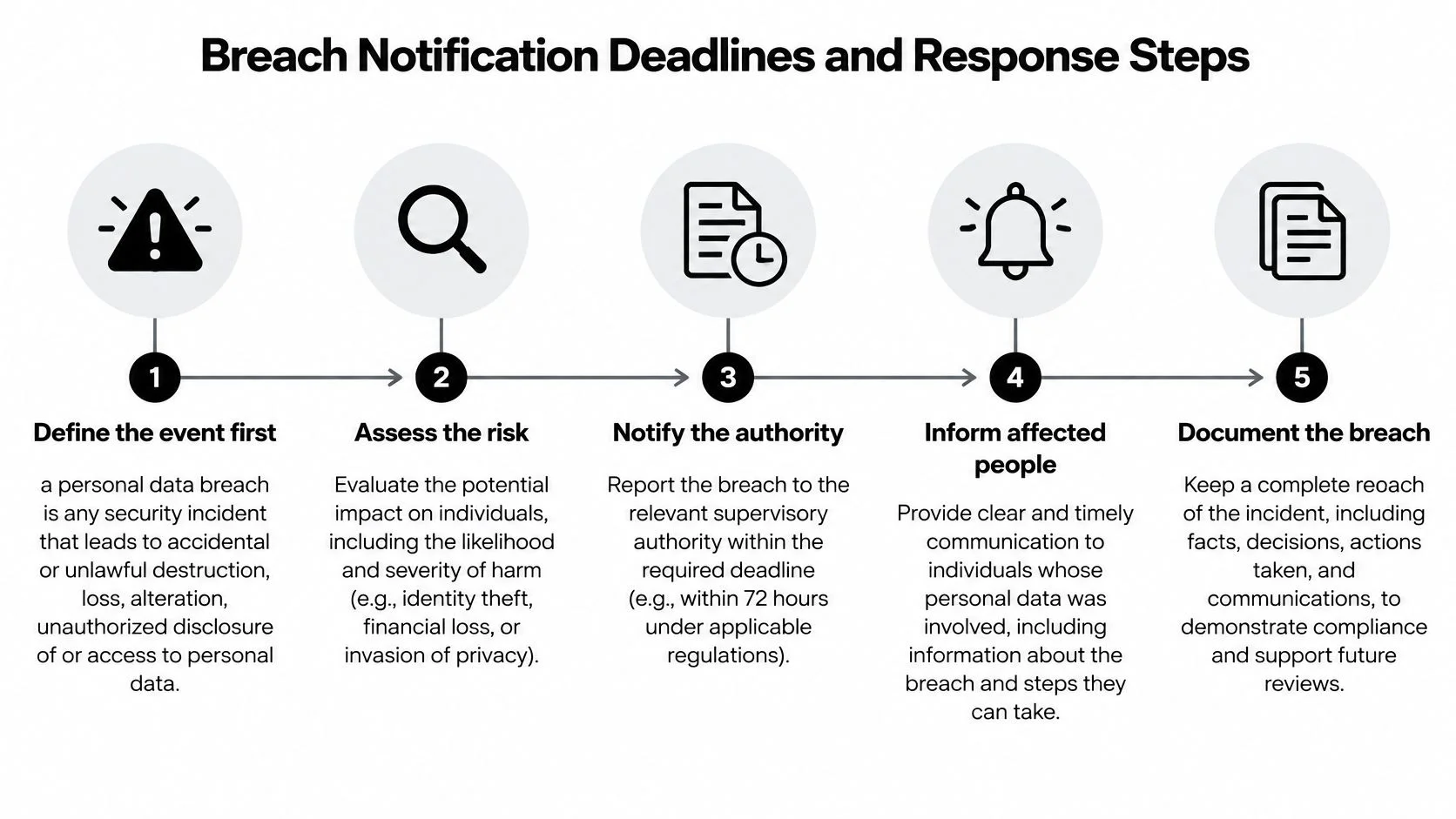
The 72-hour authority-notification clock starts when you become aware of a personal data breach, unless the breach is unlikely to risk people's rights and freedoms. A breach includes accidental or unlawful destruction, loss, alteration, unauthorized disclosure, or access, not just hacking.
Use a response sequence that staff can follow under pressure.
Breach notification deadlines by recipient
| Recipient | Trigger | Deadline | Article |
|---|---|---|---|
| Supervisory authority | Breach likely to risk people's rights and freedoms | Within 72 hours of awareness, where feasible | Art. 33(1) |
| Individuals | Breach likely to result in high risk | Without undue delay | Art. 34(1) |
| Controller, if you're a processor | Any personal data breach | Without undue delay | Art. 33(2) |
| Internal breach register | Every breach, reportable or not | Record facts, effects, and remedial action | Art. 33(5) |
Contain first, while preserving evidence. Disable compromised sessions, restrict exposed folders, or revoke access tokens. Don't destroy the logs needed to establish what happened.
Establish the categories of information, approximate people affected, recipients, and likely consequences. Then decide notification requirements, send the necessary notices, and document your reasoning even if no external report is required.
Assess consequences rather than incident labels
A misdirected email containing customer financial details may be reportable even if the recipient list is small. A lost laptop protected by effective full-disk encryption may not require notifying individuals if the information remains unintelligible and the relevant conditions are satisfied.
Neither example supports an automatic decision. Check key protection, whether the device was open, other accessible copies, and any risks from losing availability.
Use our data breach response plan to organize responsibilities and communications. If details aren't available immediately, consider phased authority reporting rather than delaying the initial notification, and explain any late report.
Run an annual tabletop exercise. Give staff a realistic scenario, require a documented notification decision, and verify that someone can contact the regulator without searching through old emails.
Confirm Your Gaps Before a Regulator Does
Turn the obligations checklist into an operational audit. A policy marked approved isn't enough if staff can't demonstrate the process or locate its records.
Use this review sequence to turn findings into assigned work.
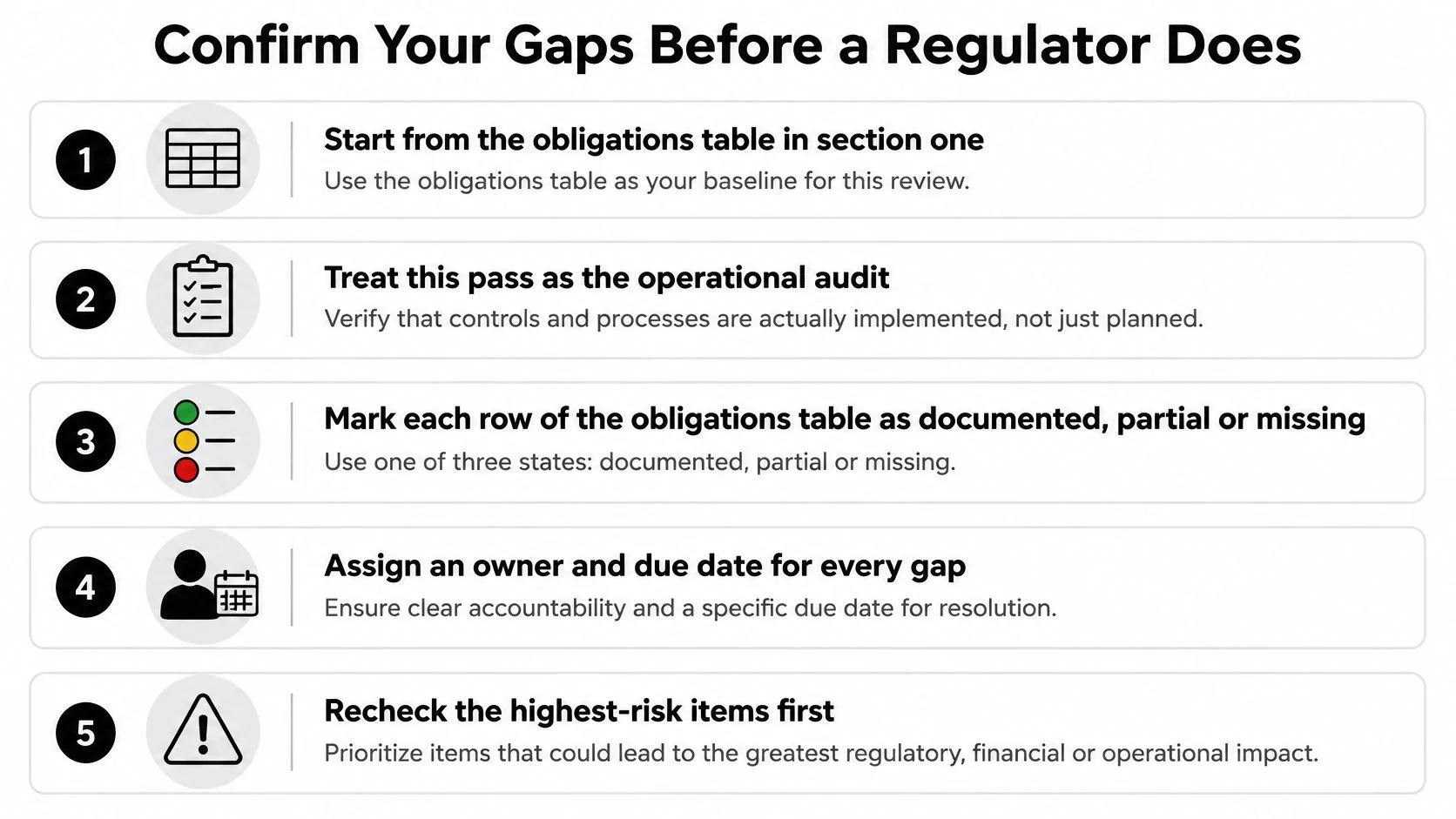
- Grade the evidence. Mark obligations documented, partial, or missing, and identify the actual supporting file.
- Reconcile operations. Compare records against your inventory, vendor invoices, and staff workflows.
- Prioritize individual harm. Address sensitive information, consequential profiling, and inadequately assessed transfers first.
- Assign ownership. Give each gap an accountable person and completion date.
- Schedule reassessment. Review quarterly and after introducing a product, vendor, or materially different use.
Regulatory enforcement makes unfinished work consequential, but fine totals shouldn't determine your priorities. A screening error that blocks employment or a disclosure that threatens personal safety deserves attention regardless of your organization's size.
Keep a compact evidence pack
Create reusable templates with these fields:
- Processing record: Activity, owner, purpose, data, people, recipients, transfers, retention, safeguards.
- Lawful-basis register: Purpose, basis, necessity assessment, balancing analysis, approval.
- DPIA: Processing description, risks, controls, residual risk, review decision.
- Rights log: Receipt, identity checks, searches, deadline, decision, response.
- Breach register: Awareness, facts, affected information, risk, notifications, remediation.
- Processor checklist: Instructions, security, subprocessors, assistance, audit, deletion.
- Transfer assessment: Destinations, access, mechanism, local risks, supplementary safeguards.
- Retention schedule: Dataset, justification, trigger, deletion owner, verification.
Our service is fully GDPR-compliant, but using a compliant service doesn't establish the lawfulness of your own purposes or decisions. Your organization remains responsible for how it uses results.
This week, name the processing-record owner and schedule a working session on the inventory. If your work involves public profiles or OSINT-style checks, use the free footprint checker to examine your own online exposure as an audit input, not a compliance certificate.
Digital Footprint Check helps individuals and businesses discover publicly accessible information and understand their online exposure. Visit Digital Footprint Check to investigate your footprint, prioritize exposed information, and bring clearer evidence into your privacy review.