· Digital Footprint Check · Content Marketing · 18 min read
How to Search Usernames on Dating Sites Safely
Learn how to search usernames on dating sites ethically, read matches as leads rather than proof, and avoid privacy risks and romance scams.

You've been texting with someone from a dating app for two weeks, and a small detail doesn't quite sit right. Maybe their handle looks identical to a gamertag you spotted in a Discord server, or a friend swears they saw the same username on another site. Naturally, your first instinct is to search usernames on dating sites to figure out whether you're talking to who they claim to be.
Running that check feels harmless, and sometimes it protects you from catfishing or identity theft. Most guides stop there, framing a username lookup as a quick way to catch a liar. What they rarely mention is that the search process itself has become an attack surface.
Fake "dating verification" pages now target cautious users who are trying to verify a match, harvesting credit card numbers and personal documents under the cover of safety. On the other side, reckless searching and over-collection can expose an innocent person's workplace, family, or old gaming accounts based on nothing more than a recycled handle. Understanding what a matching handle proves, where ethical lines sit, and how to check public clues without putting yourself at risk keeps both your privacy and your peace of mind intact.
How Strong a Username Match Really Is
Say you type a match's handle into a search bar and find the exact same string sitting on a different dating app, complete with a similar age range. It's tempting to treat that hit as a closed case. In reality, finding an identical handle across two platforms is the starting line of an inquiry, not the finish line.
Online dating has grown large enough that handle collisions happen every day. A Pew Research Center 2022 survey of 6,034 U.S. adults found that 30% of U.S. adults had ever used a dating site or app, a share unchanged from 2019. Usage spreads across multiple services rather than sitting on a single platform: 46% of online daters (14% of all U.S. adults) had used Tinder, including roughly eight-in-ten online daters under age 30, while 31% had used Match, 28% had used Bumble, and about one-fifth had used each of OkCupid, eharmony, or Hinge.
People also join niche dating communities alongside mainstream apps. Specialized platforms like Special Bridge for adults with disabilities serve distinct audiences with their own registration habits, meaning someone may reuse a familiar nickname across both broad and community-focused services. At the same time, two completely unrelated people can pick the same short handle years apart on different apps.
Evaluating Match Evidence Side by Side
A second detail from Pew matters just as much when you interpret what you find. In its companion 2022 analysis of Americans' views on online dating, where 53% of users described their overall experiences as at least somewhat positive, the researchers measured lifetime ever-use rather than active logins. A discovered profile might be an abandoned account from four years ago, not evidence of current relationship status or active swiping.
Treating username research as evidence scoring keeps you from jumping to false conclusions. If you're new to evaluating public clues systematically, learning what open-source intelligence actually covers helps frame why single data points carry low weight on their own.
| Evidence found | Confidence | Next action |
|---|---|---|
| Exact handle on one dating site only | Low lead | Note it and look for corroboration before drawing any conclusion |
| Same handle plus a generic first name or common photo | Low | Treat as a coincidence risk and add no weight to it |
| Same handle plus a distinctive photo or uncommon occupation | Medium | Check whether biography details and location line up |
| Handle linked from a second public account that also matches | Medium to high | Compare dates, location and writing style across both accounts |
| Handle on several platforms with two or more independent matching attributes | Medium to high lead | Still unverified, so confirm through a live interaction or platform-native channels |
| No result on dating sites | None | Not proof of anything, since privacy settings, other handles or no profile explain it |
Why a Blank Result Proves Nothing
Notice the bottom row of that table. Plenty of people run a username search, see zero dating profiles come back, and immediately relax. That sense of relief is misplaced.
A blank search result can mean the person doesn't use dating apps, or it can mean they use a separate alias for dating, keep their account set to private, or rely on platforms that don't index public profile URLs. Scammers also rotate disposable accounts specifically so their handles won't leave a trail.
One matching username is a question to investigate, not an answer.
Lines You Should Never Cross During a Search
Before you run a single query, decide where your investigation stops. Curiosity escalates fast when emotions are involved, and crossing from public observation into active intrusion can hurt someone's livelihood, expose private data, or break the law.
Usernames aren't always anonymous strings. NIST guidance explains that identifiers enable cross-service correlation, and even pseudonymous handles can be re-identified once combined with attributes like a name, email address, or physical address. NIST also classifies a username as personally identifiable information whenever it contains details linking it back to a real individual, whereas an arbitrary opaque handle may not qualify by itself.
Where Privacy Law and Platform Rules Draw the Boundary
You don't need special tools to stay on the right side of the line, just a clear boundary between reading public pages and poking at restricted systems. Reviewing whether open-source intelligence research is legal reinforces a simple rule: public visibility doesn't grant permission to bypass logins, scrape gated areas, or harass people.
| Action | Status | Reason |
|---|---|---|
| Viewing public profile pages visible without logging in | Allowed | Uses only information any visitor can see |
| Logging in with a guessed password or using a password-reset probe | Off limits | Unauthorized access to another person's account |
| Scraping restricted or members-only areas | Off limits | Breaches platform rules and privacy expectations |
| Messaging the person or their matches to test them | Off limits | Creates pressure and can cause real harm |
| Posting a handle or findings publicly or sending them to an employer | Off limits | Exposes a person based on an automated match |
| Sending money or identity documents to a verification page | Off limits | A common route for scams and identity theft |
Real-World Fallout for Reputation and Hiring
Crossing those lines causes damage that outlasts a bad date. Messaging a suspected partner's matches to "test" them drags strangers into a private dispute and can escalate into harassment. Posting a screenshot of a username match on social media or a local dating group exposes someone to public shaming over a lead that might turn out to be a false positive.
The stakes get even sharper when careers are involved. A reused handle often links a dating profile to gaming communities on Steam or Xbox Live, forum posts on Reddit, or professional accounts on LinkedIn, surfacing a workplace, relatives, travel plans, or security-question answers. Sharing an unverified dating profile with an employer or family member as "proof" can wreck job prospects and trigger defamation disputes. For hiring managers or HR teams handling pre-employment screening, any high-impact decision involving online profiles requires formal legal review first, because an unverified dating match is never a sound basis for rejecting or disciplining a candidate.
Dating-profile checks sit inside a much larger cybersecurity picture. According to the FBI's 2024 Internet Crime Report press release, the bureau logged 859,532 complaints of suspected internet crime with reported losses topping $16 billion, a 33% increase over 2023. Those numbers show why your search should stay focused on personal safety and fraud prevention rather than amateur surveillance. When public evidence points to fraud, document what's openly visible, keep your notes private, and report the account through the dating platform alongside official law-enforcement or consumer-protection channels.
Run the Search and Read the Matches
A disciplined workflow takes fifteen minutes and keeps you from chasing coincidences or wandering past the public layer. Follow these six steps in order, and resist the urge to skip documentation.
-
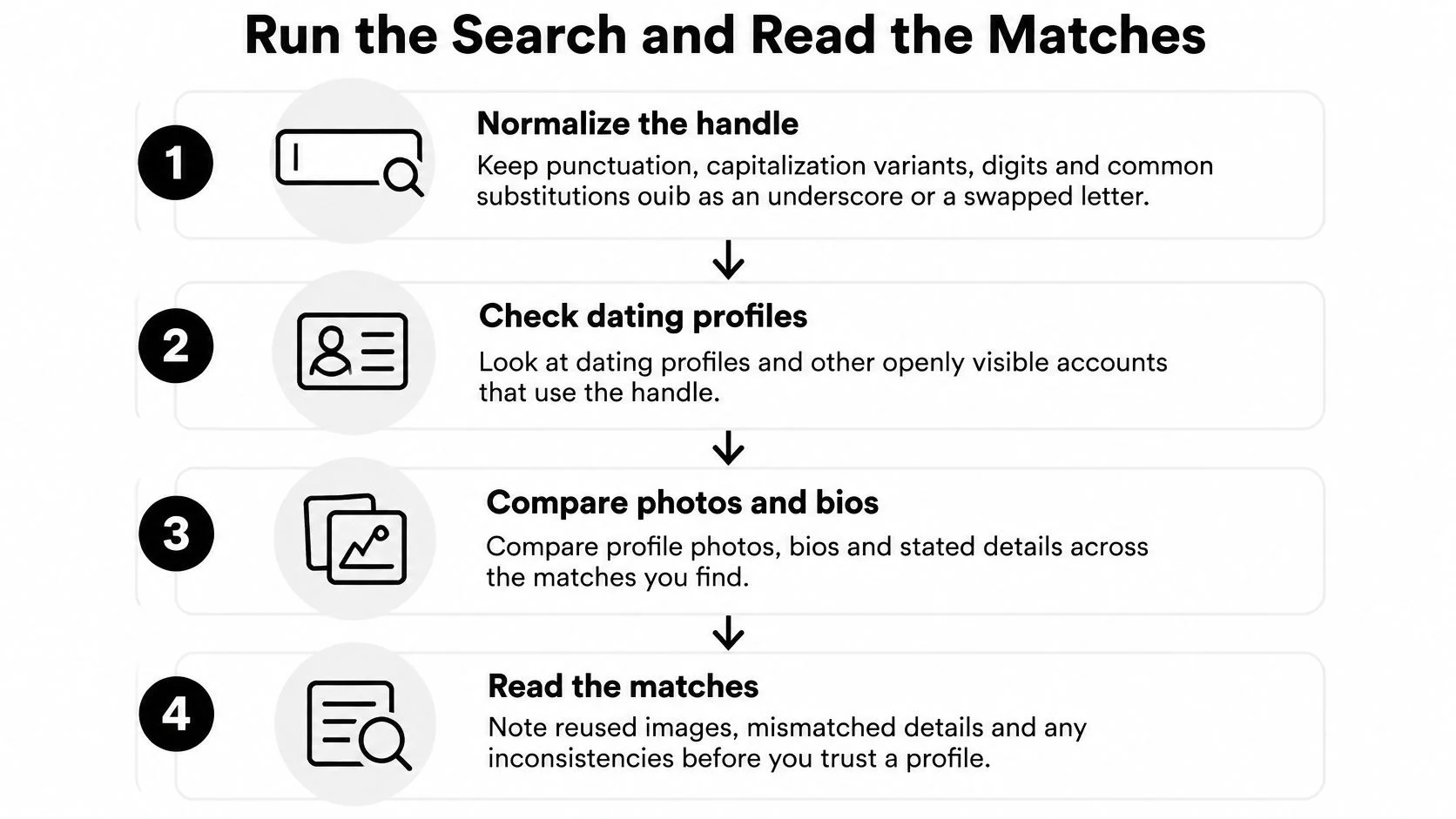
Normalize the exact handle first. Write down the handle exactly as it appears, preserving punctuation, capitalization variants, trailing digits, and common swaps like underscores, periods, or a zero standing in for the letter O. If someone uses
Alex_M94on a dating app, testalexm94,alex.m94, andalex_m04too, since people tweak usernames slightly when their preferred tag is taken on another service. -
Check openly accessible dating profiles and public platforms. Search only pages that load for any visitor without creating a fake account or logging in. Major search engines using exact-phrase quotes around the handle (
"Alex_M94") paired with platform names often reveal indexed profiles on forums, gaming networks like Twitch or Discord directories, and public dating-site pages without touching private databases. -
Log concrete attributes for every candidate match. Open a plain local note and capture the platform name, exact profile URL, visible username, stated city or region, age range, distinctive biography wording, notable photo details (such as a recurring background or pet, not private metadata), and the date you checked. Timestamps matter because profiles change, disappear, or turn out to be years old.
-
Require at least two independent corroborators beyond the handle. Never treat a matching username as sufficient on its own. Look for at least two separate non-username signals that align cleanly, such as the exact same portrait photo, an unusual phrase in the bio, an explicitly linked public Instagram or X account, or matching geography and profession.
-
Keep your working file minimal and delete it when you're done. Over-collecting screenshots and notes creates its own privacy risk if your laptop or phone is lost or compromised. Redact the raw handle in your notes where practical, save only what answers your safety question, and purge the file once you've made your decision.
-
Write a one-line conclusion framed as a range. Force yourself to summarize what you know in plain terms, such as "Likely the same person across two platforms, current activity unconfirmed" or "Matching handle only, identity unverified." Naming what remains unknown stops you from acting on assumptions.
The four-step summary below shows how the public lookup and cross-checking sequence fits together from normalization through review.
How to Read Results Without Chasing Coincidences
Once you have a few open tabs, the hardest part isn't finding matches. It's filtering out noise that looks persuasive until you examine it closely.
Discount high-collision details immediately. Common first names like Mike or Sarah, generic stock photos or sunset shots, sprawling metro areas like "Los Angeles" or "London," and boilerplate bios such as "love travel and good food" appear on thousands of unrelated profiles. Watch dates closely too: if a gaming forum account posted from Chicago in 2018 while a dating profile claims a 21-year-old living in Austin today, the timeline doesn't hold together without more evidence.
By contrast, specific details carry real weight. Say a match uses the handle river_kayak88 and writes a quirky bio line about restoring vintage Japanese bicycles in Portland. Finding that same handle on a public Strava or Reddit profile with the exact bicycle phrase and a matching dog photo gives you strong corroboration across independent attributes.
Academic testing confirms how much linked details shift identification odds. In a University of Washington Tech Policy Lab study of 400 Tinder profiles, researchers identified 47% of users using techniques ordinary people can apply, and that rate climbed to 80% when a profile directly linked another account or mentioned its username. Treat those figures strictly as observational benchmarks from one platform and sample, not guaranteed hit rates across every dating app. Most modern platforms hide more profile fields than early apps did, and privacy-conscious users deliberately separate their dating identities from their social feeds.
How Automated Checks Fit Into Manual Review
Manual search queries work well for a handful of obvious platforms, though they miss smaller forums, gaming communities, and older accounts where a username still sits in plain view. That's where structured discovery tools save time, provided you keep human judgment in charge.
At Digital Footprint Check, the workflow runs in three steps: search a username or email, review the potential matches, then take action using step-by-step guides. Because similar details don't always identify the same person, every potential match still needs manual review before you draw a conclusion. Pairing a username lookup with a visual check adds another layer when photos look overly polished or inconsistent; learning how to run a reverse image search on people helps spot stolen portraits that a handle search alone will never catch.
It's also worth watching your own mindset during this process. Checking a couple of public signals protects your safety, while compulsively digging through years of someone's digital history turns dating into an interrogation. Incorporating mindful online dating guidance from Be Your Best Self & Thrive Counseling, PLLC helps keep safety checks grounded so caution supports healthy boundaries instead of feeding anxiety.
The Hard Stop Rule
Every ethical lookup needs a built-in circuit breaker. You're checking publicly visible clues to decide whether to trust a stranger with your time, not conducting a covert investigation.
The public-layer rule: If the next step requires a login, a guessed password, a password-reset probe, or direct contact with anyone, you've left the public layer and must stop immediately.
Respecting that stop rule protects the other person's privacy and keeps you out of legal trouble. If public information leaves serious doubts unresolved, the answer isn't digging harder into private spaces. The answer is stepping back from the match.
Romance Scams a Username Search Cannot Rule Out
Even a textbook username search has a blind spot: it can't reliably screen out organized romance fraud. Scammers build disposable profiles with stolen photos, fictional backstories, and brand-new handles that never appear anywhere else online. Worse, criminals now exploit the verification urge itself.
In a growing trap known as the verification scam, a match claims they've been burned before and asks you to confirm your identity on a "dating safety" or "background verification" website before meeting up. Clicking their link leads to a polished third-party form requesting your full name, phone number, email address, and credit card details to "prove you're real." As soon as you submit that form, the site bills recurring charges or steals your financial data outright.
The image below reflects how ordinary this trap looks on screen when someone fills out a verification form alongside a dating chat.
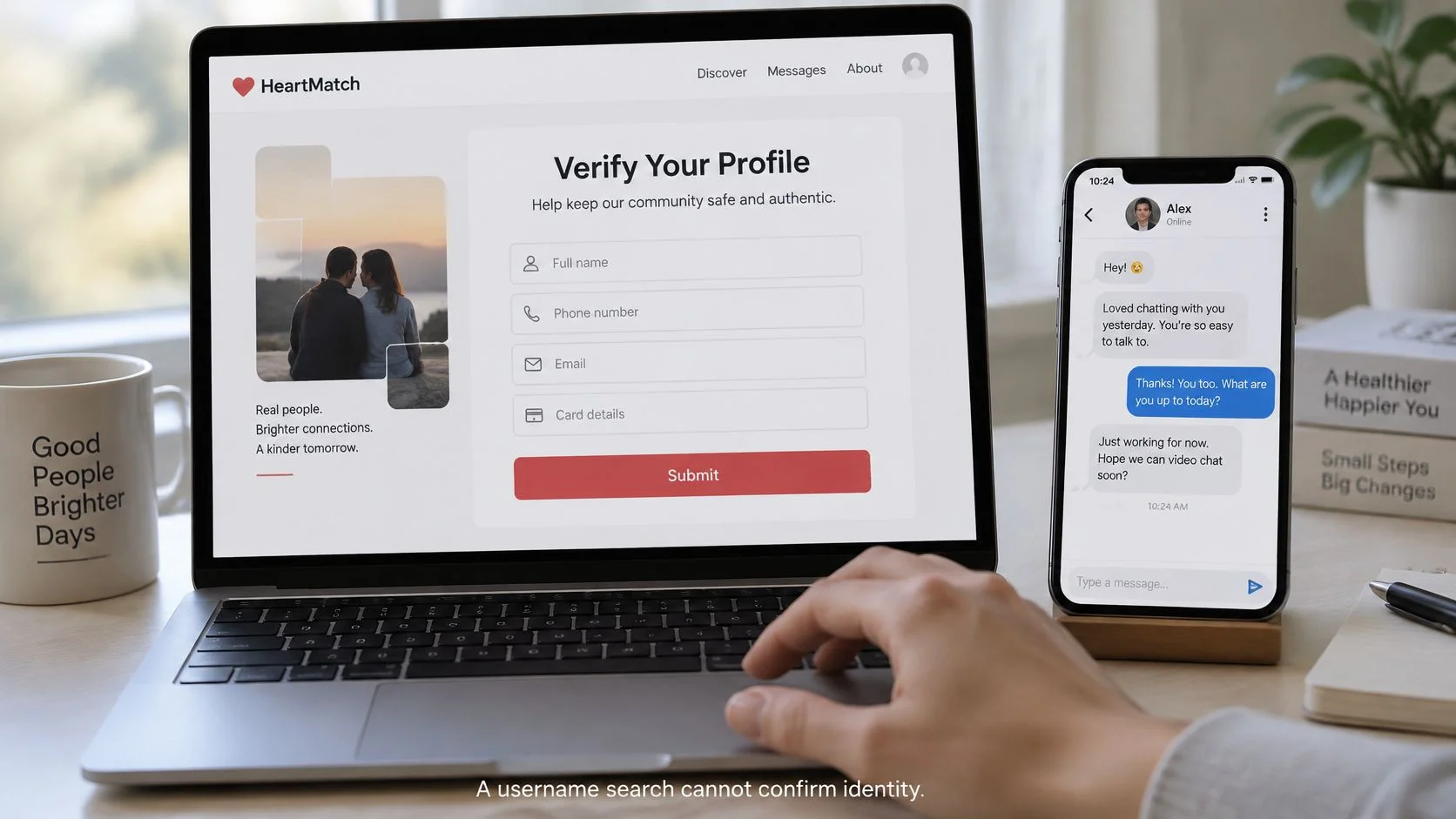
Fraudsters succeed with this tactic because online daters want stronger identity checks. A 2025 TransUnion survey found that 85% of women and 87% of men think dating platforms should verify information like users' age, photo recency, and location. Scammers weaponize that exact expectation by sending you off-platform to a fake checker that looks official.
The Scale of Reported Romance Fraud
Official complaint logs show how much money disappears through relationship deception every year, even before counting victims who never file a report.
| Source | Year | Reported figure |
|---|---|---|
| FBI Internet Crime Complaint Center 2024 Report | 2024 | 17,910 confidence or romance fraud complaints and $672,009,052 in reported losses |
| FTC Consumer Protection Data | 2023 | 64,003 romance scam reports, $1.14 billion in reported losses and a median loss of $2,000 per person |
| FBI Salt Lake City Field Office | 2024 | 7,626 victims over age 60 and about $389 million in reported losses |
| UK Finance via Global Dating Insights | First half of 2025 | £20.5 million reported lost to romance scams |
The same UK industry coverage noted that 61% of dating-app users surveyed had matched with a profile they later believed was a bot, scammer, or catfish, alongside FBI warnings that fake verification pages specifically harvest names, phone numbers, email addresses, and payment cards. Meanwhile, the FTC classified romance fraud under imposter scams and found it carried the highest median reported loss among all imposter-scam categories. Remember that every total in that table reflects reported incidents only; embarrassment, fear, and uncertainty about where to report keep many losses out of public statistics.
Behavioral Red Flags That Matter More Than Any Handle
To see how fraudsters build emotional momentum before asking for money or verification clicks, watch the short breakdown below on how modern dating scams unfold.
Recognizing common scams on dating apps comes down to watching behavior rather than trusting a clean username search. Pay close attention to four warning patterns:
- Financial requests tied to sudden urgency: Any request for money connected to travel hiccups, medical emergencies, customs fees, cryptocurrency, investments, gift cards, or "help" receiving funds signals a scam, no matter how believable the story sounds.
- Repeated excuses to avoid live video or meeting: Broken webcams, overseas military deployments, offshore oil rigs, or last-minute work crises keep you from confirming the person's face in real time.
- Fast pressure to leave the dating app: Moving immediately to WhatsApp, Telegram, or SMS strips away platform moderation, reporting histories, and built-in safety prompts.
- An unverifiable backstory paired with third-party verification links: Details that shift between conversations, or any link asking you to pay or upload ID to "verify your safety," warrant an immediate stop.
One of the simplest safeguards comes straight from FTC guidance: tell a trusted friend or family member about an online relationship early. An outside perspective spots secrecy, rushed declarations of love, and emotional pressure weeks before you notice them yourself. An inconsistent handle is a reason to ask calm questions, not proof of fraud, and a spotless username search never clears someone who asks for your card number.
Decide What to Do With a Suspicious Match
Once a search turns up contradictions, or a match triggers behavioral red flags, hesitation works against you. Following a clear sequence protects your bank account, your personal identity, and your emotional bandwidth.
-
Pause contact and stop sharing personal details. Don't send your home address, workplace name, daily schedule, private photos, or personal email until inconsistencies are resolved. Giving yourself twenty-four hours of space breaks the artificial urgency scammers rely on.
-
Keep every message inside the dating platform. Stay on the app's native messaging tool until genuine trust builds over time. Platform messaging preserves timestamps and lets safety teams review violations if you need to report the account later.
-
Request a brief, live video call. Watch both whether the call happens and how your match reacts to the request. Authentic daters might suggest a convenient time; manipulators get defensive, stall repeatedly, or send pre-recorded clips that never respond to real-time cues.
-
Verify claimed jobs or credentials through independent channels. If someone claims to be a licensed nurse, attorney, or corporate manager in your city, check public state licensing boards, official company directories, or a mutual contact you already know. Never rely on phone numbers, websites, or "employer" email addresses handed to you by the match.
-
Draw a permanent line against sending money or documents. Never transfer funds, buy gift cards, invest in cryptocurrency platforms, share bank logins, or upload a driver's license or passport to an online romantic contact or any verification site they send you.
-
Act immediately if money or sensitive data has already moved. Contact your bank or card issuer right away to freeze compromised accounts and dispute transactions. Report the profile inside the dating app, preserve chat logs and URLs, and file formal complaints with the FTC and the FBI's Internet Crime Complaint Center (IC3).
Supporting Someone Caught in a Suspicious Relationship
Layered verification is what separates a raw lead from a dependable conclusion. When you're helping a parent, sibling, or friend evaluate a suspicious online romance, approach the conversation without blame or mockery.
Shame is a scammer's best ally, because embarrassment keeps people quiet while losses keep growing.
Ask calm, practical questions about whether they've met on live video or whether money has entered the conversation, and offer to walk through running a safe dating background check together using strictly public information. If deception has already happened, the financial hit is only half the recovery; resources covering how to heal after being betrayed from reVIBE Mental Health offer practical steps for rebuilding self-trust after a manipulative experience.
Checking Your Own Digital Exposure First
Before you worry about searching someone else's handle, flip the lens onto your own accounts. Reusing the same username across a dating app, a PlayStation or Steam profile, a local running club, and an old forum makes it effortless for a stranger to map your real name, employer, and neighborhood in minutes.
I'd start by auditing your own handles before updating any dating profile. You can run our free username search tool to see which public profiles appear under the names you use every day. Your first search is free, with no credit card required, and Digital Footprint Check does not store or sell users' search queries, so you can spot exposed accounts and separate your dating handle from the rest of your digital life cleanly.
Protecting yourself while dating online starts with knowing what public information connects your handles across social networks, gaming platforms, forums, and data breach records. Digital Footprint Check scans more than 500 public sources and gives you clear, step-by-step guidance to review matches, lock down exposed accounts, and reduce identity-theft risk without compromising your privacy. Visit Digital Footprint Check to audit your digital footprint and keep your personal details under your control.