
· Digital Footprint Check · Content Marketing · 17 min read
Online Reputation Fix: What You Can Actually Remove
A step-by-step online reputation fix: audit what's live about you, choose between deletion, delisting, correction and suppression, then monitor results.

Search "online reputation fix" and the ads line up the same way: negative results gone in 30 days, guaranteed. Removal requests are usually rejected for the same reason. The content is accurate, it is opinion, or it is a public record, and no policy covers it. Deletion gets sold because it is easy to describe, not because it is usually available.
A reputation problem is rarely one page. It might be a review on a platform you forgot you had, an old forum handle tied to your real name, a court listing that is factually correct, a data broker selling your address, or a password leaked four years ago. Each item needs its own remedy, its own evidence, and its own amount of patience. Bundle them into one cleanup and the work stalls.
I would rather map each item to a remedy you can file and document than chase a promise the publisher was never going to honor. Accurate, duplicated, or lawfully published material often stays. The useful work is sorting what can move from what cannot.
The honest version: you can often change what a search returns. You can rarely delete what a source published.
What an Online Reputation Fix Can Really Do
An online reputation fix is not a deletion service. Anyone promising guaranteed removal or a fixed timeline is selling something the platforms don't offer. Search engines don't auction off results, and publishers don't erase pages because you're upset about them. What you can realistically do narrows to four outcomes, each with its own decision-maker and its own evidentiary bar.
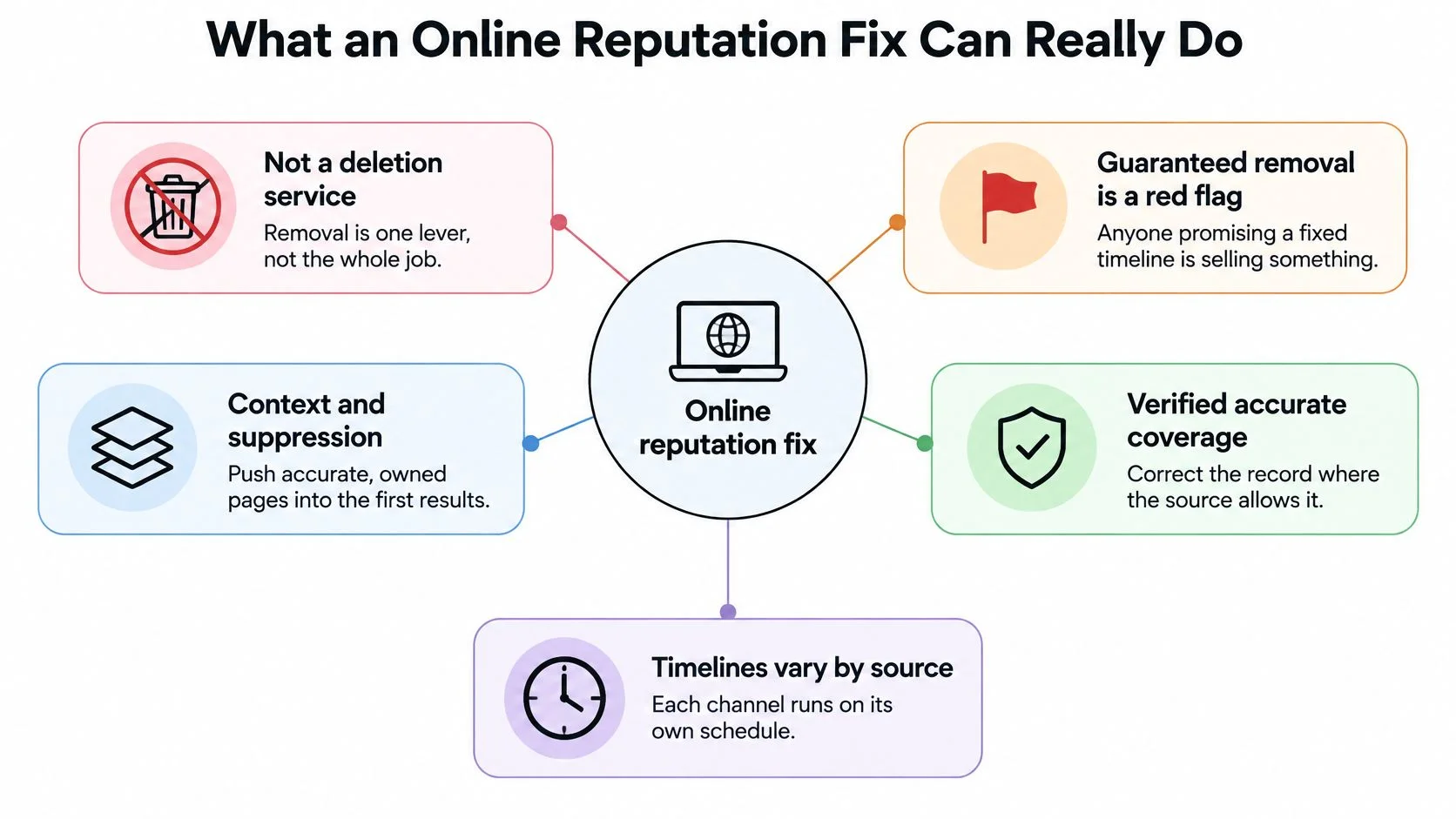
Source deletion happens at the site and depends on a policy violation: personal data posted without consent, targeted harassment, a breach of the platform's terms. Search-result delisting is decided by the search engine, under its own removal policy or a legal basis like a court order, and it leaves the page live at its origin. Correction requires a publisher to accept that a specific claim is false, which means dated records rather than a complaint. Suppression is the only lever entirely in your hands, and it runs on time and authoritative publishing instead of anyone's cooperation.
| Outcome | Who decides | Evidence required | Realistic result |
|---|---|---|---|
| Source deletion | Site or platform moderator | Proof of policy violation | Page removed at its origin |
| Search-result delisting | Search engine under its policy or local law | Legal basis or policy match | URL dropped from results while the page still exists |
| Correction | Publisher | Proof of falsity and dated records | Page amended; archived copies may persist |
| Suppression | You, through new authoritative content | Time and published assets | Accurate results displace the harmful item |
Jurisdiction matters more than most guides admit. Privacy law and platform terms vary by country while search engines operate across borders, so the same page can be removable in one market and untouchable in another. A privacy complaint and a defamation claim are different instruments with different thresholds, and neither one touches an accurate public record.
The scale of what you're managing is why this is sustained work rather than a single takedown. The BrightLocal 2024 Local Consumer Review Survey found that 75% of consumers regularly or always read online reviews when researching local businesses, and 41% used three or more review sites before deciding. Freshness counts too, with 27% expecting reviews to be as recent as two weeks, up from 25% the year before. A clean result on one platform buys you nothing on another.
What that means in practice: reputation work is a monitoring discipline, not a project with an end date. The item you removed in March is not the item that appears in September.
The publishing side deserves its own plan. If accurate material is going to displace a hostile page, the assets have to look like a person with a track record rather than a shell profile with three posts. A guide showing how to stand out beyond your resume covers how to build that presence deliberately instead of letting a bio page and a dormant profile do the work.
By the end of this, you should be able to answer four questions about any harmful item: where it lives, whether it's true, which remedy applies, and whether new exposure is still happening.
Should You Clean Up Before a Job Search
Audit first, delete second, and never scrub something you couldn't explain in an interview. That order matters more than most job-search advice admits, because the risk is real and old.
A CareerBuilder survey conducted by The Harris Poll between April 4 and May 1, 2018 found that 70% of employers used social-media sites to research job candidates, and 57% of those employers had found content that caused them not to hire someone, according to the CareerBuilder survey summary. The same tracking shows the practice climbing from 12% of companies in 2006 to 25% in 2010 and 70% in 2018. The most common triggers were provocative photos or videos, drinking or drug content, and discriminatory comments.
Deleting everything is not automatically the right response. Scrubbing a decade of history can read as concealment to a recruiter who notices the gaps, and it destroys context you might need later. Screening carries compliance risk of its own: inconsistent checks create discrimination patterns, and US rules now address discriminatory AI use in employment, as AMS Inform's review of social-media screening sets out. Job seekers end up caught in the middle of that.
Keep a dated record. Screenshot what's public before you change anything, so you can show what existed and when.
Remove only what's private, false or a policy breach. An old address, a leaked phone number, a quote attributed to the wrong person.
Correct before you erase. Ask a publisher to fix an error before asking them to pull the page, because the second request is the one they refuse.
Publish accurate professional material. Your own pages are the ones you control outright, and they're what a recruiter finds when the search goes well.
If you want to see what an employer's search would return, run it on yourself first. Our guide to running an employment background check on yourself walks through the same sources a screener uses. The goal isn't a blank footprint. It's one you can defend.
Audit What Is Live and Build the Documented Baseline
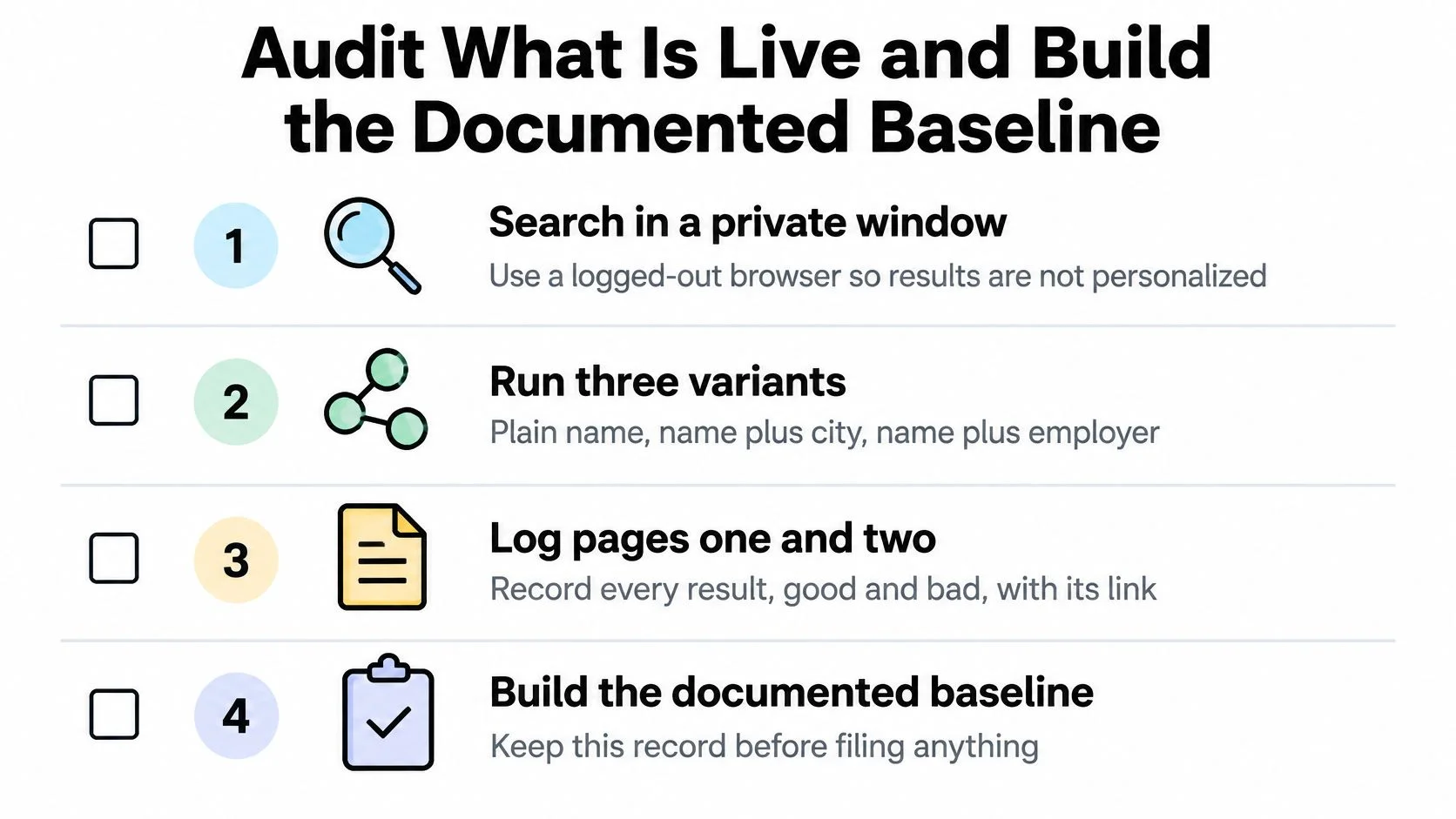
A removal request filed against a page you can't prove existed is a weak request. Publishers, moderators and platforms all ask the same opening question: where exactly is the content, and what exactly does it say? The baseline answers that before anyone asks. Searching feels like the whole job, but the search only finds the material. The documentation is what makes it actionable.
The six-step baseline
- Search in a private window. Log out first, so personalization doesn't hide the results everyone else sees. Run your name plain, then name plus city, then name plus employer.
- Log pages one and two. Record every result with its position, URL and the date you saw it, good and bad. A hostile page in position seven is a different problem from one in position one.
- Search your identifiers, not just your name. Run each email address and every username you've reused. Old forum and gaming accounts surface this way, and they're the ones you forgot existed.
- Check the platforms your industry uses. Review sites, professional networks, and the people-search and data broker sites that scrape public records.
- Run a breach check on each email address. This tells you which leaks tie your credentials to your name, which is a security problem before it's a reputation problem.
- Classify every finding on six attributes. Who owns the page, whether the claim is verifiable, whether it's legally removable, where it currently ranks, how negative it reads, and who's likely to see it.
That sixth step is the one that decides everything after it. Ownership determines the route: content on your own profiles responds to editing, content on a publisher's page responds to a correction request, and content inside a moderated platform responds to a policy argument. Legal removability is the harsher filter, because accurate reporting, duplicated listings and lawfully published records often have no removal route at all, no matter how much they cost you. Sorting those items out now, before you write a single request, keeps you from spending weeks chasing takedowns that were never available. The items that fail the filter go on a suppression list instead, and that decision belongs in the audit, not after the third rejection.
A Google Research qualitative study on reputation repair found that users often failed to fix reputation problems because they couldn't identify a feasible repair mechanism. Diagnosis is a technical requirement, not a preliminary. If you can't name the mechanism for a given page, you don't have a plan yet.
Keep the dated screenshots and URLs in one folder and treat the log as seriously as the searching. The baseline is what makes a 30-, 60- and 90-day comparison honest, and it's what exposes the cases where a result was only temporarily displaced by a newer page. When a publisher or platform does act, their confirmation email goes in the same folder next to the screenshot it resolved, so the record shows both the problem and the outcome.
Practical rule: if a claim isn't in your baseline, you'll never be able to prove it changed, improved or came back.
A single sweep is faster than working through dozens of tabs by hand. Digital Footprint Check searches more than 500 sources and offers free profile, username, data breach and reverse email checks, so you can see what's visible before you start filing anything. Reports show exactly which information about you exists online, with no hidden details. The service doesn't remove data on your behalf; its step-by-step guides walk you through contacting each site and requesting the change yourself. For a reputation-specific view, the online reputation checker organizes findings by platform and visibility, which maps cleanly onto the ownership classification in step six.
One pass through these steps typically turns up more than a name search alone, because the identifier and breach checks surface accounts that never mention your full name. Log those too. Forgotten accounts are the ones a screener finds first.
Match Each Problem to the Right Remedy
The remedy follows the type of item, not how much it bothers you. A leaked password and a hostile review both feel urgent, but one is a same-day credential rotation and the other is a moderation queue with a wait attached.
| Content type | Best remedy | Evidence required | Realistic timeline | Common failure point |
|---|---|---|---|---|
| False statement in a news or blog article | Correction request to publisher, then legal complaint | Documented proof of falsity, dated records | 2-8 weeks for correction; legal route takes months | Publisher refuses and no defamation threshold is met |
| Accurate but old arrest or court report | Delisting if law allows, otherwise suppression | Jurisdiction-specific legal basis; search engine policy match | 4-12 weeks for delisting review | Accurate public record not covered by any policy |
| Hostile workplace review on Glassdoor or Indeed | Platform moderation or company response | Proof of policy breach: personal data, profanity, conflict of interest | 3-10 business days for moderation | Review is opinion and stays within policy |
| Leaked username, email or phone number | Abuse report plus credential rotation | Screenshot, URL, account ownership proof | 24 to 72 hours for the abuse report; rotate the credential the same day | Copies already scraped and recirculating |
| Data broker listing with home address or phone | Opt-out request per broker | Identity verification, listing URL | A few days to several weeks | Listing reappears in a later scrape |
| Duplicated or cached copies | Delist original, then chase mirrors | Original URL plus mirror list | Weeks, ongoing | Mirrors outrank the original |
| Breached credentials | Credential rotation and monitoring | Breach name, affected account | Immediate; monitoring ongoing | Password reused on other accounts |
Why each route fails
Publisher refusals. A correction request dies when you can't point to one false sentence and attach the document that contradicts it. Vague complaints get filed under "disagreement" and closed. Editors act on evidence they can verify in minutes, and a court disposition or dated record gives them exactly that.
Accurate records. This is the hardest category and the one that generates the most bad advice. If the record is right and lawfully published, the honest options are delisting where local law permits it or building stronger context around it. Spending months hunting for a deletion route that doesn't exist is the most common way people waste the first quarter of a reputation fix.
Opinion dressed as fact. A review saying your team was rude is opinion, and platforms treat it as protected speech. A review naming your home address is a policy breach. Moderation only responds to the second, so the evidence you quote has to come from the platform's own rules, not from how unfair the review feels.
Scraped copies. You can win a removal against one URL and lose the search result entirely because five mirrors copied the text within a week. The original has to fall first, then each mirror, in that order.
Reuse. A leaked password isn't a content problem. Rotating it on the affected account and everywhere it was reused is the only fix that matters.
The rule that saves time: if the item is accurate and lawful, stop hunting for a deletion route and start building the page that outranks it.
Some remedies are legal rather than reputational, and they follow their own rules. Record sealing and expungement sit in that category. Guides on sealing DUI records in Georgia exist because that outcome runs through the courts, and no amount of publishing or suppression work changes what a judge decides.
Our guide to removing negative search results breaks each row into the contact route and the wording that gets a response, with the DIY steps for filing it yourself.
File the Request So It Stands a Chance
Start at the source. Most sites publish an abuse, corrections or privacy contact, and a request that cites their own policy clause and quotes the exact passage gets triaged faster than an angry paragraph ever will.
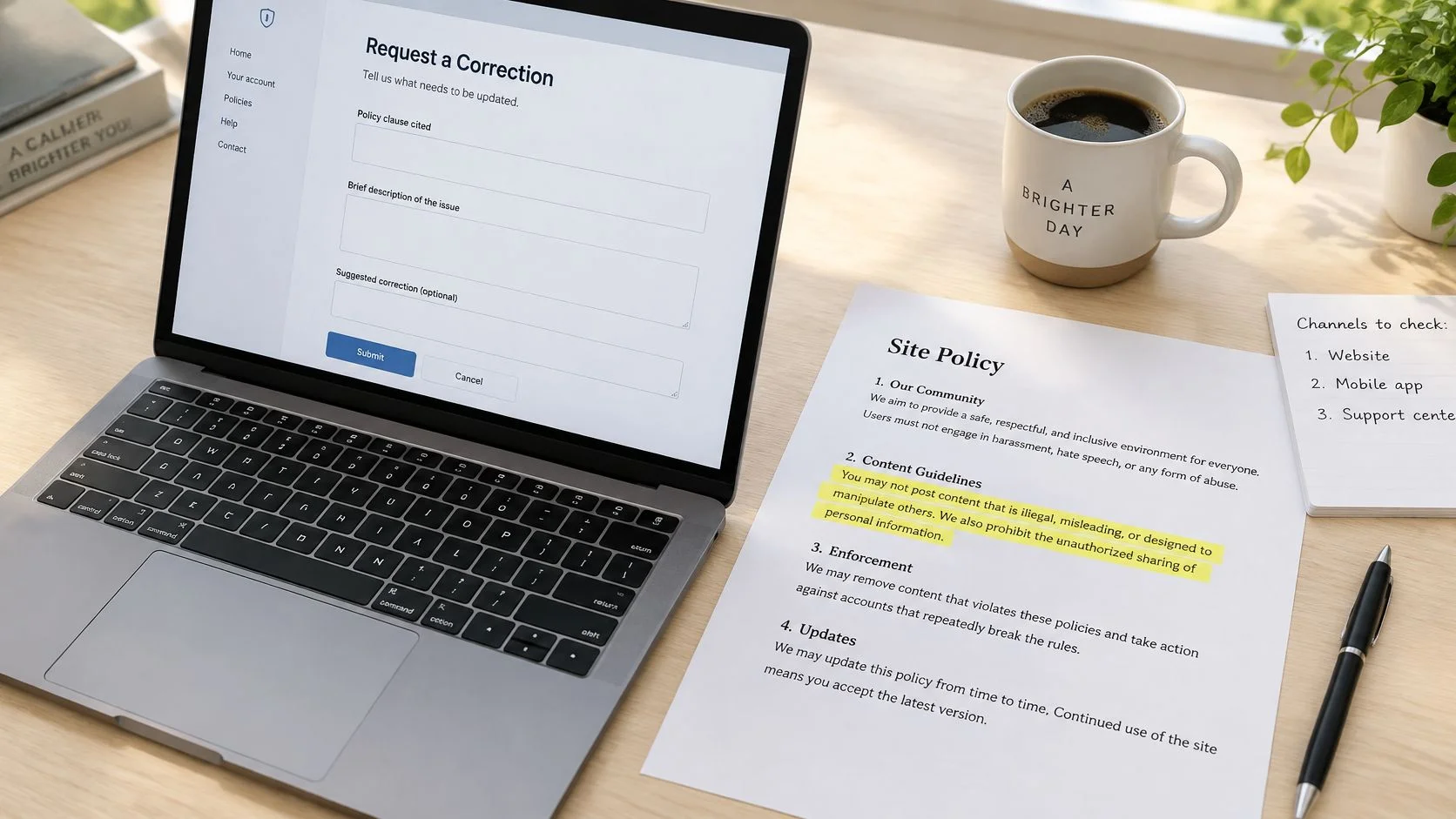
The single most common reason a takedown request is rejected is that it asks for too much, too vaguely. "Please remove this defamatory page" gives a moderator nothing to act on. "The third paragraph states I was arrested in 2019; the attached court disposition shows the case was dismissed and sealed; this breaches your policy on publishing criminal records without disposition" gives them a decision they can defend to their own team.
Request skeleton: the URL; the specific sentence or image at issue; the evidence that it is false, private or in breach of policy; the clause or law you're invoking; the outcome you want, whether that's correction, anonymization or removal. One page. No adjectives.
Keep a copy of everything you send. The evidence pack you build for the source is the same pack you'll reuse for the search engine, the regulator or the lawyer, and rebuilding it from scratch each time is how requests get abandoned.
Search-engine delisting comes after the source declines or can't be reached, not before. Use the engine's own removal tool, attach the same evidence, and quote the policy section you're matching. For data brokers, use each broker's opt-out form individually and diarise a re-check at 30 days, because the listing often returns with the next scrape. For breached credentials there is nothing to remove: rotate the password, turn on two-factor authentication, and check where else you reused it.
There's a distinction worth internalizing before you write anything. Asking a site to correct something is a request most policies allow. Asking it to erase something is a request very few allow. Frame the first, and you'll get a response far more often than you expect.
Consistency across the listings you control matters as much as the requests you send, since conflicting name, address or phone data across directories is itself a signal that confuses both readers and search engines. A guide to keeping your directory listings consistent covers the submission side of that housekeeping.
Close the loop with a tracking habit: one spreadsheet row per request, with the date sent, the channel, the evidence attached, the response date and the outcome. Unanswered requests are the ones that die, and a template helps you escalate without starting over. Our cease and desist letter template is the next step when a polite request goes nowhere and the claim is clearly false.
When Removal Is Off the Table and How to Keep the Fix Working
When the damage is accurate, duplicated or legally untouchable, the remaining levers are contextual. Publish a clear, factual account on a property you own so the first result explains rather than accuses. Pursue delisting only where local law or platform policy supports it. Build the mirror list before you celebrate a removal, because delisting one URL while five copies rank is a temporary win with a short shelf life.

For negative reviews, drop the generic apology. Acknowledge the specific failure, give a factual explanation without attacking the reviewer, state the concrete corrective action, and move sensitive details to a private channel. Match the response to the failure type: research summarized in Information Technology and Management found explanation most broadly reduced perceptions of quality, attitude and fulfillment problems, compensation worked best for quality failures, and apology alone mainly addressed attitude problems.
The same research offers a useful caution. In a large observational study of hotels, beginning to respond was associated with an average 0.12-star rating increase and a 12% increase in review volume, but responding hotels also received fewer, longer negative reviews. Read volume and sentiment together, or you'll mistake a change in reviewer behavior for a change in service.
Avoid the predictable mistakes. Deleting legitimate criticism destroys your credibility with everyone who saw it. Identical templated replies signal that nobody read the complaint. Unverifiable claims invite a second, worse review. Disclosing personal information in a public response creates a new problem while you're solving the old one.
Then keep the fix working. Rerun the same search variants and review checks at 30, 60 and 90 days, then quarterly. Track branded-query rank, page-one presence, the positive-to-negative mix, median response time and the outcome of every request you filed. Suppression isn't automatically safer either, since new content can expose employment history, location, relatives or gaming identities you'd rather keep quiet.
Breach exposure needs its own recurring check, because it changes without you doing anything. The Identity Theft Resource Center's 2025 data found that 80% of consumers surveyed had received a data-breach notice in the previous 12 months. A quarterly pass over broker listings and leak data is cheaper than discovering the problem during a hiring round; our data broker removal guide covers the opt-out routes and the re-check cadence.
If a removed item returns, work out what you're looking at before you refile. A new mirror needs a new abuse report to a different host. A re-indexed page usually means the original delisting lapsed, and the original evidence pack will carry it again.
The first step in any online reputation fix is knowing what's out there, and that's what Digital Footprint Check is built for: it maps the public profiles, breach records, broker listings and review mentions attached to your name, then gives you the step-by-step guides to act on each one yourself. Start with the free check, build your dated baseline, and file your first request this week. Visit Digital Footprint Check to see what a search of your name returns today.