· Digital Footprint Check · Content Marketing · 14 min read
How Much Does Online Reputation Management Cost in 2026
Wondering how much does online reputation management cost? See 2026 price ranges for DIY, SaaS and agency plans, cost drivers and ROI tips.

Monitoring-focused online reputation management can start at $99–$299 per month, standard ORM often costs $1,000–$5,000 per month, and crisis or enterprise coverage can reach $10,000–$50,000+ per month. The price depends on the work involved, not on a single universal ORM fee.
You might be checking your name before a job interview, reviewing your business after a harsh customer complaint, or searching for an old social profile before joining a dating app. In each situation, the question sounds simple: how much does online reputation management cost? The honest answer is that monitoring a healthy profile and repairing a damaged search presence are completely different jobs.
A low-cost tool may alert you when someone mentions your name. A managed campaign may require new content, search engine optimization, review responses, public relations, privacy work, or urgent crisis coordination. This guide breaks down those differences so you can compare quotes fairly, understand what you’re paying for, and avoid buying a crisis package when you only need visibility.
Introduction Why Reputation Costs Matter Right Now
A job seeker searches their name the night before an interview and finds an outdated complaint near the top of the results. A local business owner notices that one angry review appears before helpful information about opening hours, services, and customer support. Neither person necessarily needs a large agency retainer, but both need to know whether the visible problem is small, persistent, or connected to wider privacy risks.
The broad 2026 pricing pattern is straightforward. Entry-level monitoring may cost $99–$299 monthly, standard ORM commonly falls between $1,000 and $5,000 monthly, and crisis or enterprise programs can rise to $10,000–$50,000+ monthly, depending on scope, severity, and response speed. The current reputation management cost breakdown also reflects a wider market where small-business spending ranges from low hundreds to low thousands, while more complex retainers require substantially more labor.
Practical rule: Don’t compare a monitoring dashboard with a search-result suppression campaign. They may both be called ORM, but they solve different problems.
The budgeting mistake is treating reputation as a fixed subscription, like a streaming service. Some providers charge a setup fee, a monthly retainer, a fixed project fee, or a per-result suppression fee. Crisis work may also include a response-time commitment, often called an SLA, that requires people to monitor and respond outside ordinary working hours.
A sensible decision starts with exposure. Check what appears publicly under your name, email, phone number, usernames, gaming accounts, and professional identity before choosing a service level. A clear explanation of why online reputation management matters can help you connect search visibility with employment, trust, privacy, and personal safety. Once you know what’s visible, you can budget for the problem you have instead of the most expensive problem a vendor can describe.
What Online Reputation Management Actually Includes
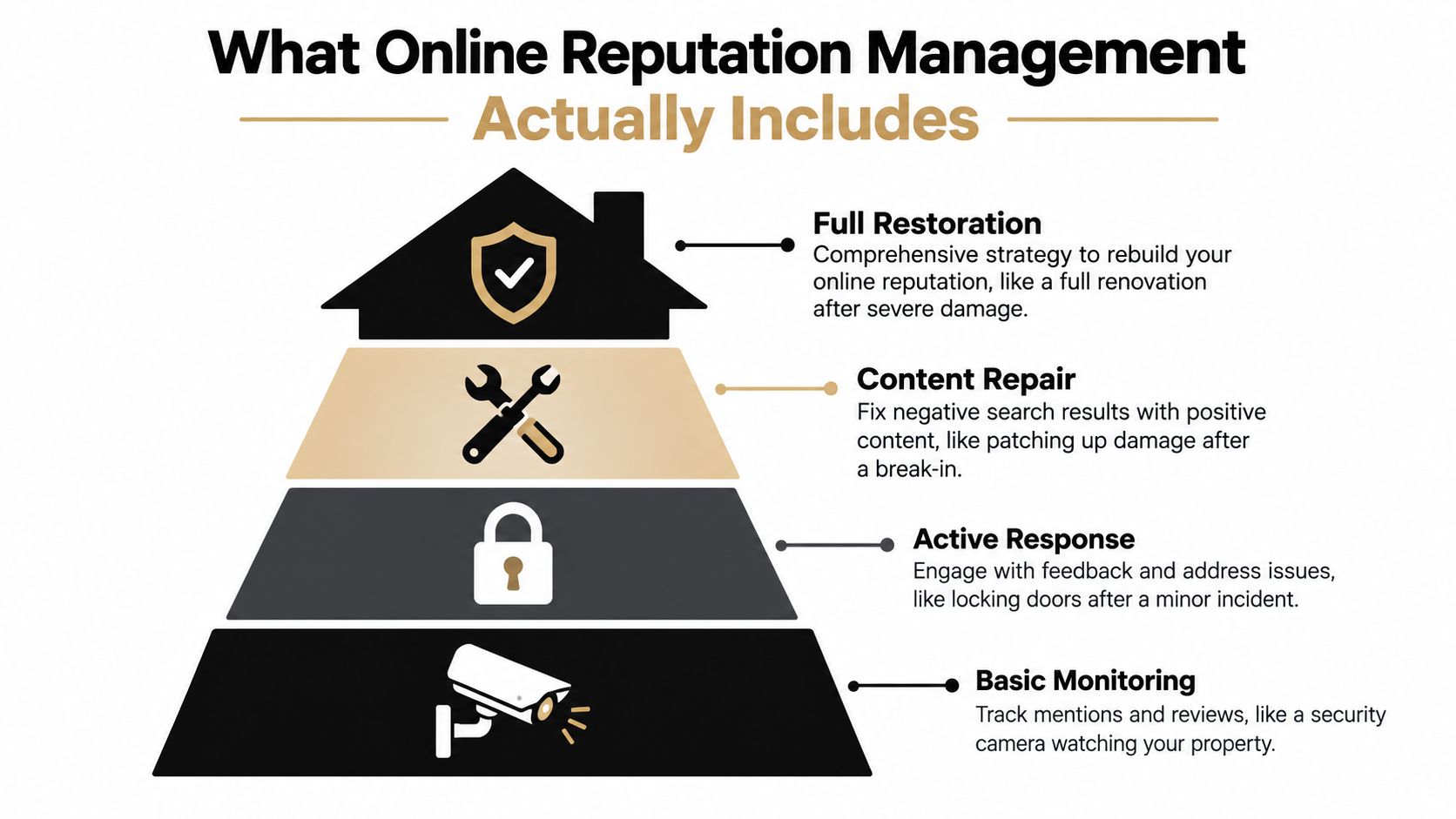
Online reputation management is easier to understand through a home-security analogy. Monitoring is the alarm system. Active response is locking the doors and handling a small incident. Content repair is fixing visible damage. Full restoration is rebuilding the property after a serious break-in.
The foundation is monitoring
Basic monitoring tracks mentions, reviews, public posts, search results, and sometimes account exposure. Software may collect alerts, while a person reviews unusual or harmful findings. This layer can suit a professional with a stable search presence, a gamer checking whether old usernames are exposed, or a small company that wants to notice new reviews quickly.
Entry-level services can fall below $100 per month for alert triage and templated responses, while self-serve monitoring software is often priced around $50–$500 per month, according to market commentary on ORM pricing layers. The lower price reflects automation and limited human intervention. It doesn’t usually include custom content, extensive SEO, or emergency response.
Response addresses visible feedback
Active response means deciding whether and how to reply to a review, complaint, impersonation attempt, or social post. Good responses require accuracy and restraint. A defensive reply can attract more attention, expose private information, or create a second reputation problem.
Review management may include drafting responses, routing legitimate service issues to staff, reporting policy violations, and keeping messaging consistent. It may also include monitoring professional networks, dating profiles, gaming communities, or public forums where identity signals affect trust.
Content repair and restoration require more work
When a negative page ranks prominently, monitoring won’t change its position. A suppression campaign may strengthen accurate pages, improve professional profiles, publish useful articles, build relevant links, and optimize existing websites. The negative page usually remains online. The objective is to give searchers a fuller and more accurate picture.
Full-service work can also involve public relations, legal review, removal requests, executive communications, and coordinated crisis response. That combination explains why managed programs commonly range from $1,500–$10,000 per month, while executive or enterprise coverage can reach $10,000–$50,000+ per month, as outlined in this 2026 ORM cost analysis.
The broader ORM market has become a multi-billion-dollar category. One 2026 summary places the global market at roughly $6.9 billion in 2025, with a projection of about $14.0 billion by 2031 and an estimated compound annual growth rate near 12.6%. That growth helps explain why recurring retainers, software subscriptions, and high-value crisis projects have become standard buying models. If you’re still unclear about the boundaries, this guide to what online reputation management includes provides useful context, while practical advice on how to boost your brand reputation can help with everyday maintenance.
How Much Does Online Reputation Management Cost by Model
The cheapest option isn’t automatically the right option. It may be perfectly adequate when you want to find hidden accounts or receive alerts, but it won’t replace a coordinated campaign against an authoritative news result or an active impersonation problem.
| Service Model | Typical Monthly Cost | What You Get | Best For |
|---|---|---|---|
| DIY manual work | Little or no service fee, plus your own time | Search checks, profile cleanup, privacy-setting reviews, direct platform requests | People with a healthy footprint and a manageable issue |
| SaaS monitoring | About $50–$500 | Automated alerts, dashboards, mention tracking, limited workflow tools | Individuals and small teams that can handle responses |
| Managed ORM retainer | About $1,000–$5,000 for standard work | Monitoring, review management, content, SEO, reporting, and strategic support | Professionals and businesses with recurring reputation needs |
| Full-service or enterprise coverage | About $10,000–$50,000+ | Crisis monitoring, rapid response, suppression, PR, escalation, and wider coverage | High-risk brands, executives, and active public crises |
DIY work can include searching your name in a private browser, reviewing image results, checking old social posts, updating a LinkedIn profile, and requesting removal of exposed personal details where a platform permits it. The financial cost may be low, but the effort and judgment are yours.
Software-first services add automation. A dashboard can help you spot a new review or mention before it gets overlooked, but it generally can’t determine whether a response should involve customer service, legal counsel, or silence. Some tools also focus on reviews rather than broader identity exposure across public records, social platforms, professional networks, and gaming profiles.
Managed retainers bring people into the process. Depending on the package, staff may create content, respond to reviews, optimize pages, monitor keywords, coordinate with public relations teams, and produce reports. Pricing guides also describe personal ORM as ranging from hundreds to low thousands per month for light work, with complex personal cases moving into $3,000+ monthly retainers, as discussed in this personal reputation management pricing guide.
Before accepting a proposal, match it to the specific issue. A free exposure check may be enough to decide whether you need a monitoring tool, a privacy cleanup, or professional help. For broader managed support, review the scope of online reputation management services and ask exactly which deliverables are included.
Key Cost Drivers That Change Your Quote
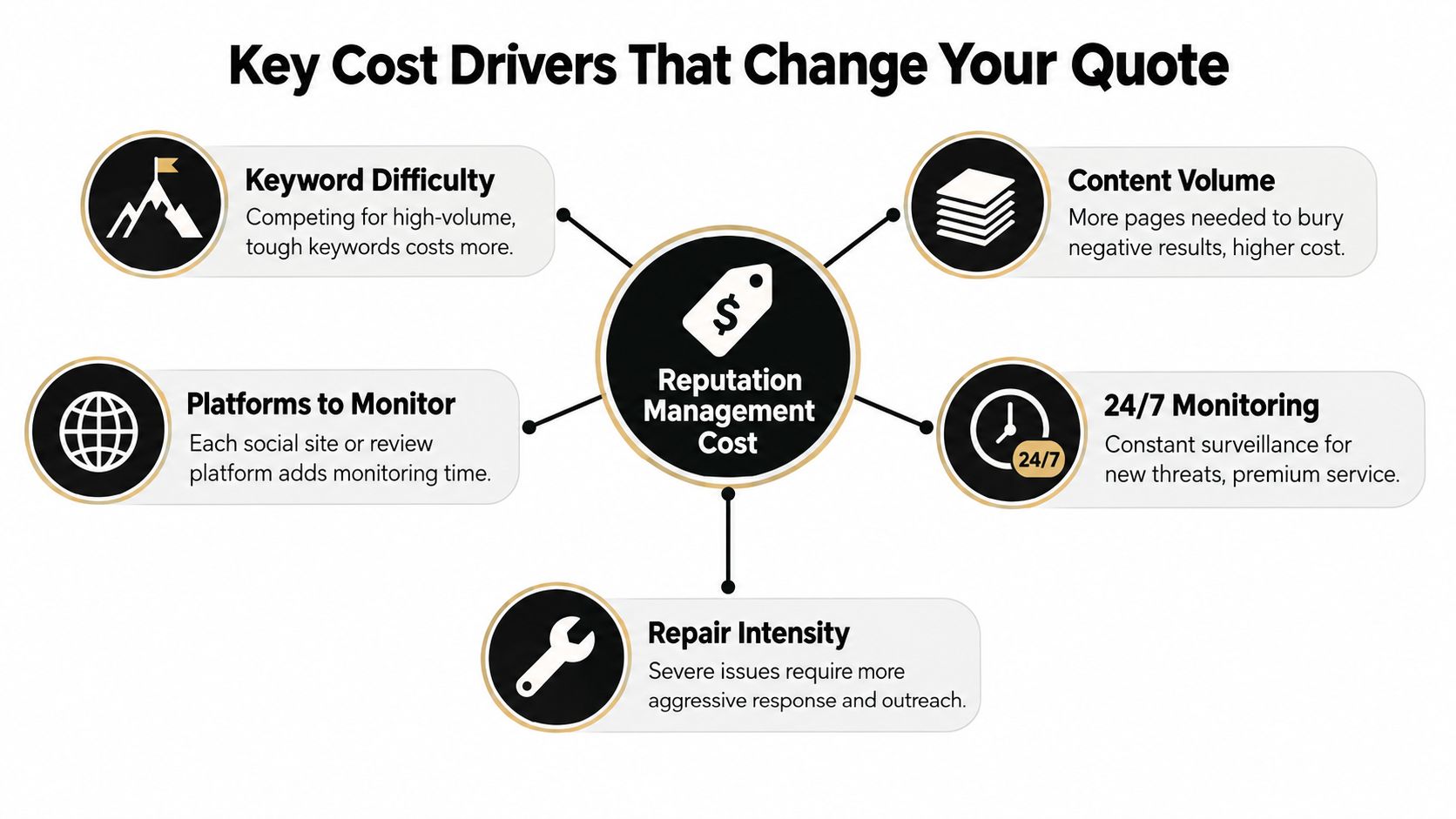
Two clients can search the same keyword and receive dramatically different quotes because the work behind that keyword may be completely different. The practical pricing equation is scope multiplied by complexity and speed. More platforms, harder search results, urgent deadlines, and greater repair intensity all require more people and more specialized work.
Content volume and keyword difficulty
A single outdated profile is easier to address than several negative pages from established publications. The first situation may involve correcting details, improving an existing biography, and strengthening a few professional profiles. The second may require a sustained content and SEO campaign designed to compete with pages that already have strong authority.
Content volume matters because every page needs research, writing, editing, approval, publication, and optimization. Keyword difficulty matters because a name shared with many people, a competitive company name, or a search term dominated by major publishers can require more assets and a longer campaign.
Platforms and response coverage
A business managing reviews on one platform has a narrower workload than one tracking review sites, social networks, forums, news coverage, and executive profiles. Each channel has different rules, notification systems, audience expectations, and response risks.
A basic monitoring layer may operate during normal working hours. A crisis SLA can require 24/7 monitoring, rapid escalation, prepared statements, stakeholder communications, and coordinated responses. That service is expensive because the provider must reserve staff and processes for threats that may arise at any time.
Timeline, legal work, and hidden fees
Routine improvement can be planned over several months. A brand dealing with negative press before an important announcement may demand compressed production, senior oversight, weekend coverage, and faster approvals. The more urgent the deadline, the less efficiently teams can spread work across a normal schedule.
Legal escalation adds another layer. A provider may help document false claims or submit platform requests, but legal review, formal notices, and court-related work can create separate professional fees. Independent pricing guidance notes that ORM may include $500–$10,000+ monthly retainers, one-time suppression projects, and $8,500–$25,000+ active crisis engagements. Read the full ORM pricing structure carefully so you don’t mistake a low monthly monitoring fee for the total cost of remediation.
Ask vendors these questions before signing:
- Setup fees: Is the audit, baseline report, or account configuration billed separately?
- Per-result charges: Does each targeted search result create an additional fee?
- Content limits: How many pages, profiles, responses, or articles are included?
- Platforms: Which review sites, social networks, forums, and public sources are monitored?
- SLA coverage: What response time applies, and does it include nights and weekends?
- Exit terms: What happens to published content and monitoring after the contract ends?
Privacy issues can sit beside ORM. If people-search sites expose addresses or relatives, a data broker removal guide may be more relevant than a content-suppression package.
Real World Pricing Scenarios and Timelines
Price ranges become easier to use when you connect them to recognizable situations. The examples below are planning scenarios, not guaranteed outcomes. Actual pricing depends on the pages involved, the number of platforms, the authority of competing results, and the amount of human work required.
Scenario A is a job seeker with light cleanup
A professional preparing for interviews may discover an old public profile, an inaccurate directory entry, or a few unhelpful links. If the issue is limited and the person already has credible professional assets, the work may involve profile consistency, privacy cleanup, content improvements, and monitoring.
Some pricing summaries place light cleanup at $1,000–$3,000 per month, while personal ORM guidance describes lighter work in the hundreds to low thousands. A simpler project may still be quoted as a fixed fee rather than a retainer. Timelines for light work are commonly described as three to six months, although minor profile corrections can happen sooner. The meaningful outcome is a clearer search presence, not a promise that every unwanted page disappears.
Scenario B is a small business managing reviews
A small business may need help tracking customer reviews, responding consistently, improving local profiles, and publishing useful service information. Its risk is often distributed across customer experience, local search, social profiles, and review platforms rather than concentrated in one damaging article.
Industry summaries place small-business and professional ORM spending around $500–$2,500 per month, while standard small-business programs can move higher when content and suppression are included. A campaign may run for several months or longer, depending on review activity and search competition. Success might look like faster responses, a more complete profile, a healthier mix of recent information, and fewer old complaints dominating the first page.
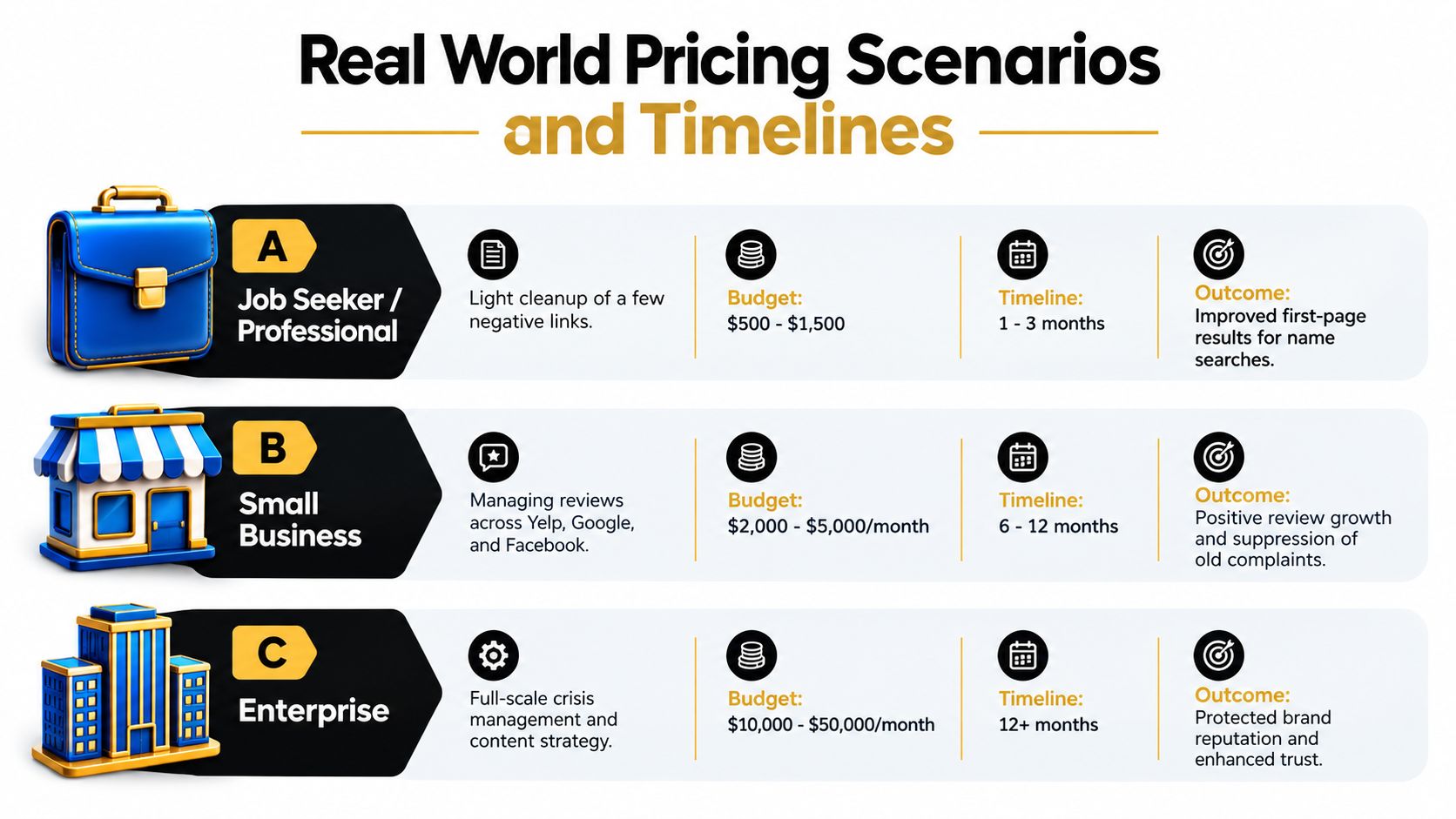
Scenario C is a high-profile or regulated repair
A company facing negative press, a search-result suppression problem, regulatory sensitivity, or executive exposure needs more than review replies. The program may combine content strategy, SEO, public relations, legal review, stakeholder communications, and continuous monitoring.
Standard suppression programs are often listed at $3,000–$10,000 per month, while regulated or high-profile repair can exceed $10,000 per month. Timelines may extend from nine to eighteen months when authoritative negative results must be challenged through stronger content rather than removed. Enterprise pricing summaries place ongoing coverage at $10,000–$50,000+ monthly, and high-profile crisis response can reach $15,000–$50,000+ monthly.
A separate issue is removal from public-record or mugshot-style sites. That work follows different rules from search suppression, so compare the scope carefully before choosing a mugshot removal service. Ask whether the provider is pursuing removal, suppression, privacy protection, or some combination.
Is Online Reputation Management Worth the Investment
ORM is worth paying for when the visible problem can realistically affect something valuable, such as a job opportunity, customer trust, professional relationship, personal safety, or access to an account. It may not be worth a large retainer when your search results are accurate, your privacy exposure is limited, and you can maintain your profiles yourself.

For an individual, use a simple break-even question. What opportunity could the visible problem put at risk, and what would it cost to lose that opportunity? A job seeker might start with a search audit and profile cleanup rather than committing to a large suppression campaign. An executive, doctor, attorney, or business owner may justify more support because other people use their name as a trust signal.
Companies can apply the same logic to leads, hiring, partnerships, and customer retention. The value isn’t limited to higher ratings. A consistent digital identity can help an employer distinguish you from someone with a similar name, help a customer find accurate support information, and help a family recognize suspicious impersonation.
Scam exposure adds a serious safety dimension. FTC data reported through the first nine months of 2025 included 55,604 romance-scam complaints and more than $1.16 billion in reported losses, with a median victim loss of $2,218 in the third quarter of 2025. These figures appear in coverage of the FTC romance-scam data. The FTC also reported in April 2026 that nearly 60% of people who lost money to a romance scam in 2025 said it began on social media, as described in its social-media scam data spotlight.
Review essential brand protection tactics alongside privacy hygiene. The right first step may be monitoring, account security, or data removal rather than expensive content creation.
How to Choose the Right Plan and Control Costs
Start with an exposure audit before speaking to vendors. Search your name, business name, usernames, email addresses, phone numbers, gaming identities, and common variations. Review search, image, video, social, professional, and public-record results, then classify each finding as accurate, outdated, harmful, private, or potentially fraudulent.
Use this checklist when comparing plans:
- Define the outcome: Decide whether you need alerts, review responses, privacy cleanup, profile improvement, suppression, or crisis response.
- Request an itemized scope: Ask for setup fees, content quantities, platforms, reporting, response hours, and any per-result charges.
- Separate removal from suppression: A provider should explain whether it can request removal, improve the surrounding results, or only monitor the page.
- Check ethical boundaries: Avoid services that promise guaranteed rankings, fabricate reviews, impersonate people, or use deceptive reporting.
- Start proportionately: Use DIY work or software when the footprint is healthy, then add managed support when the problem requires specialized content, SEO, PR, or legal judgment.
- Protect adjacent accounts: Secure dating, gaming, social, and professional profiles so reputation work isn’t undermined by impersonation or exposed credentials.
Digital Footprint Check is one option for an initial exposure review. It searches across 500+ platforms, including social networks, data-breach databases, gaming profiles, professional networks, and public records, and offers a free reputation scan without requiring a credit card. That kind of first look can help you decide whether you need a monitoring plan or a more intensive ORM consultation.
Before you budget for online reputation management, see what information is publicly connected to your name, accounts, and contact details. Visit Digital Footprint Check for a free exposure check, then use the findings to choose a proportionate privacy, monitoring, or reputation-management next step.