
· Digital Footprint Check · Content Marketing · 12 min read
Mugshot Removal Service: How to Erase Booking Photos Online
Learn how a mugshot removal service works, from legal takedowns to search engine suppression. Protect your reputation and job prospects with proven strategies.

You found the mugshot while applying for a new job, or maybe a client mentioned it before you did. That's the moment people realize this isn't just an old arrest photo, it's a live reputation problem sitting in search results, background checks, and anyone's curiosity.
A good mugshot removal service is not about asking one website nicely and hoping it behaves. It's a documentation-heavy, deadline-driven process that uses law, evidence, and search visibility tactics to get the image down, keep it down, or bury it where it won't matter.
Why Mugshots Persist Online and What Is at Stake
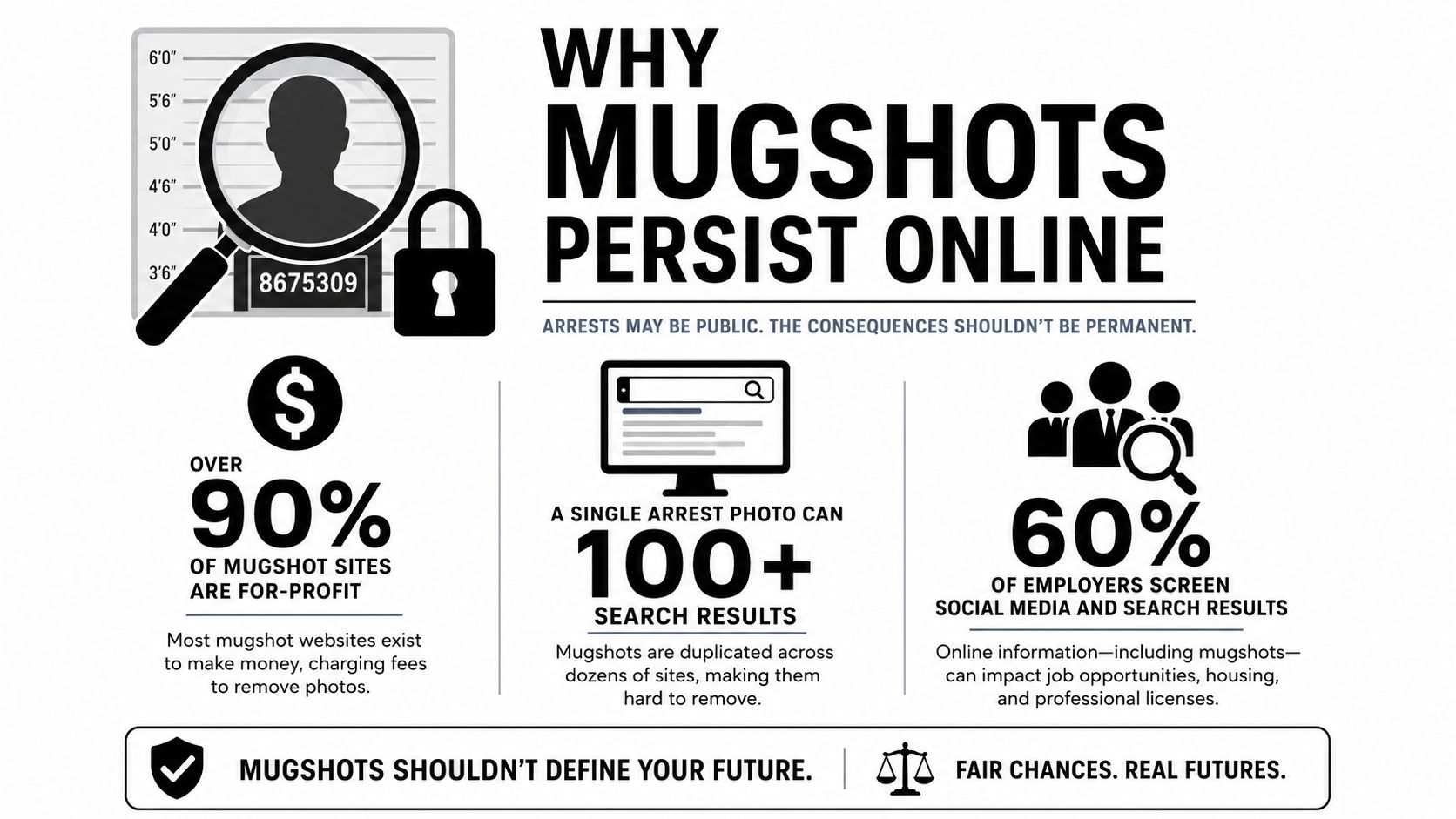
The worst part of a mugshot is that it can outlive the case that created it. A dismissed charge, a favorable resolution, or a clean-up later in the process does not automatically stop a booking photo from circulating through commercial sites, search engines, and copycat domains.
That's why people get blindsided during a job search. A recruiter runs a background check, a hiring manager Googles the name, and a booking photo appears before the candidate gets a chance to explain anything. The practical damage lands fast, in interviews, tenant screening, dating, and even simple professional introductions.
Reuters reported that one mugshot-aggregation site had amassed over 5 million records, and it also noted that some sites charge a small fee for removal and waive fees for people who were exonerated. That scale matters because one arrest photo rarely stays on one page. It gets copied, mirrored, scraped, and republished across a wider record ecosystem, which is why removal is usually a persistence problem, not a one-site fix. You can read a broader guide to post-arrest process if you want to understand how early case handling affects later reputation problems.
Practical rule: if the photo is on one aggregator, assume it's already being tracked by others.
These sites became a secondary market around public records. They built searchable databases from law-enforcement images, then monetized takedown requests, so the business model itself created a reason for the image to linger. That's why a serious removal campaign has to target both the host and search-engine de-indexing, not just the original upload.
The issue is also personal, not just legal. A mugshot can distort how coworkers, neighbors, or a date sees you, especially when they only see the arrest photo and never learn what happened after. If you need a broader context for how public records affect online identity, the Digital Footprint Check guide to public records is a useful companion to this topic.
Building Your Complete Mugshot URL Inventory
Don't contact anyone until you know exactly where the photo appears. If you skip this step, you'll miss mirrors, duplicates, and scraper pages, then spend weeks chasing the same image in different places.
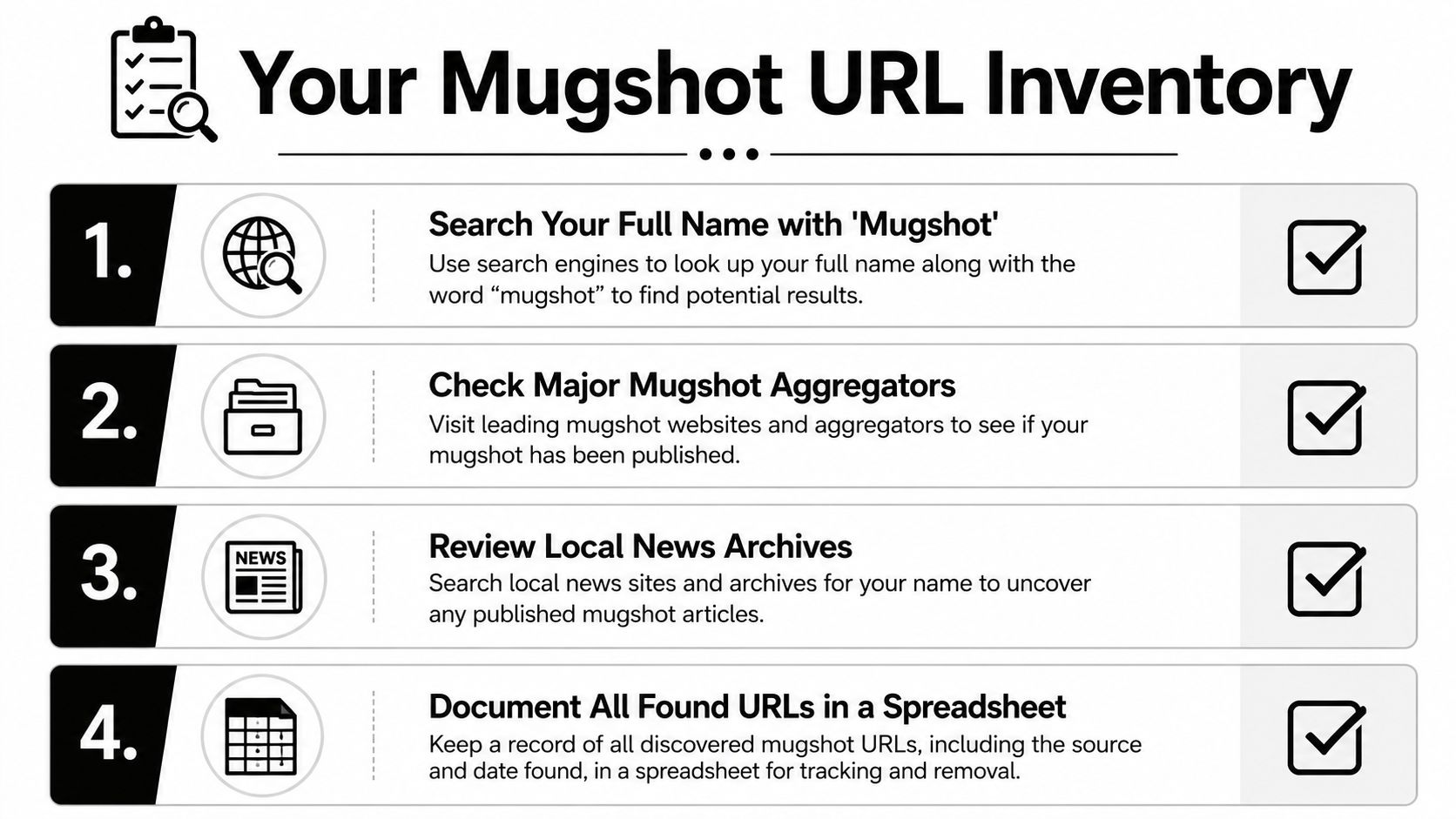
Start with search. Run your full name with mugshot, arrest, and the county or city where the booking happened. Then use reverse-image search and quoted-name searches to catch the copies that don't rank on page one but still exist in the index.
A disciplined inventory should record more than “it's online somewhere.” Write down the page URL, image URL, site or domain, discovery date, and a screenshot PDF for every instance you find. That documentation matters because a site that stalls, denies, or republishes the image can't plausibly claim it never got notice.
The fastest way to mess this up is to assume the original publisher is the only target. In reality, publisher domains, scraper sites, and aggregators often all host the same booking photo, sometimes with slightly different metadata or article text. If you only chase the first source, the mirrors keep the photo alive elsewhere.
Here's the workflow I recommend.
- Search by name and booking terms. Use your full name with mugshot-related keywords, then repeat the search with initials, middle names, and common misspellings.
- Check duplicates across domains. Find every copy, not just the highest-ranking one, because syndication makes the same photo appear under different URLs.
- Save hard evidence. Screenshots, PDFs, and timestamps create a record if the site later edits or deletes the page.
- Build a spreadsheet. Include the URL, domain, image location, date found, current status, and next action.
A clean spreadsheet saves time when a lawyer, site owner, or search engine asks for proof.
If you need a structured way to think about discovery and evidence collection, the OSINT tools for beginners guide is a solid reference point. The point isn't to become a technical investigator, it's to avoid sloppy claims and incomplete requests.
Legal Frameworks That Give Your Takedown Request Teeth
A polite email is weak. A legally supported demand with the right documents is different, because the site owner now has a deadline, a compliance obligation, and a paper trail that can be used against them later.
Georgia is the clearest example of why structure matters. A Georgia legal guide says a request can be made when an arrest has been restricted, and the requester must send name, date of birth, arrest date, and arresting agency by certified mail with return receipt requested or statutory overnight delivery. The same guidance says a company that fails to remove the booking photo within 30 days can face a complaint to the Georgia Department of Law's Consumer Protection Division. That turns the request from a favor into a timed legal obligation. For a practical overview of the broader removal process, remove mugshots from web is a useful companion resource.
Florida is even more forceful on enforcement. A Florida legal source says websites must remove a booking photo within 10 business days when the requester shows proof of qualifying outcomes such as dismissal, nolle prosequi, acquittal, completion of a pretrial diversion program, sealing or expungement, or mistaken identity. The same source says the law forbids charging a fee for removal in those circumstances and allows civil penalties of up to $1,000 per day for violations. A separate Florida-focused source says republication or redistribution after a proper removal request can trigger a $5,000 per day penalty.
That difference matters. Sites that profit from embarrassment tend to move faster when the law is specific than when the request is just emotional or informal.
| State | Compliance Deadline | Required Documentation | Penalties for Noncompliance |
|---|---|---|---|
| Georgia | 30 days | Name, date of birth, arrest date, arresting agency, qualifying court proof | Complaint to the Georgia Department of Law's Consumer Protection Division |
| Florida | 10 business days | Proof of dismissal, nolle prosequi, acquittal, diversion completion, sealing, expungement, or mistaken identity | Up to $1,000 per day, with $5,000 per day for republication after a valid request |
The key legal question is not just “was I arrested?” It's whether your case ended in a way that triggers removal or restriction rights. Dismissals, acquittals, expungement, pretrial diversion completion, and mistaken identity all change the situation if you can prove them with court records or certificates.
If you're working through eligibility, the what is a DSAR guide helps explain why documentation and formal requests matter so much in privacy work. The same logic applies here. Sites that ignore a clean, qualified request are much easier to pressure than sites receiving a vague message with no evidence.
The more exact the proof, the less room the site has to stall.
Deletion Versus Suppression and When to Use Each
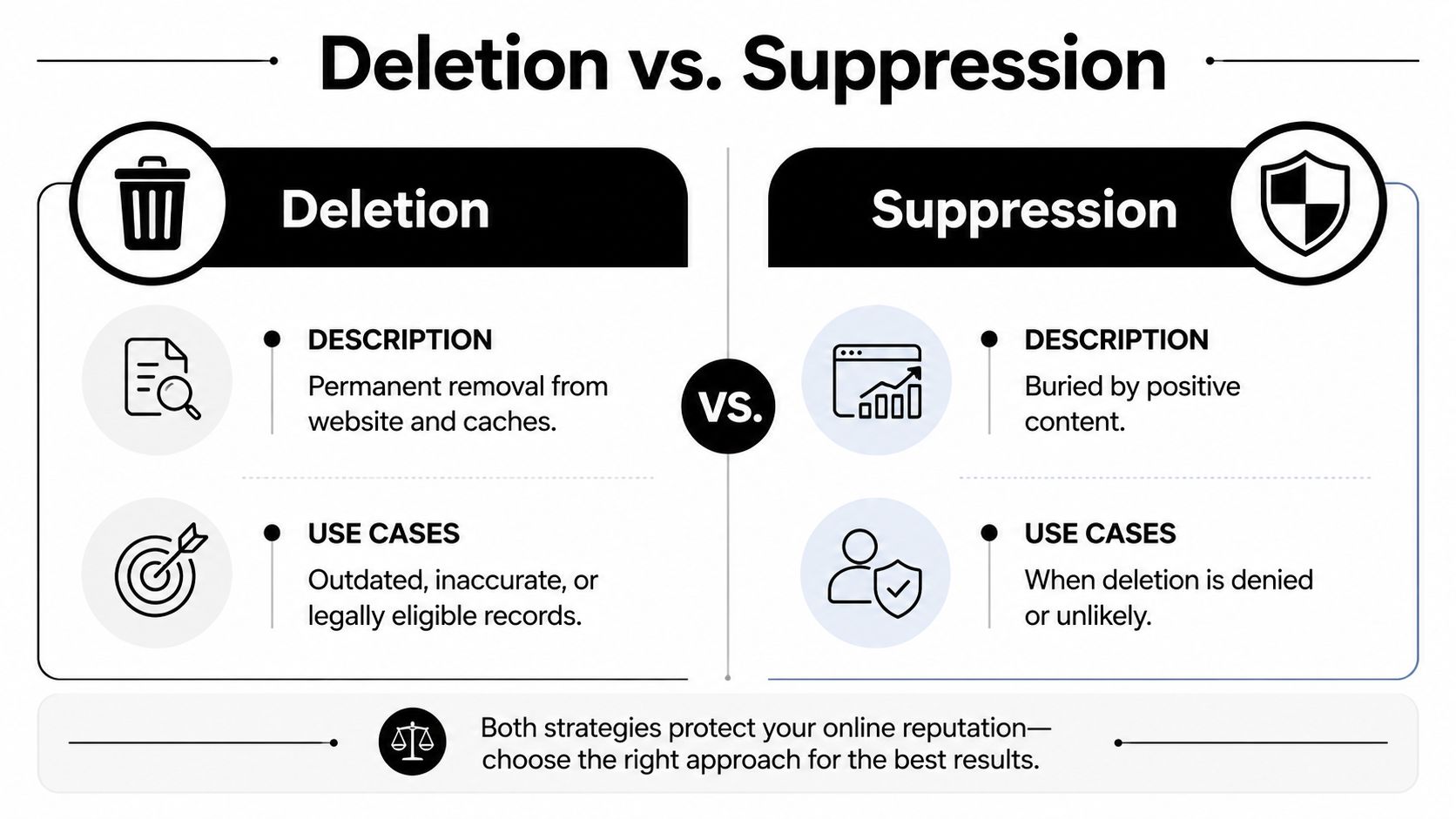
A mugshot problem starts one of two ways. The file comes down, or the search results get buried. Deletion is the cleaner outcome, and suppression is the practical fallback when removal is blocked, delayed, or only partly available.
Use deletion when the law supports it, the site will comply, and the photo can be removed from the page or database. That is the right call for clearly eligible cases, especially when you have court proof and a written request the site has to treat seriously. If the records are accurate and the operator is responsive, deletion stops the problem at the source.
Use suppression when the site refuses to remove the image, drags its feet, or keeps the page live. The job then shifts to building stronger search results with profiles, bios, articles, and owned pages that push the mugshot down. For a plain-language walkthrough of what gets removed from Google and what simply gets buried, the how to remove personal information from Google guide is a useful reference point. The win is visibility control, not false promises about total erasure.
A lot of people assume payment solves everything. It does not. Mugshots often remain public records, and copies can show up on other sites or in search indexes, which is why suppression has to run alongside takedown work. The core issue is durability, not whether one page disappears for a moment.
The cleanest way to sort the options is simple.
- Deletion works best when a site is legally required to remove the record or has already agreed in writing.
- Suppression works best when the photo keeps resurfacing, the site is uncooperative, or the record is public and likely to be mirrored.
- Both together work best when you need the photo removed where possible and buried where removal is not realistic.
Search-engine de-indexing sits between those strategies. A page can still exist on a site and stop showing up in ordinary searches if the index is handled correctly, and that difference matters when the goal is to protect job prospects, dating privacy, or basic peace of mind.
For expungement-related context outside Georgia and Florida, the Texas expungement eligibility guide shows how record status affects later visibility fights. Once the record status changes, the visibility strategy can change too.
Pay-to-remove operators create their own trap. If the business model depends on squeezing fear-driven fees, your “solution” can turn into a repeat bill. I want legal removal first, suppression second, and no payment unless the facts and the contract are strong.
When to Hire a Reputation Management Firm or Attorney
DIY works only when the record is simple, the site responds, and the legal path is already clear. Once one of those pieces breaks, staying solo costs time and weakens your position.
Bring in an attorney when the site ignores a certified demand, the matter crosses state lines, or the mugshot is tied to identity theft, wrongful arrest, or a record that must be sealed before removal has any chance of working. Legal help also makes sense when the site has already shown it will not comply, because informal follow-up turns into a stall tactic fast.
A reputable reputation firm does a different job. It manages search visibility, tracks reappearance, and helps suppress the result set with owned content and profile cleanup. It should not promise miracles, and it should not pretend it can erase public records everywhere at once.
That separation matters. A firm can push down exposure and keep watch for new copies, but it cannot replace legal pressure when the site is ignoring a valid takedown request or hiding behind jurisdictional arguments. A lawyer can force the issue on notice, deadlines, and statutory rights, while the reputation side handles the search results that remain.
Scam operators stand out quickly. They lead with guaranteed removal, push for upfront payment, and dodge any explanation of what happens if a site republishes the image later. If they cannot explain the difference between deletion and suppression, they do not understand the work.
Use a simple decision rule.
- Hire an attorney first when eligibility depends on court status, a statutory deadline, or a formal demand letter.
- Hire a reputation firm when the legal side is settled but search results still show too much exposure.
- Use both when the photo appears on multiple sites and the timeline is urgent.

Before paying anyone, run a public-facing scan and review the actual footprint. A tool such as Digital Footprint Check's reputation management services can show where a mugshot or related personal data appears online, which gives you a real count of copies before you negotiate with a remover.
If the first response is vague confidence instead of a written process, walk away.
The cost of hiring help goes beyond the invoice. It includes saved time, preserved evidence, and the chance to avoid a sloppy request that alerts a site to harden its position.
Monitoring Your Digital Footprint to Prevent Reappearances
A mugshot removal win does not last if you stop watching. New aggregator domains show up, old copies get reindexed, and one careless republisher can undo work you already paid for.
Set up Google Alerts for your full name, past names, and arrest-related keywords. Then run reverse-image searches on a regular schedule, because a reused booking photo can surface before the text around it does. If you already built the inventory, re-check those domains quarterly and update the status field whenever something changes.
Use a simple monitoring rhythm.
- Monthly: search your name with mugshot terms and review search results by hand.
- Quarterly: rerun reverse-image checks and review old URLs for reappearance or mirror copies.
- After any new mention: save screenshots right away and add the page to your inventory.
Speed matters. The faster you catch a new copy, the easier it is to send a fresh notice, show repeat publication, and push for de-indexing or legal follow-up. Waiting gives the site time to spread the image again and makes your next request weaker.
You should also keep building positive content. Owned profiles, clean professional pages, and updated bios help crowd the top of the search results so a single mugshot cannot dominate your name. That is the long game, and it works because search visibility is a competition for attention, not a one-time event.
If you want a broader scan that includes public records and other exposed data, visit free checker. Run it first, then compare the results against your own inventory so you know where your name is already exposed before another site copies the image.
If you need a more complete exposure review, use Digital Footprint Check to map public records, duplicate listings, and related personal data before you send another takedown request.
A final warning. Do not treat monitoring as a casual search habit. It is the evidence trail that tells you when suppression failed, when deletion held, and when you need to escalate with a tighter demand or an attorney.