· Digital Footprint Check · Content Marketing · 16 min read
Online Reputation Management Services That Actually Work
Compare online reputation management services by type, cost, and use case. Find the right DIY, SaaS, or agency option for your needs in 2026.

A recruiter searches your name before the interview. The first page looks fine, but the second page contains an old forum post, a tagged photo you forgot about, and a data-broker profile exposing personal details. A small business owner can face the same problem when a damaging review, inaccurate directory listing, or social complaint starts shaping customer decisions before anyone contacts the company.
That’s the practical reason online reputation management services exist. They monitor what appears across search engines, social networks, people-search sites, data-broker listings, breach databases, and review platforms, then help you respond, remove content where removal is legitimate, suppress harmful results, and publish accurate material that deserves visibility. The right choice isn’t automatically the most expensive package. It depends on your exposure surface, the urgency of the problem, and whether you can act on alerts yourself.
| Service tier | Best fit | What it usually delivers | Main limitation |
|---|---|---|---|
| DIY tools | Low exposure, technically confident users | Manual audits, alerts, platform requests, profile cleanup | You handle every action |
| SaaS platform | Teams managing recurring mentions or reviews | Monitoring, dashboards, workflows, reporting | Alerts don’t equal remediation |
| Specialist agency | Active crisis, executive risk, legal or complex exposure | Strategy, content, takedowns, escalation, crisis response | Higher cost and longer commitments |
What Online Reputation Management Services Actually Do
A hiring manager pastes a candidate’s name into Google, scans the visible results, and clicks the second page when nothing answers the question clearly. A business owner searches the company name and finds a viral one-star review on Yelp, even though the review is old and the underlying complaint was resolved. Neither person is conducting an in-depth investigation. They’re making a quick judgment from public information.
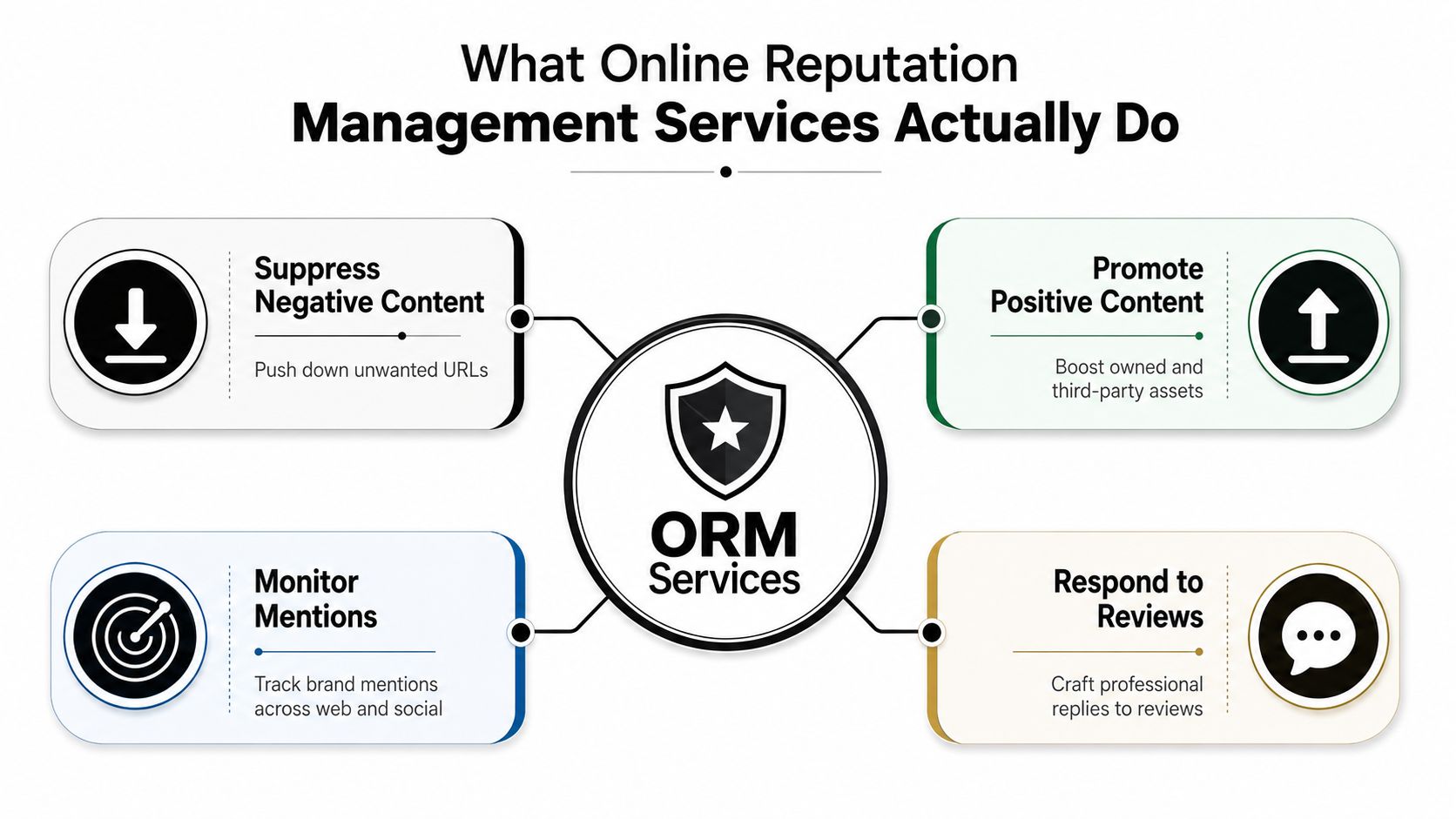
Online reputation management, or ORM, is the coordinated process of monitoring, improving, and protecting that public information. A legitimate provider may track mentions, respond to reviews, request removal of policy-violating or unlawful material, create accurate content, and promote credible pages so outdated or misleading results receive less attention. Suppression isn’t the same as deletion. Most services can’t erase lawful criticism, and any vendor promising to remove everything is selling fiction.
The four surfaces a real ORM service must cover
Search engine results: Google and other search engines expose articles, profiles, images, videos, forums, and cached references. Search work may involve correcting owned pages, publishing useful content, improving technical visibility, or pursuing a valid removal request.
Social profiles: Public posts, tagged images, comments, usernames, and abandoned accounts can affect job prospects, relationships, dating safety, and personal security. A job seeker may need to review tagged photos, while a company may need escalation rules for a fast-moving complaint.
People-search and data-broker listings: These pages can connect names to addresses, phone numbers, relatives, age ranges, and other records. Removal processes vary by provider, and repeat monitoring matters because information can reappear.
Review platforms: Google, Yelp, Glassdoor, industry directories, and niche marketplaces require a different workflow. The priority is usually factual response, service recovery, policy reporting, and consistent documentation, not indiscriminate removal.
A single Glassdoor entry, blog post, or data-broker record can influence hiring, lending, purchasing, and dating decisions. For a broader explanation of the business impact, see why online reputation management is important.
The category includes useful educational material, such as Exerta’s brand trust protection, but buyers should still separate monitoring from intervention. A dashboard can tell you that a mention exists. It doesn’t automatically determine whether the mention is defamatory, a legitimate complaint, a privacy risk, or a signal of a deeper operational problem.
That distinction leads to the central buying decision. DIY works when exposure is limited and you have time. SaaS works when volume is recurring and your team can respond. Agencies earn their fee when the exposure is complex, urgent, or legally sensitive.
The ORM Market in 2026 and Why It Keeps Growing
ORM is now a substantial global commercial category, not a narrow SEO add-on. One recent forecast values the market at USD 2.315 billion in 2025 and projects USD 3.534 billion by 2034, representing a 6.4% compound annual growth rate, while another estimate places it at about USD 6.9 billion in 2025 and roughly USD 14.0 billion by 2031, at around 12.6% CAGR. The estimates differ because researchers define “online reputation management services” differently, but both show durable commercial demand. (Intel Market Research market forecast)
ORM Market Snapshot 2026
| Metric | Value |
|---|---|
| Recent forecast for 2025 market size | USD 2.315 billion |
| Forecast market size for 2034 | USD 3.534 billion |
| One estimate of 2025 market size | About USD 6.9 billion |
| One estimate of 2031 market size | Roughly USD 14.0 billion |
| Forecast CAGR in the first estimate | 6.4% |
| Forecast CAGR in the second estimate | Around 12.6% |
| North America share in one 2026 analysis | 38% |
| Europe share in one 2026 analysis | 26% |
| Asia-Pacific share in one 2026 analysis | 24% |
| Projected broader market size for 2032 | USD 22.18 billion |
One 2026 analysis places North America at 38%, Europe at 26%, and Asia-Pacific at 24% of global ORM share, while projecting the broader services market could reach USD 22.18 billion by 2032. (2026 ORM statistics and regional analysis) These figures reflect adoption in economies where search visibility, employer screening, reviews, and digital identity affect commercial outcomes.
The market’s growth comes from structural pressure. Personal information now travels through social profiles, public records, data brokers, gaming communities, and breach databases. Employee reviews on platforms such as Glassdoor and Indeed can shape employer perception, while synthetic and AI-generated content makes it harder to identify the original source of a claim or image. SaaS vendors have made monitoring more accessible, but agencies increasingly sell crisis response, legal escalation, content development, and executive protection.
That maturity helps buyers. You can ask vendors for monitored surfaces, response workflows, reporting frequency, removal methodology, escalation rules, and contract boundaries. Resources such as Netco Design LLC’s guide to choosing the right ORM vendor are useful starting points, but don’t select a provider because it promises “visibility improvement.” Select one that defines the work in deliverables you can verify.
DIY Tools, SaaS Platforms, and Agencies Compared
The three service tiers solve different operational problems. DIY is a hands-on process, SaaS is an information and workflow layer, and an agency is an outsourced response function. Confusing those roles is how buyers overpay for alerts or underprepare for a crisis.
| Criterion | DIY Tools | SaaS Platforms | Agencies |
|---|---|---|---|
| Monitoring scope | Manual searches, Google Alerts, selected platform checks | Automated web, social, and review monitoring | Broader monitoring with human analysis and escalation |
| Remediation | Data-broker requests, profile cleanup, direct responses | Templates, workflows, task assignment | Suppression, content creation, takedown requests, crisis response |
| Reporting | Spreadsheet or personal notes | Dashboards, trend reports, exports | Custom reports, executive summaries, strategic reviews |
| Compliance | Depends on your own knowledge | Built-in controls vary by provider | Contractual processes, legal review, documented escalation |
| Pricing model | Free or tool-by-tool expenses | Subscription, seats, locations, or monitored assets | Retainer, project fee, or custom engagement |
| Best fit | One person with limited exposure | A team handling recurring volume | Complex risk, public figures, legal exposure, or urgent incidents |
DIY works when the problem is narrow
Start with private-window searches for your name, company, email addresses, usernames, and common misspellings. Check social profiles, review pages, data-broker listings, gaming accounts, and breach notifications. Google Alerts can help with basic monitoring, while platform-specific privacy controls and legitimate opt-out forms address some exposure.
DIY fails when you can’t keep a record of requests, don’t know whether a review violates platform rules, or need content published and promoted consistently. It also fails when an issue involves threats, intimate imagery, impersonation, stalking, or active legal claims.
SaaS adds consistency, not judgment
Platforms such as Brandwatch, Reputology, and Birdeye can collect mentions, organize review responses, and assign work across a team. They’re a strong fit for local businesses and HR or marketing groups that need a shared queue. They won’t decide whether a post is defamatory, negotiate a takedown, or repair a broken customer experience without human direction.
Use tools for monitoring your digital footprint and keeping your data safe to compare monitoring approaches, then test whether your chosen platform covers the sources you care about.
Agencies handle the messy parts
A full-service agency may combine search strategy, content creation, legal removal requests, press outreach, review operations, and crisis communications. That depth matters when the issue spans several platforms or when executives, employees, customers, or journalists are involved. It’s unnecessary for someone who only needs to remove an old directory listing and lock down public social profiles.
My default recommendation is hybrid. Use software for continuous discovery, keep routine cleanup in-house, and buy specialist hours for removal disputes, crisis response, and legal review.
Five Evaluation Criteria That Separate Good Vendors From Noise
A polished sales presentation doesn’t prove that a vendor can protect your identity. Ask for operational specifics before signing anything. The strongest providers can tell you what they monitor, what they can change, how they document decisions, and what happens when a platform rejects a request.
| Criterion | Questions to Ask | Red Flag |
|---|---|---|
| Monitoring scope | Which search engines, social networks, review sites, people-search services, breach sources, and forums are covered? How many result pages or assets are checked? | “We monitor the internet” without a source list |
| Remediation depth | Do you suppress, request removal, create content, or only send alerts? Who handles legal takedowns? | A guaranteed deletion promise |
| Reporting cadence | Do reports arrive weekly or monthly? Can I access raw mentions and action history? | A vague sentiment score with no evidence |
| Compliance posture | How do you handle GDPR, CCPA, FTC disclosure rules, platform policies, and sensitive data? What happens after a rejected request? | No written compliance process |
| Pricing transparency | Is pricing based on queries, assets, locations, seats, projects, or a retainer? What triggers extra fees? | “Results-based” pricing with undefined results |
Monitoring scope comes first
A tool that watches Google reviews but ignores social comments is incomplete for a consumer brand. A service that tracks a company name but not executive names, product names, phone numbers, email addresses, and usernames misses obvious risk. Ask for a sample report using your actual exposure, not a generic demonstration account.
Remediation must match the problem
Removal is appropriate for some privacy violations, impersonation, policy breaches, or unlawful content. Suppression is more realistic for lawful criticism or stale coverage. Content creation helps only when the new material is accurate, useful, and strong enough to earn attention.
Practical rule: Never pay for “suppression” until the vendor explains which assets it will create, where they’ll appear, who owns them, and how progress will be measured.
Reporting should support decisions
You need the original URL, platform, date found, category, severity, action taken, current status, and next step. Executive summaries are useful, but raw evidence matters when HR, legal, security, or communications teams need to review an incident.
Compliance and pricing complete the test. Ask what the provider does when a process could trigger a platform strike, expose private information, or create a misleading impression. For pricing context and service boundaries, review Digital Footprint Check pricing, then demand the same clarity from every vendor you shortlist.
Matching ORM Services to Individuals, Job Seekers, HR, and Small Brands
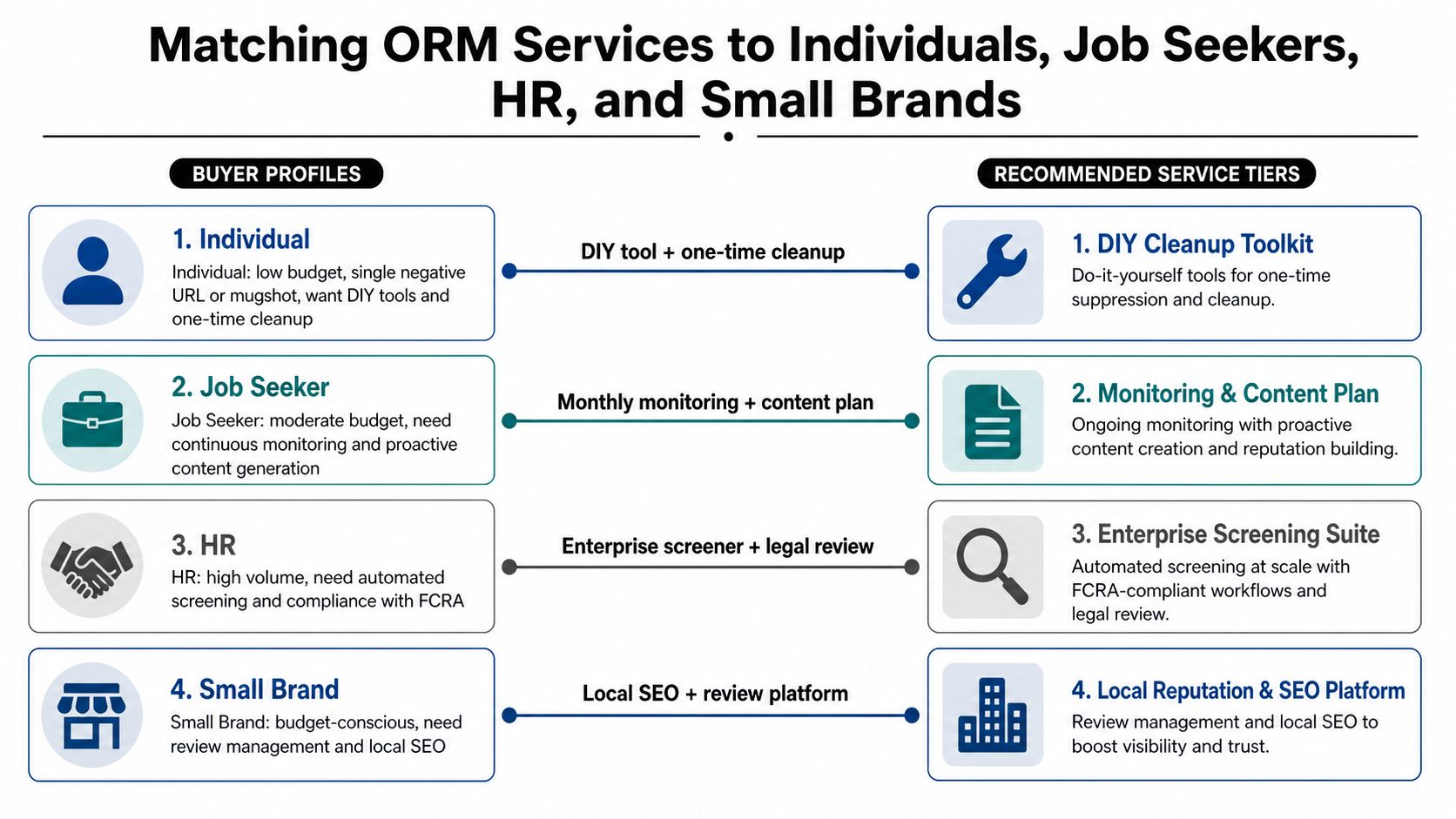
Your exposure surface should determine your service tier. A person with one outdated result doesn’t need the same stack as an employer monitoring executive impersonation or a local business managing reviews across several locations.
Individuals need targeted cleanup
If you have one negative URL, a mugshot listing, an exposed address, or an abandoned account, begin with an audit. Remove information from profiles you control, submit legitimate opt-out requests, document every request, and avoid vendors claiming they can erase lawful reporting. A DIY process plus a one-time specialist engagement is usually more rational than a permanent retainer.
Privacy and safety issues deserve priority over search aesthetics. If your footprint reveals home details, relatives, breach exposure, or accounts you no longer recognize, treat it as an identity and security problem, not merely a branding problem.
Job seekers need professional consistency
Recruiters may review LinkedIn, portfolio pages, public social profiles, tagged photos, forums, and old usernames. Clean up visible inconsistencies, separate personal and professional accounts where appropriate, check privacy settings, and publish accurate work samples. A lightweight monitoring subscription can help you detect new mentions while you maintain the content yourself.
Use this guide to cleaning up social media for a job search before buying content campaigns. Hiring teams generally need a coherent, truthful professional record, not a manufactured personality.
HR and executive teams need controls
HR teams face a larger exposure surface because they handle multiple people, sensitive decisions, and compliance obligations. They need documented consent, access controls, retention rules, escalation paths, and careful separation between public research and protected employment information. Executive protection adds impersonation monitoring, deepfake awareness, rapid takedown coordination, and incident response.
An agency becomes appropriate when the team can’t investigate and escalate quickly enough internally, especially when threats, doxxing, impersonation, or coordinated harassment appear.
Small brands should prioritize reviews
A local service company lives in Google Business Profile, Yelp, industry directories, social comments, and location-specific searches. A review-management platform can automate requests, assign responses, and identify recurring complaints. Keep agency support available for a public incident, false allegation, or review dispute that requires careful documentation.
For most readers, the best stack is monitoring plus selective human intervention. Anyone already facing active legal exposure should start with a qualified attorney and an agency that can work within legal instructions. Don’t let a marketing vendor make legal judgments on your behalf.
Compliance-Driven Reputation Work and the New Rules on Reviews
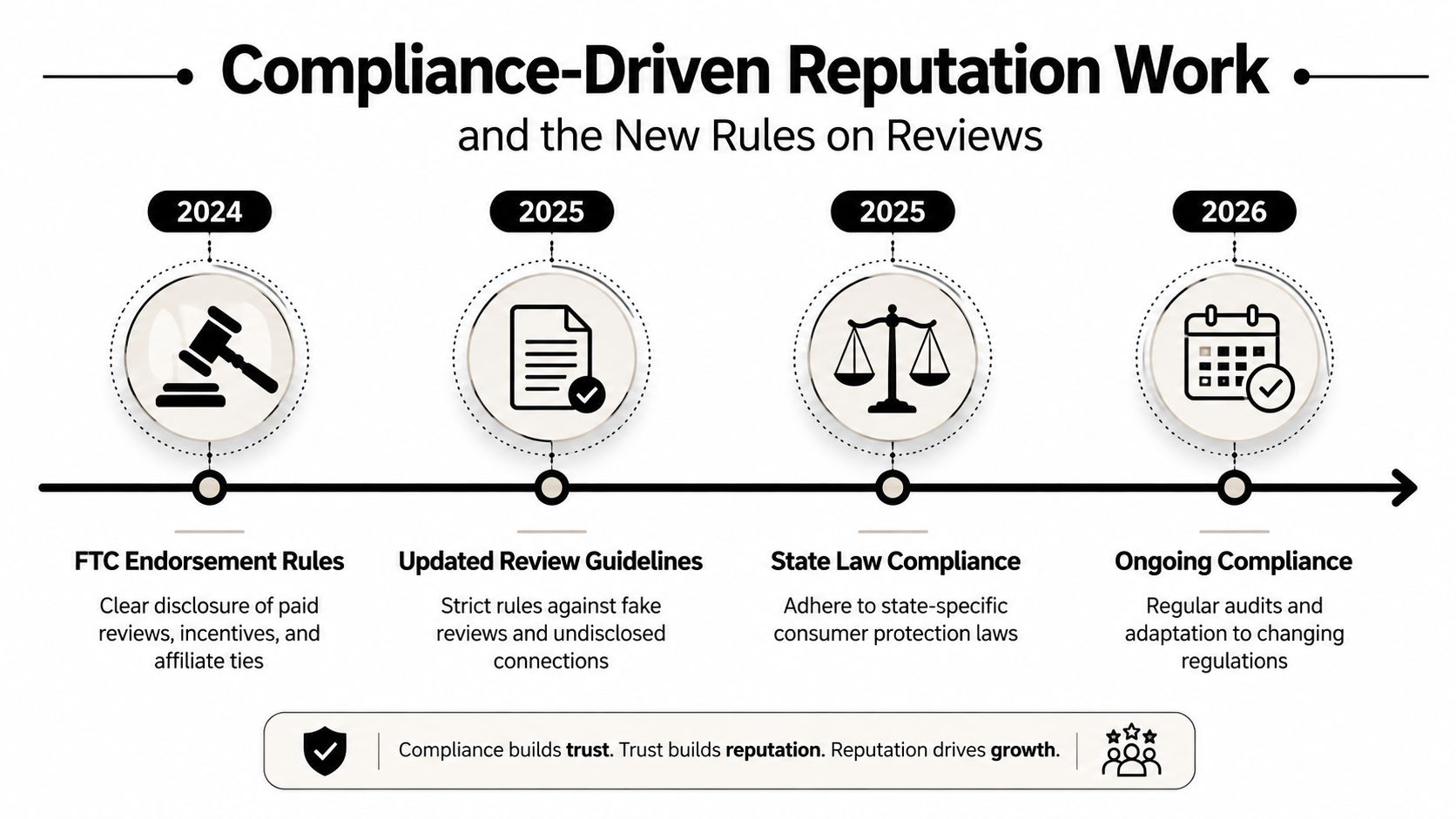
Compliance isn’t a paragraph at the end of an ORM proposal. It determines whether the strategy protects you or creates a new liability.
The UK’s Digital Markets, Competition and Consumers rules took effect on 6 April 2025 and cover consumer reviews across products, services, digital content, and star ratings. They also require businesses to label incentivised reviews clearly. In the United States, the FTC consumer review rule took effect on 21 October 2024, and maximum civil penalties rose to $53,088 per violation in 2025. (Taylor Wessing’s analysis of fake and misleading review rules)
Fake reviews are a legal risk
Buying fabricated reviews, arranging undisclosed incentives, suppressing honest negative feedback, or creating fake customer personas can expose a company to regulatory and platform action. The UK rules explicitly reach incentivised reviews and ratings, while the FTC framework makes deceptive review practices more than a search-ranking concern.
A vendor should help you request authentic feedback without conditioning rewards on a positive rating. It should preserve records showing who requested a review, what disclosure was used, whether an incentive existed, and how complaints were handled. Buying a batch of five-star reviews is not reputation management. It’s evidence creation against your own business.
Privacy removals require judgment
A removal request might involve a data-broker listing, doxxing, non-consensual intimate imagery, impersonation, harassment, or a legitimate public-interest article. The correct route depends on the platform, jurisdiction, facts, and legal basis. Suppression can be appropriate for lawful content, but it shouldn’t be used to conceal material information from people making legitimate safety or employment decisions.
A provider should explain how it handles data minimization, authorization, evidence preservation, and escalation. For a practical discussion of reputation management for businesses, look for guidance that distinguishes criticism, defamation, privacy violations, and platform-policy breaches.
Teams also need to understand whether their research methods are lawful. Review whether OSINT is legal before collecting or distributing personal information, particularly in HR screening, investigations, relationship disputes, or security work. Professional ORM should leave an audit trail, not just a cleaner-looking search page.
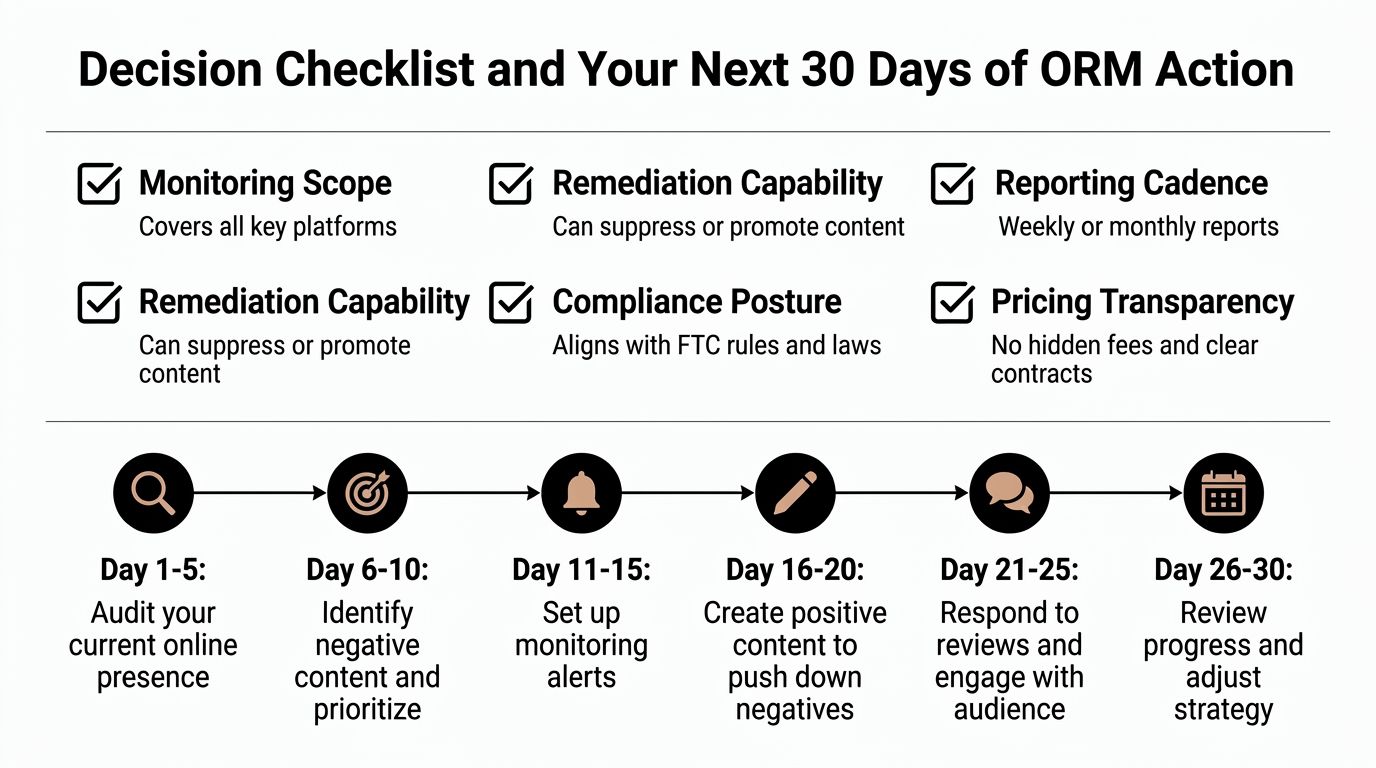
Decision Checklist and Your Next 30 Days of ORM Action
Choose a service only after scoring it against the exposure you have. A provider that excels at review replies may be unsuitable for breach exposure, while a crisis agency may be wasteful for a single outdated profile.
The buying checklist
- Monitoring scope: Does the service cover your search results, social profiles, review platforms, people-search listings, breach exposure, and relevant usernames?
- Remediation capability: Can it distinguish removal, correction, suppression, response, and new content creation?
- Reporting cadence: Will you receive actionable weekly or monthly reports, source URLs, status updates, and historical records?
- Compliance posture: Does the contract address platform rules, privacy obligations, review disclosures, and escalation to counsel?
- Pricing transparency: Are fees clear for monitored assets, locations, seats, queries, takedown attempts, content, and additional work?
Reject any vendor that guarantees a clean internet, promises instant deletion, refuses to identify monitored sources, or reports only a mysterious “reputation score.” A credible provider will explain what it can control and what remains outside its control.
A practical 30-day action plan
Days 1 to 5, establish a baseline. Search your name, company, executives, email addresses, phone numbers, usernames, and common misspellings in a private browser window. Record search results, social profiles, reviews, public records, exposed contact details, and breach indicators. Save URLs and screenshots so you can distinguish new findings from old ones.
Days 6 to 10, rank the exposure. Put direct safety risks first, including home addresses, impersonation, threats, exposed credentials, or intimate material. Next rank employment, customer trust, financial, and search visibility issues. Don’t spend your first week polishing a profile while an exposed account creates a security problem.
Days 11 to 15, activate monitoring. Set up Google Alerts and platform alerts, or test a SaaS service against your actual names and brands. If you need a broader identity audit, Digital Footprint Check can search across social media, public records, gaming profiles, professional networks, and breach databases, then return findings for review.
Days 16 to 20, build truthful assets. Update owned profiles, correct inaccurate information, publish useful professional or business content, and prepare response templates. Don’t manufacture testimonials or create fake accounts.
Days 21 to 25, handle feedback. Respond to legitimate reviews calmly, report policy violations, invite private resolution when personal details are involved, and document every action. For social or email feedback, use channel-specific workflows. The 2020 State of Online Reputation Management report found that consumers generally expect responses within hours, with 24 hours treated as the practical upper limit, while social channels usually require replies within a few hours. (2020 State of Online Reputation Management report)
Days 26 to 30, measure and decide. Review coverage, response times, unresolved URLs, review status, profile exposure, and security findings. Review-management guidance recommends handling all reviews in under 24 hours, negative reviews in under 4 hours, and targeting 100% response coverage. (Review-management KPI guidance) Use those as workflow targets, not promises of business outcomes.
Start with the smallest tier that covers your real risk, then upgrade when the workload or severity demands it. A free baseline scan gives you better negotiating power than a sales call because you’ll know which surfaces need attention before you buy monitoring, SaaS workflows, or agency support.
Digital Footprint Check helps you identify exposed information across search results, social platforms, public records, gaming profiles, professional networks, and breach databases before you choose an ORM service tier. Run the free check through Digital Footprint Check, review the findings, and use the report to prioritize privacy cleanup, job-search preparation, or reputation monitoring.