
· Digital Footprint Check · Content Marketing · 13 min read
Identity Theft Risk Assessment: What Raises Your Risk
Learn how an identity theft risk assessment ranks exposed data, breached passwords and online accounts, with a step-by-step method to score your own risk.
Checking whether your email appears in a breach is useful advice. Treating the result as your identity theft risk assessment isn't. An old password you no longer use and a working password for your primary email shouldn't receive the same attention, even if both appear in a single breach.
The important question is what someone can do with your information today. A public address, a reused gaming username and an exposed recovery email can form a usable chain, even when none looks especially dangerous on its own.
What an Identity Theft Risk Assessment Measures
How likely is it that someone can use my information against me? Answering that requires more than counting leaked records. An identity theft risk assessment reviews exposed information, connects it to accounts and recovery methods, and identifies the harm an attacker could cause.
Say you discover an abandoned forum profile and a public professional biography. The forum contains a password you retired; the biography reveals your employer and a personal email address that still controls account recovery. The second discovery may deserve more attention, despite not being a breach.
The scale warrants a structured approach. The FTC's Consumer Sentinel Network recorded more than 6.47 million consumer reports in 2024, including roughly 1.1 million identity-theft reports, or 18%. Separately, Javelin Strategy & Research estimates consumers lost $27.2 billion to identity fraud in 2024, a 19% increase from the previous year.
The information that matters
- Exposed data: What's publicly visible or included in a leak, such as your address or identity documents.
- Reused credentials: Passwords, security answers and recovery details shared across services.
- Online accounts: Services holding your identifiers, including forgotten accounts.
- Impact: What someone could access, impersonate, purchase or disrupt.
Think of a house with many doors. A spare key under the mat matters more than the number of windows. Likewise, account count provides context, but an accessible recovery route may determine your immediate risk.
A personal security assessment should turn those observations into a prioritized record. The useful outcome is a scored list of exposures and a clear repair order, not a reassuring badge that says nothing was found.
Which Exposed Data Creates the Highest Risk
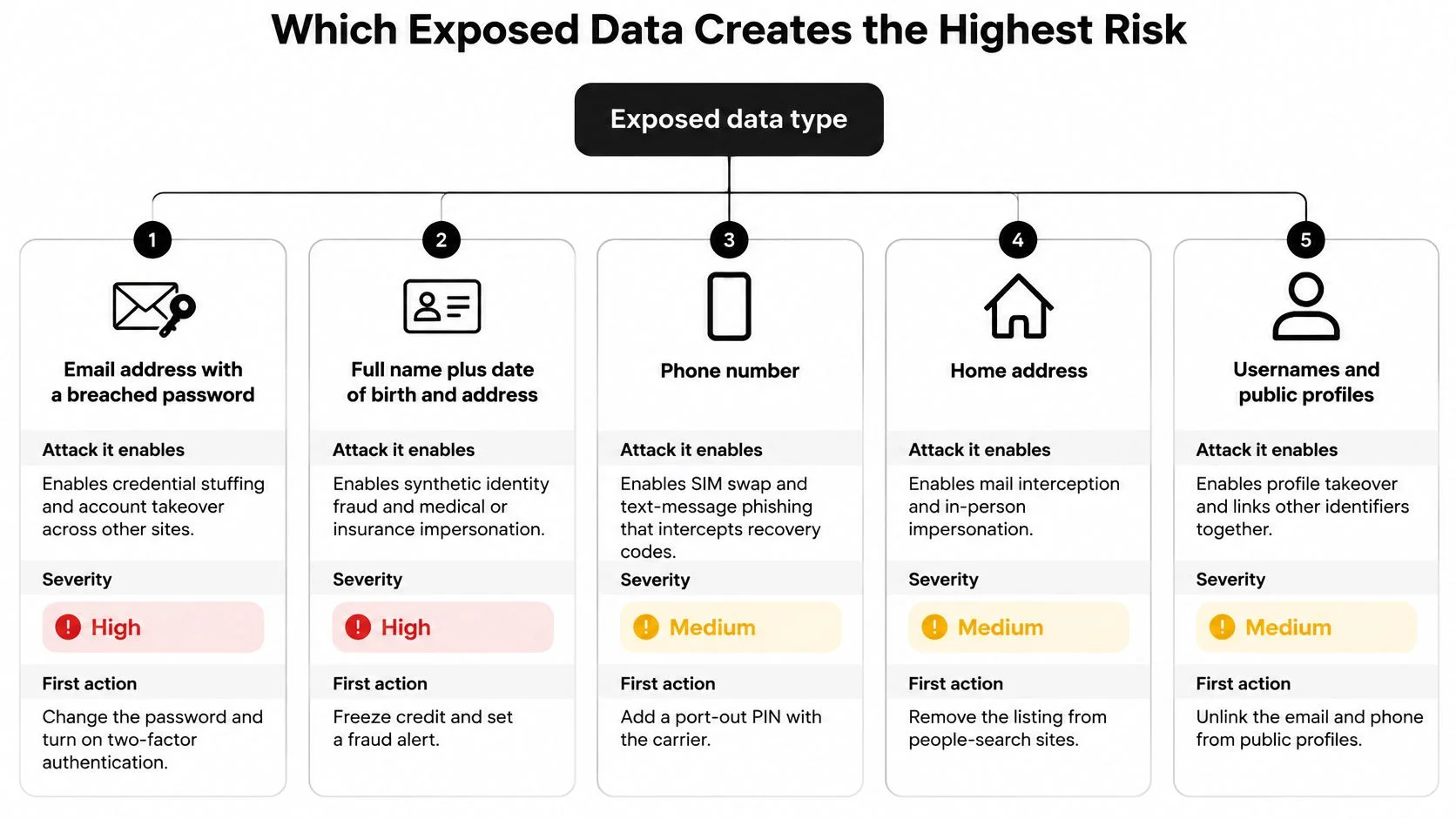
Use this table as a starting judgment, not an automatic verdict. Severity changes with usability, account access and personal circumstances.
Exposed data types, the attacks they enable and first actions
| Exposed Data | Attack It Enables | Severity | First Action |
|---|---|---|---|
| Email address with a breached password | Account takeover through credential reuse | High | Change the password and enable MFA |
| Full name plus date of birth | New-account fraud and impersonation | High | Remove date of birth from public profiles |
| Government ID number | Opening accounts and tax or benefit fraud | Critical | Check credit reports and consider a credit freeze |
| Phone number | SIM swap attempts and recovery abuse | High | Use app-based MFA instead of SMS where offered |
| Home address | Physical targeting, mail fraud and fake delivery scams | Medium to high | Request removal from people-search sites |
| Employer and job title | Recruiter impersonation and workplace phishing | Medium | Limit public role details and resume copies |
| Security question answers | Account recovery abuse | High | Replace with random answers stored in a password manager |
| Usernames reused across sites | Linking accounts and guessing passwords | Medium | Use distinct usernames for sensitive services |
| Photos and travel posts | Believable impersonation and location clues | Low to medium | Remove geotags and review older posts |
The visual summarizes common exposure patterns. Treat its ratings as illustrative, particularly where a phone number controls sensitive account recovery.
Why breach volume can mislead
The Identity Theft Resource Center's 2025 Data Breach Report records 3,322 U.S. data compromises, while victim notices fell 79%, from 1.36 billion to 278.8 million. That divergence doesn't prove attackers became more selective. It does demonstrate why fewer notices cannot establish that an individual's exposure became less dangerous.
Combinations matter. According to the Insurance Information Institute's summary of FTC data, 14% of identity-theft reports in 2024 included more than one type of identity theft.
Use critical for government identifiers and financial identifiers that support serious misuse. Treat usable credentials, recovery answers and birth dates as high priorities. Employer details, addresses and usernames often begin at medium, but move them upward when they connect to sensitive access or a safety threat.
A compromised government identifier needs a different response from a public username. Follow the steps for a compromised Social Security number rather than assuming a password change resolves it.
Assessment question: Which attack path does this information enable today?
How Breached Passwords Lead to Account Takeover
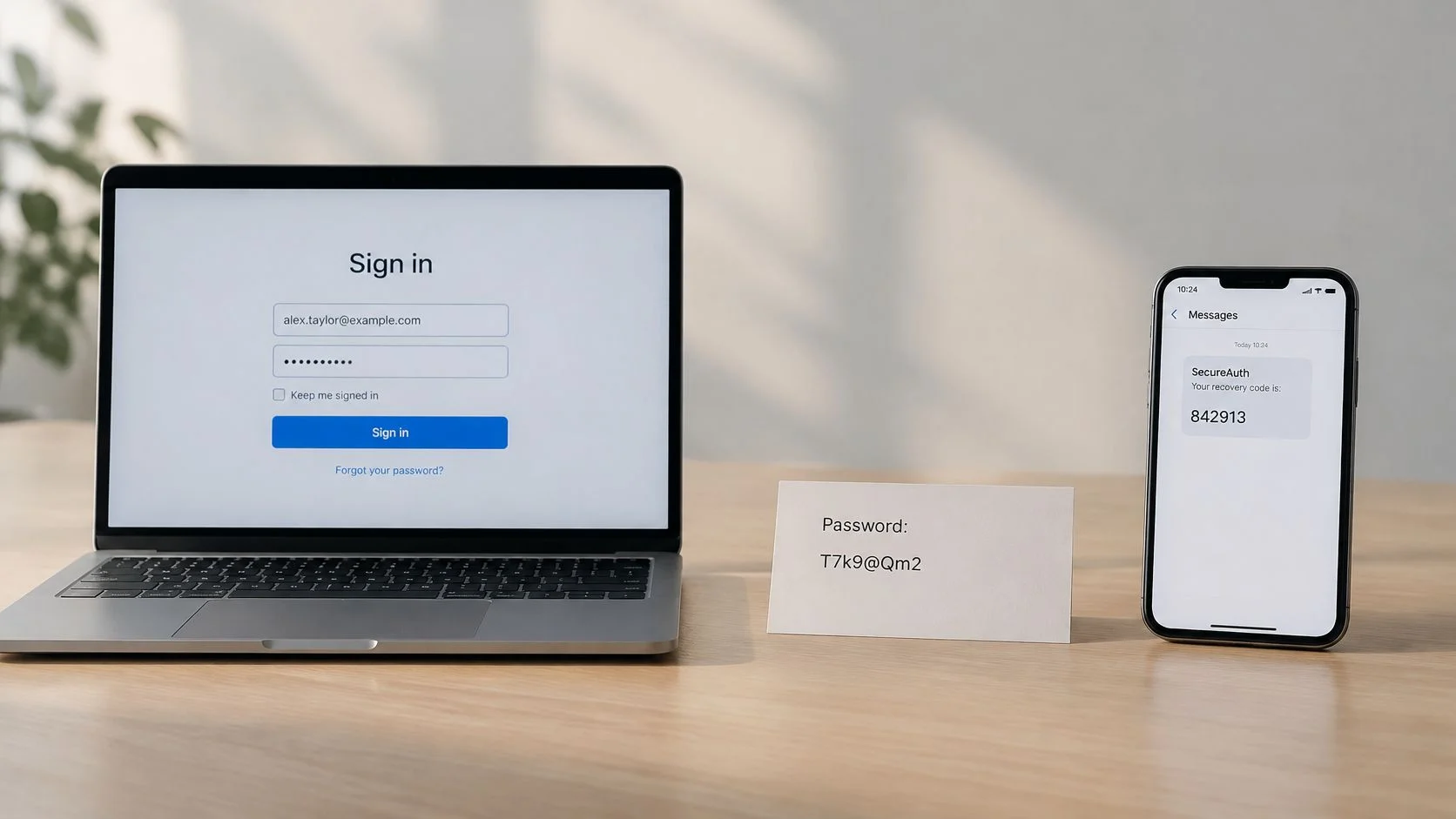
A leaked password becomes dangerous when it still opens something. The devices you use may be secure while an attacker signs in elsewhere with valid credentials.
The FBI's 2024 Internet Crime Report records 859,532 complaints and reported losses exceeding $16 billion, up 33% from 2023. Those totals cover internet crime broadly, not identity theft alone.
Follow the takeover chain
- Test the leaked login. An attacker tries an exposed email-password pair on other services. This is credential stuffing, automated testing of credentials stolen elsewhere.
- Inspect recovery options. A successful login may reveal a backup email, phone number, linked account or saved payment method.
- Take control. Where the service permits it, the attacker changes the password or recovery settings and locks the owner out.
Say you reuse a forum password on a shopping account. After the forum leaks, someone accesses the shop, views your address and attempts purchases using a stored payment method. Whether those purchases succeed depends on the merchant's additional checks.
Opening an account isn't the same as accessing one
NIST's digital identity framework separates identity proofing, establishing who someone is, from authentication, verifying their access to an existing account, and federation, transferring identity assertions between services. Personal documents primarily affect proofing; reused passwords primarily affect authentication.
Check whether each important password is unique, whether email and banking have multifactor authentication, and whether a phone number can bypass stronger protections through recovery. Prefer passkeys or security keys where available; an authenticator app is another option when those aren't supported.
Use the accompanying video as a prompt to review your own login and recovery settings.
Stronger controls reduce the chance that a stolen password succeeds. They don't eliminate every recovery, impersonation or device-compromise scenario.
Job, Dating and Gaming Profiles That Widen Exposure
A profile doesn't need to publish a password to help a scammer. It can supply the details that make a fraudulent message sound credible.
Professional visibility needs boundaries
The FTC's 2024 fraud-loss announcement reports more than $12.5 billion in consumer-reported fraud losses, up 25%, with $750.6 million attributed to business and job-opportunity scams. Those categories aren't limited to identity theft, but they show why employment-related exposure deserves attention.
Say a fake recruiter references your employer and a project described in your public resume. The message feels relevant, then asks for identity documents or an equipment payment. Verify the recruiter through the employer's independently located careers page before sharing documents.
Keep professional achievements visible while removing unnecessary home addresses, birth dates and personal contact details. That supports job prospects without publishing a ready-made identity dossier.
Dating and gaming need different checks
The FBI's romance-scam warning identifies 17,910 U.S. romance-scam reports in 2024, involving $672,009,052 in reported losses. A dating profile revealing your workplace, relatives, travel habits and social handles can give an impersonator material for convincing conversation.
- Dating verification: Compare profile details for inconsistencies and reverse-search reused photos. A matching photograph or verification badge isn't proof of someone's intentions, and catfishing checks shouldn't require sharing your own identity documents.
- Gaming security: Review linked payment methods, friends lists and connected services. A stolen gaming account can become a route for unauthorized spending or scam messages to friends.
- Account discovery: Use a cross-platform username search to locate forgotten profiles, then verify ownership before requesting changes.
Delete dormant accounts and restrict unnecessary public fields. A dedicated sign-up email can separate casual registrations from your primary correspondence, but protect it carefully if services use it for recovery.
Every retained profile deserves an access and recovery review.
When Identity Exposure Affects Safety and Housing
Identity risk can become a safety risk. A financial-loss checklist won't adequately prioritize an exposed address when someone is trying to avoid an abusive former partner.
The ITRC's 2025 Annual Report identifies survivors of domestic or intimate-partner violence, people experiencing homelessness, formerly incarcerated people and human-trafficking survivors among groups needing specialized identity-crime support. It also describes secondary consequences for affected consumers, including being denied loans or housing.
Document review can help establish what needs correcting, but access to those documents must itself be safe.

Prioritize the harm someone could cause
Consider these hypothetical situations:
- An address reaches a former partner. Prioritize address listings, relatives' profiles and workplace location before routine payment-data cleanup.
- Someone impersonates an employer. A fabricated message disrupts a genuine job opportunity. Preserve correspondence and confirm the facts with the legitimate organization through a separate channel.
- A fake account affects a housing application. Record the impersonation, contact the platform and explain the disputed material to the housing provider through its established process.
Understanding how scammers can misuse your address helps identify risks beyond unsolicited mail. Workplace details and family connections may expose a new location even after your own profile is private.
Use a safe device where possible. Don't enable notifications or make conspicuous account changes on shared devices if that could reveal your activity to someone threatening you; a victim-support advocate can help plan safer steps.
Safety first: If physical safety is at risk, contact local police or a domestic-violence advocate before online cleanup. Seek emergency assistance if danger is immediate.
Keep dated screenshots of impersonation somewhere the threatening person can't access, and contact relevant government identity-crime or local victim-support services.
Score Your Exposure and Fix the Top Risks First
Use a residual-risk register, a record of what's still vulnerable after existing protections. NIST's updated digital identity guidance calls for continuing evaluation of risks and control effectiveness, rather than treating the initial selection of safeguards as the endpoint.
Build a usable assessment
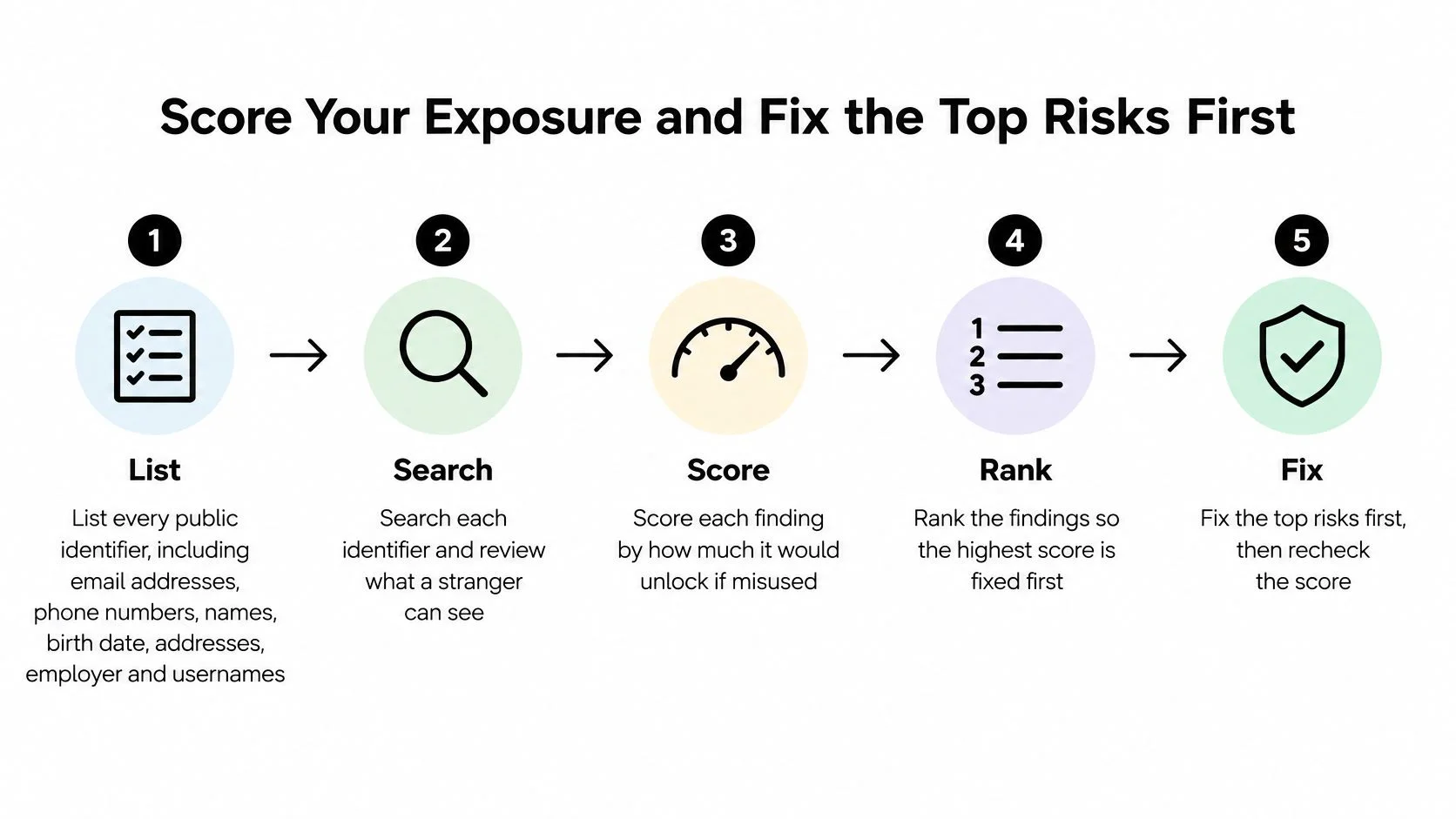
- Inventory your identifiers. List email addresses, phone numbers, names, birth date, addresses, employer and usernames. Include old details that still connect to active accounts.
- Search and verify matches. Review results yourself. Similar names, handles or contact details don't necessarily identify the same person; don't act on an unverified association.
- Check breach exposure. For each email, note whether a breach involved a password you used and whether that password remains active anywhere. Never submit a current password to an unfamiliar checking site.
- Name the attack path. Classify each finding as impersonation, account takeover, new-account fraud or recovery abuse. Write a concrete scenario rather than recording personal information exposed.
- Assign severity. Put usable government identifiers and live credentials near the top. Raise priority when the information could affect housing, employment or personal safety.
- Record account protections. Note unique passwords, MFA, recovery methods and active sessions. Check settings rather than relying on memory.
- Schedule reassessment. As a practical review cadence, recheck at least every 90 days, and sooner after a breach notice, suspicious login or meaningful life change. This is a recommended routine, not a guarantee or regulatory deadline.
Don't stop at the first search result or score the account once and forget it. A finding becomes actionable when you know what to change and how to verify the change.
The visual gives a compact version of the workflow.
Record enough detail to act
Residual-risk register fields
| Register Field | What to Record | Example Entry |
|---|---|---|
| Exposure | The identifier or data found | Email address in a recent breach notice |
| Attack scenario | How it could be misused | Password reuse on a banking app |
| Affected account | Service or process at risk | Primary email account |
| Control coverage | Protections already in place | Unique password, no MFA |
| Detection signal | How misuse would be noticed | Login alert from an unknown device |
| Remediation owner | Who acts on the item | You |
| Reassessment date | When to recheck | After remediation and at the next scheduled review |
Use separate entries where the same exposure affects different accounts. A banking password-reuse scenario and an unprotected email account need distinct checks, even if the same breach prompted both discoveries.
Repair access before tidying profiles
Start by securing email and banking, preferably from a trusted device. Review unfamiliar sessions, recovery destinations and connected applications, then revoke access you don't recognize.
Next, replace every breached password still in use. Remove publicly posted government identifiers and birth dates, then secure phone and backup-email recovery methods. Finish by reviewing job, dating and gaming profiles for unnecessary information.
At Digital Footprint Check, our process is to search a username or email, review potential matches, then act using step-by-step guides. Our continuous breach and dark-web monitoring alerts users to potential identity-theft risks; each relevant alert should update the register rather than sit unread.
No service can guarantee absolute security. The objective is lower remaining risk, with evidence that your most important controls work.
For an initial discovery pass, run a free digital-footprint check, compare the results with your register and verify every potential match before acting.
Risk Level Lookup
Use the highest unresolved risk to set urgency. Don't average a critical exposure together with harmless public information, because that would make the overall result look safer without removing the dangerous access route.
The lookup below is a practical triage framework, not a prediction of your probability of becoming a victim. Its timing recommendations help organize work; evidence of active misuse requires an immediate response regardless of the original rating.
| Risk Level | Decision Rule | Response |
|---|---|---|
| Critical | Any usable critical exposure remains unresolved | Fix today; escalate active fraud to the affected institution |
| High | Several high-severity exposures remain open | Fix this week, prioritizing direct access to valuable accounts |
| Medium | Only medium exposures remain, with sensitive access protected | Monitor at the scheduled 90-day check |
| Safety override | Exposure creates a credible physical-safety threat | Seek appropriate safety support before making visible changes |
Apply judgment rather than counting matches
Say a check finds an old gaming handle, a public resume and a current email password in breach material. The password determines immediate urgency. Removing the gaming handle first would improve privacy without addressing the most direct access risk.
A different person might have no exposed passwords but discover a current address associated with an abusive former partner's searches or threats. That person's priority is safety planning, not improving a generic account-security score.
A smaller footprint isn't automatically a safer footprint. Prioritize the information someone can use against you.
Downgrade a finding only after checking the relevant protection. Confirm that the old password no longer works, the recovery destination belongs to you or the public listing is no longer accessible at its original location.
Keep uncertain findings marked as unverified rather than treating them as established identity theft. If you find unauthorized transactions, unfamiliar account openings or changed recovery details, move from preventive assessment to incident response: contact the affected institution through a trusted channel, preserve records and dispute unauthorized activity.
Your final rating should describe what remains exploitable, not how many searches you've completed.
Digital Footprint Check helps you discover publicly accessible profiles, breach exposure and other information that can inform your identity theft risk assessment. Visit Digital Footprint Check to investigate your online footprint, review potential matches and turn verified findings into a prioritized protection plan.