· Digital Footprint Check · Content Marketing · 12 min read
How Do You Reverse Lookup a Phone Number Safely in 2026
Learn how do you reverse lookup a phone number safely, which free methods work, how to judge matches, and how to protect your privacy.
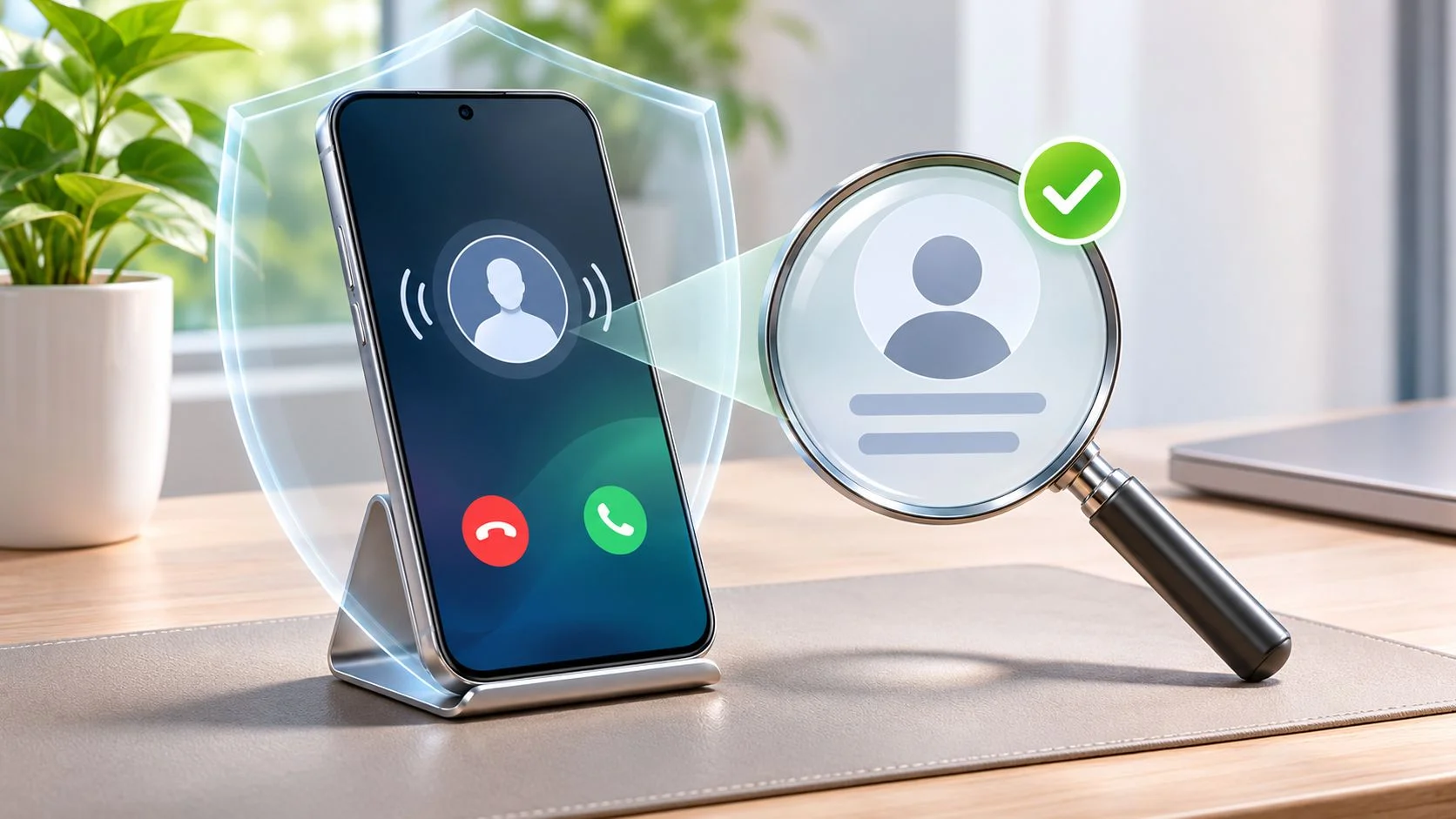
Your phone rings, and the caller says there's a problem with your bank account, delivery, or gaming login. Or someone you've met on a dating app sends a number that doesn't quite fit their story. You want to check it without calling back, handing over personal details, or paying for a report that names the wrong person.
So, how do you reverse lookup a phone number safely? Start with the number's international format, search public sources, compare independent matches, and verify consequential claims through a separate channel. The distinction that matters most is simple: a reverse lookup shows what a number is linked to, not who is calling right now.
Reverse Phone Lookup Methods Compared
A reverse lookup starts from one number, and the method you choose determines what comes back. A search engine retrieves indexed pages, a carrier tool classifies the line, and a people-search service attempts to connect the number with personal records. Those are different tasks, not interchangeable levels of certainty.
Start with the question you need answered
If you want to know whether a contractor publishes the number on their website, you probably don't need a personal background report. If you're checking a suspicious message, reports describing the same payment demand may be more useful than an associated name.
Reverse phone lookup methods and what each one returns
| Method | What It Can Show | Typical Cost | Main Limit |
|---|---|---|---|
| Exact-number search in quotes | Public posts, listings and scam reports that are indexed | Free | Covers only indexed pages |
| Crowd-sourced spam databases | Spam or scam labels added by other users | Often free | Labels can be wrong or malicious |
| Business directories and official websites | The number an organization publishes | Free | Shows the listed number, not the caller |
| Carrier or line-type lookup | Mobile, fixed-line, VoIP, toll-free or premium-rate | Free basic checks or paid detailed results | Usually doesn't reveal an owner's name |
| Paid people-search reports | Names, addresses and linked profiles | Usually paid | Stale or merged records are common |
Use Google or Bing to search the complete number in quotation marks. Open the result rather than trusting the snippet, and check whether the number appears in the actual page content. A removed listing or an unrelated string of digits isn't useful corroboration.
Crowd-sourced tools can help you recognize a reported script, such as someone demanding payment for a missed delivery. Read the descriptions, not just the warning badge. A label without context gives you little basis for deciding what happened.
When another tool adds value
For international numbers, BubblyPhone offers a resource to find who called you abroad. Treat its output as a starting point for checking international associations, not as authentication of the person speaking.
A curated collection of free OSINT tools can also help you choose a tool for the specific question instead of submitting the number to every site you encounter.
Free methods mainly help establish business associations and reported abuse. Paid reports attempt broader identity resolution, which can add leads but also expose unrelated people's information. Before paying, check what the report promises, whether it identifies its sources, and whether the purchase creates a subscription.
Practical rule: Start free. Move to a paid report only when a clear, legitimate purpose justifies both the expense and the privacy cost.
How to Run a Reverse Lookup Step by Step
Keep a private working note before you begin. Separate what the caller claimed from what you find, so an early assumption doesn't become the conclusion.
Prepare and search the number
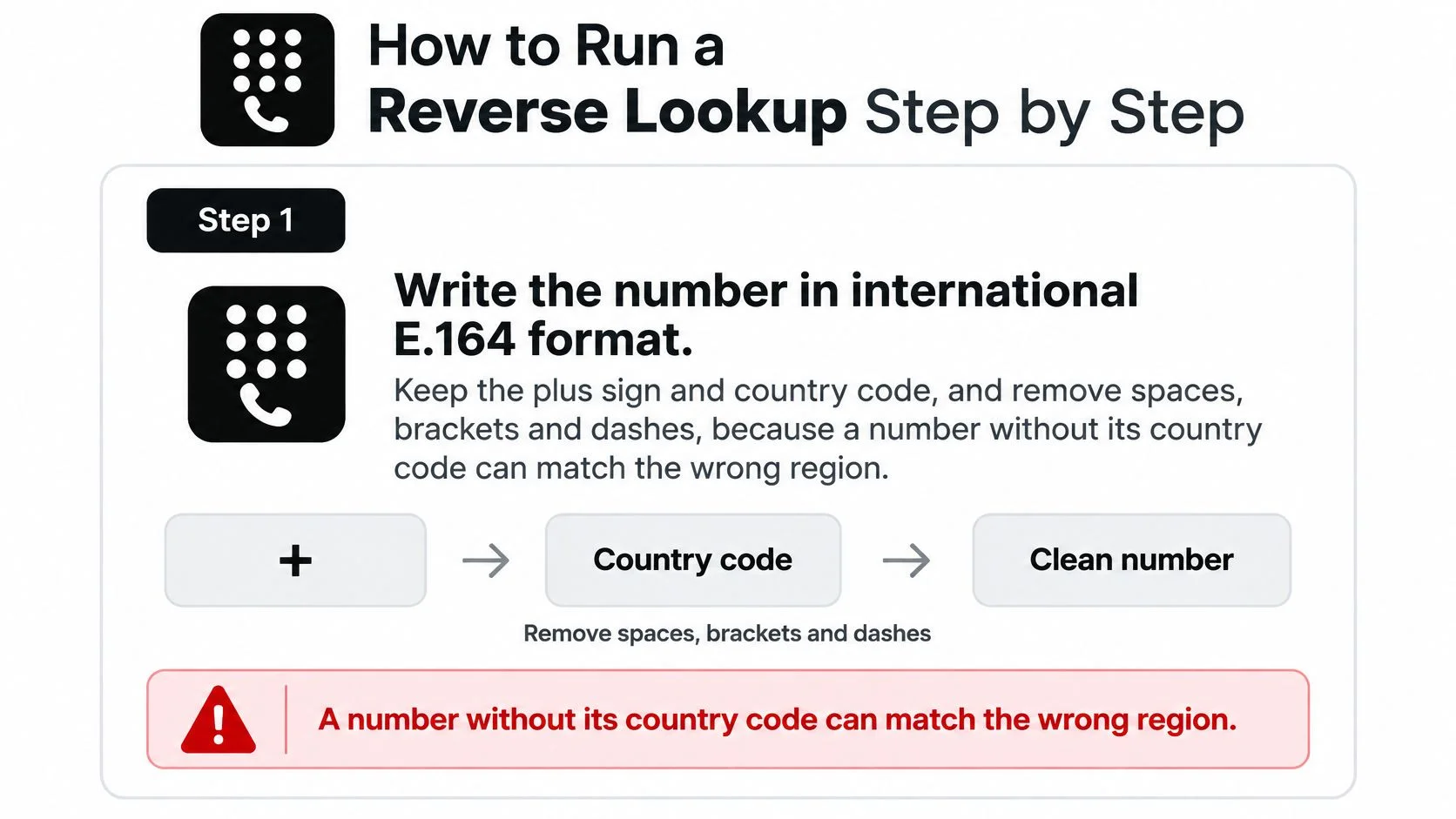
International formatting prevents avoidable mismatches. Keep this normalization pattern beside your search:
-
Write the number in international format. Keep the plus sign and country code, and remove spaces, brackets, and dashes from your working copy. The international numbering framework, ITU-T Recommendation E.164, provides the foundation for interpreting the country code and national number structure.
-
Identify the numbering region and line type. Check whether the number is mobile, fixed-line, VoIP, toll-free, or premium-rate using a numbering-plan or carrier lookup. Treat this as routing context: a country code doesn't establish the caller's physical location, and a VoIP classification doesn't establish dishonesty.
-
Search the exact number in alternative formats. Try its international form, its locally formatted form, and a version with the spacing commonly used in that country. Record which representation produced each result so you can reproduce the search.
-
Check the claimed organization's own records. Look for the number on its official contact page and in relevant business directories. Open the organization's site independently rather than following a link in the suspicious message.
-
Look for independent agreement. Compare unrelated sources that associate the exact number with the same business or person, paying attention to publication and update dates. Several websites copying the same directory entry count as one evidence trail, not independent confirmation.
-
Record provenance and confidence. Note when you searched, where each result appeared, and whether the association looks current. Preserve only the information needed to answer your question, rather than downloading every available personal record.
-
Reserve consequential conclusions for separate verification. If a result could affect money, employment, safety, or a relationship, leave it unconfirmed until you use an independent channel. Don't contact a suspected private owner because a report supplied their address or another number.
Keep a usable evidence record
Numbers can be ported, reassigned, disconnected, or used through virtual business systems. That's why a technically valid number and a plausible name still need evidence connecting them at the relevant time.
Use this compact record:
| Field | What to record |
|---|---|
| Displayed number | International-format number from the call log |
| Linked entity | Business or person named by the sources, marked as unconfirmed |
| Line type | Tool result, or unknown |
| Evidence date | Listing date and your query time |
| Confidence | Low, medium, or high, with a brief reason |
For a broader evidence-handling workflow, use our guide to how to use OSINT. Keep observations distinct from interpretations, especially when you're comparing profiles or business records.
This video offers an additional walkthrough to accompany the search process:
Judging Whether a Match Is Reliable
A lookup identifies associations with the number presented or historically attached to an account. It doesn't authenticate the current caller. A convincing business match can therefore be accurate and still provide no assurance about the incoming call.
The FCC's caller-ID spoofing advisory reported more than 52,000 consumer complaints about caller-ID spoofing in 2018, and cited findings that more than 80% of scam callers displayed a familiar-looking number, while one in three scam calls was answered because the number appeared familiar. Familiarity is precisely what an impersonator wants you to rely on.
Score the association, not the person
Use a qualitative scoring habit rather than inventing a precise probability. Ask whether each piece of evidence strengthens the number-to-entity association, weakens it, or leaves the question unresolved.
Signals that raise or lower confidence in a lookup match
| Signal | Effect on Confidence | Why It Matters |
|---|---|---|
| Exact match in two or more unrelated sources | Raises | Independent sources reduce the chance of one bad record |
| Consistent geography and matching dates | Raises | The location and timing fit the claim being checked |
| Crowd-sourced spam label with no other support | Lowers | Labels reflect reports, not verified ownership |
| Stale directory listing | Lowers | The number may have been reassigned since the listing |
| VoIP or toll-free line | Lowers confidence in a personal identity inference | Accessible or shared business services aren't reliable identifiers of a particular person |
| Name that appears only as a caller-ID label | Lowers | A displayed label isn't authenticated identity evidence |
The VoIP and toll-free distinction needs care. Legitimate businesses use both, so don't downgrade a business merely for using them. Lower your confidence only when someone treats the line type as proof that a specific individual owns or operates the number.
Keep the displayed number and attributed entity in separate fields. The FCC unwanted-call complaint dataset distinguishes the caller-ID number from the advertiser's business number, a useful reminder that they can be different.
Caller authentication doesn't eliminate this gap. The FCC's caller-ID authentication recommendation describes STIR/SHAKEN as part of a broader anti-robocall effort: it helps establish authorized use of a number on IP calls, not that the speaker is the person or organization claimed.
A name with no date is a lead, not a finding. Even a current association isn't proof of who placed a particular call.
Test both kinds of mistake
A false positive means you attach the wrong identity to the number. A false negative means you find nothing and mistakenly conclude there's no relevant association.
Search alternative number formats to test whether indexing caused a missed result. Compare dates and geography to test whether an apparently good result concerns an old subscriber. Don't interpret a blank report as a clean bill of health.
The principles behind open-source intelligence matter here: trace information to its origin, consider competing explanations, and make your conclusion no stronger than your evidence.
Apply the same standard to uncomfortable cases
A dating contact's number points to someone else. Say a people-search report names an uninvolved person in another city. That could indicate a misleading dating profile, but it could also be a stale record or a reassigned number. Don't message the named person, publish the report, or accuse your contact on that basis.
Instead, keep dating app verification on the platform, decline money requests, and evaluate whether the person's behavior and independently checkable claims remain consistent. A phone association alone can't establish catfishing or infidelity.
A debt collector uses a recycled line. An old directory result may name a former subscriber rather than the current business. Neither that mismatch nor a plausible business listing settles whether the debt is legitimate. Request the relevant documentation and verify the organization independently before discussing payment.
Escalate uncertainty rather than forcing a verdict:
- Conflicting identities: Keep the attribution unresolved until you can explain the disagreement.
- Possible reassignment: Require current evidence instead of relying on an undated listing.
- High-impact decisions: Don't turn a lookup into an employment, credit, safety, or relationship allegation.
- Threats or extortion: Preserve messages and seek appropriate platform, organizational, or law-enforcement assistance rather than pursuing a suspected owner.
Protecting Your Privacy While You Search
A legitimate question doesn't justify collecting everything a site will sell you. Checking whether a contractor publishes a contact number is different from obtaining their home address, relatives' names, and personal profiles.
The European data-broker market study identifies low success rates in reverse phone lookup and related identity-linking uses, alongside re-identification risks from combining datasets. More linked information can create more exposure without creating a more accurate match.
Set the boundary before searching
A failed search doesn't mean someone has no online footprint. A successful search can still surface a previous subscriber or merge information about different people. Treat both outcomes cautiously.
Write down the purpose in plain language, such as confirming a contractor before paying a deposit or checking a marketplace buyer before meeting. Stop when you've answered that question.
- Minimize collection: Keep the relevant business listing, not a bundle of unrelated personal records.
- Keep results private: Don't post names, addresses, or screenshots in public groups to crowdsource an accusation.
- Avoid unnecessary uploads: Don't grant an app access to your contacts merely to investigate a single number.
- Delete finished notes: Remove working material once the purpose is settled, unless you need to preserve evidence of an incident.
Privacy boundary: Investigate a claim or a risk. Don't use the search to build a dossier on someone.
Protect reputations as well as accounts
Harassment, stalking, doxxing, and discriminatory screening aren't legitimate extensions of a lookup. Employers should never make a standalone hiring decision from a phone-number match. An inaccurate association can damage job prospects without giving the applicant a meaningful chance to correct it.
For workplace context, Paradigm International Inc.’s guide to employee privacy rights for US employers is a useful starting point for reviewing privacy boundaries, not a substitute for advice about a specific screening process.
If you search your own number, inspect each listing separately. Our explanation of what data-broker sites are can help you understand why different sites may hold different versions of your information.
Use each site's correction or deletion procedure, identify the inaccurate association, and retain a private record of your request. Supply only the verification information necessary for that procedure. Apply the same approach when an old gaming profile or professional account exposes contact details you no longer want public.
Confirm the Number Before You Reply
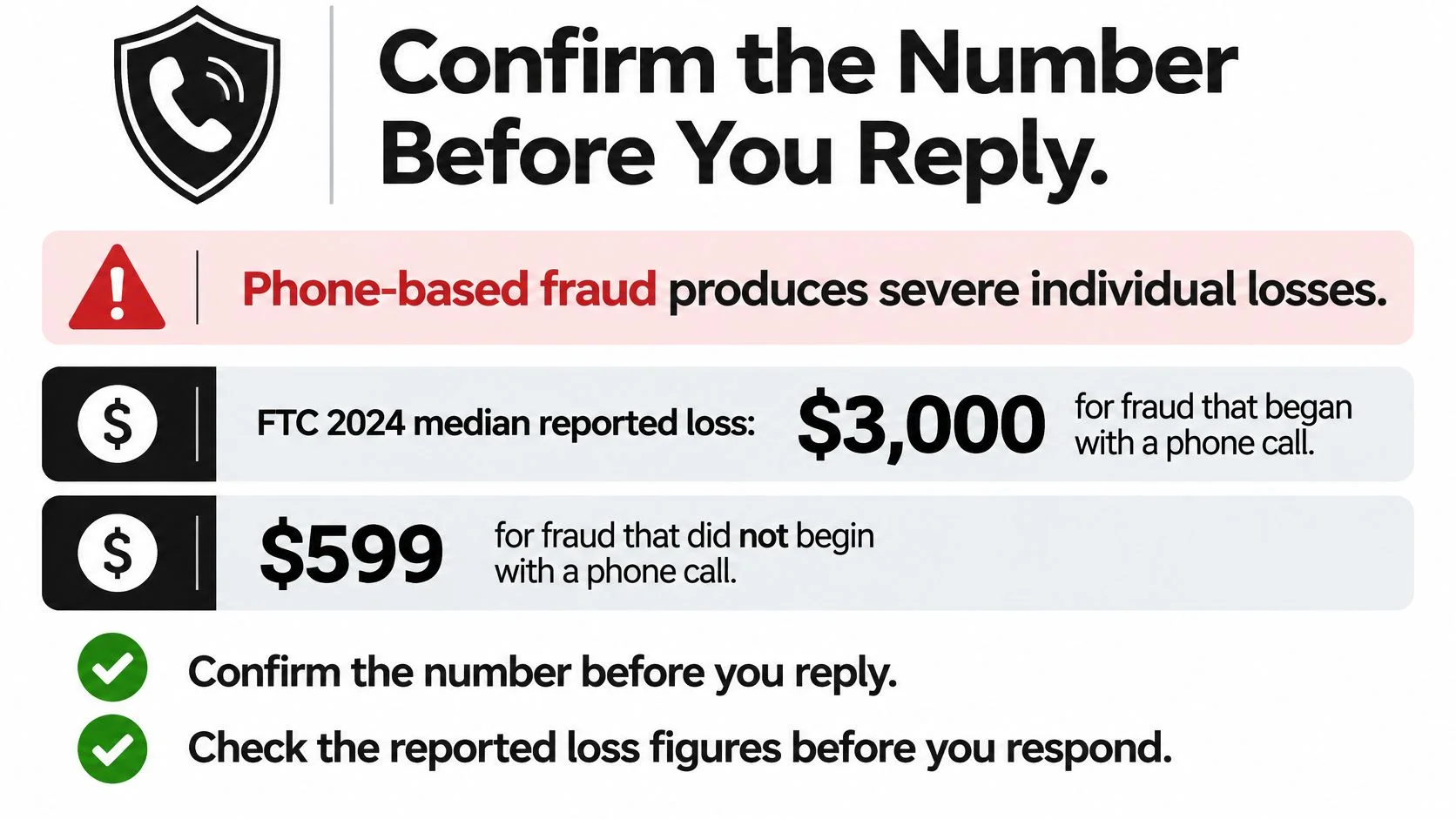
The financial stakes justify slowing down. In its analysis of fraud reported for 2024, the FTC's older-adults report found a median reported individual loss of $3,000 for fraud originating with a phone call, compared with $599 for fraud originating on social media.
Keep the comparison precise: the second figure concerns social-media-originated fraud, not every kind of non-phone fraud. The practical response is to verify before sharing anything valuable.
Use this visual reminder alongside the verification checklist:
Replace urgency with an independent route
- End a pressured call. You don't need to resolve an alleged account emergency while the caller controls the conversation.
- Find the organization's published number. Use its official website, a recent statement, or the app you already use.
- Initiate a fresh contact. Call that independently obtained number, not the incoming number or one supplied in the message.
- Withhold secrets and payment details. Never share one-time codes, passwords, or payment details during the suspicious call.
If the caller claims your gaming account has been compromised, open the platform's app or support pages yourself. If a supposed romantic partner needs an emergency transfer, pause the transaction rather than treating a matching name as permission to pay.
Our guide to numbers not to call provides additional context for deciding when returning an unfamiliar call is the wrong next step.
Check your broader exposure separately
A suspicious number may prompt you to review your own online identity. Digital Footprint Check works in three steps: search a username or email, review potential matches, then act using step-by-step guides. Start with a free digital footprint check; the free preview has limited features, while paid options provide fuller checks.
Our pay-as-you-go packs cost $5 for 2 searches, $10 for 5 searches, and $30 for 20 searches. We don't remove information for you; our guides explain how to contact sites and request changes yourself.
Keep that exposure review separate from caller authentication. A reverse lookup can surface a warning sign or a useful listing, but it isn't a verdict on an incoming call. Confirm through an official channel before you respond.
Digital Footprint Check helps you review publicly discoverable information linked to your username or email and use practical guides to address unwanted exposure. Visit Digital Footprint Check to review potential matches, prioritize inaccurate or sensitive listings, and take the next steps yourself.