· Digital Footprint Check · Content Marketing · 15 min read
What Is Dark Web Monitoring and Why It Matters
What is dark web monitoring? See what alerts can uncover, what a clean result misses, and how to stop identity theft early.

Dark web monitoring searches hidden networks and criminal marketplaces for exposed credentials and identity data, then alerts you to a possible risk. An alert can shorten the time between exposure and action, but it does not certify that your accounts or identity are safe. A match on your email address is a lead, not proof that someone has used your information.
The issue often surfaces when a bank sends a warning or a game store asks you to reset a password after a breach. A password you set years ago suddenly needs attention, and it is easy to picture a stranger holding a file with your name on it.
Often, what turns up is a bulk text file of exposed records. Your entry may be old, partly inaccurate, or copied from an earlier dump. Treat the alert as a reason to check the details and secure any affected accounts, rather than as proof of identity theft.
What Dark Web Monitoring Means for You
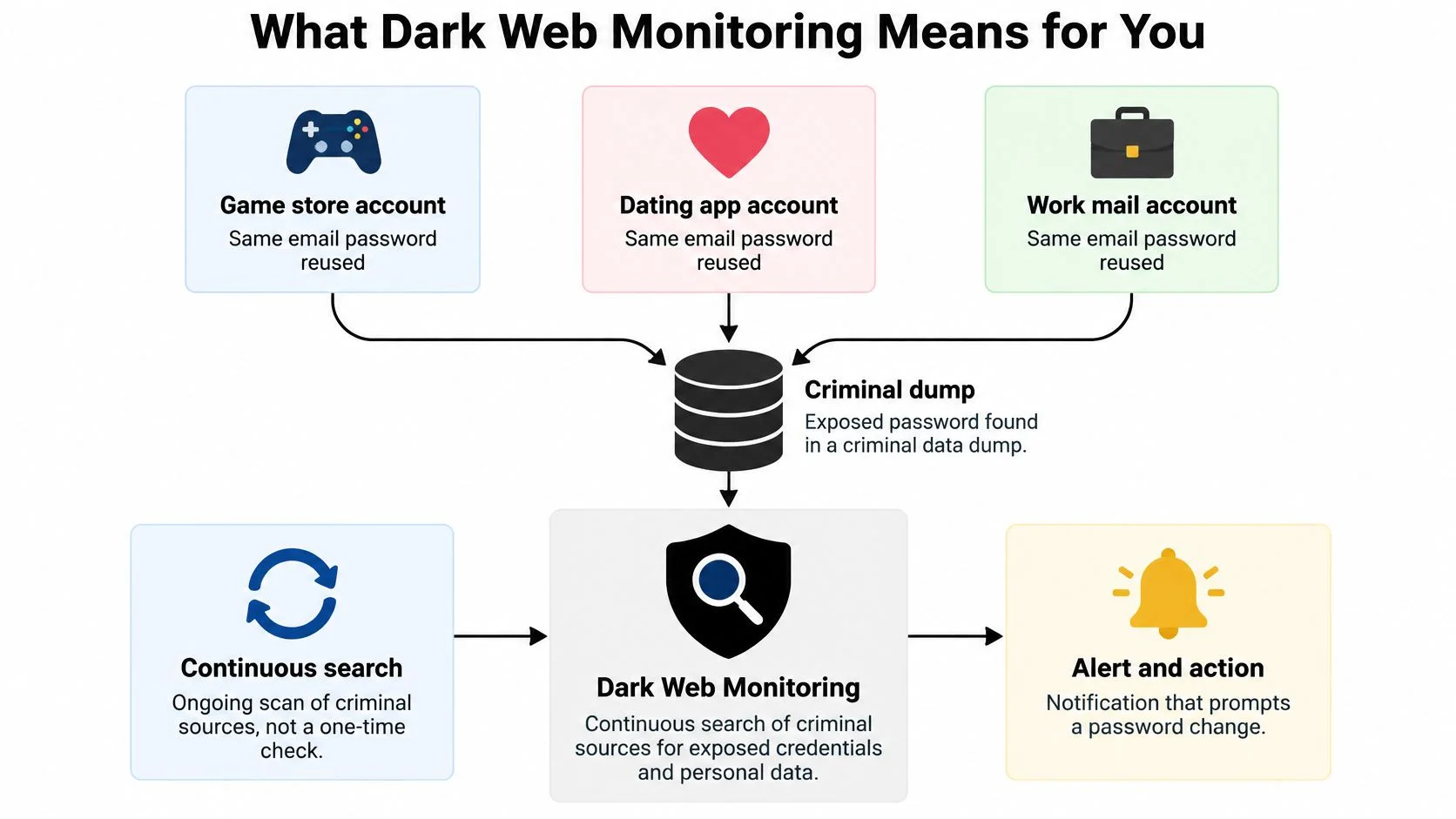
Say you used one password in three places: a game store where you bought a headset, a dating app you open on Sundays, and the work mailbox that resets everything else. You changed none of them, because nothing bad happened. Then a breach at the game store drops that email and password into a criminal dump, and the same string now opens three doors.
Dark web monitoring is the continuous process of searching restricted, anonymity-oriented networks and criminal marketplaces for exposed information such as usernames, passwords, credentials, identity records, and payment-card data, as the Congressional Research Service sets out in its dark web primer. The word continuous carries the weight. A one-time lookup is a photograph. Monitoring is the camera left running.
Three layers, one locked room
Picture a library. The surface web is the open shelves, indexed and browsable. The deep web is the staff-only stacks, meaning your inbox, your bank portal, the company intranet, all behind a login. The dark web is a locked room at the back that generally requires special software, such as Tor or I2P, to enter.
Tor started as a research project. The U.S. Naval Research Laboratory developed onion routing for anonymous communications, and Tor was released publicly in 2002. That history explains the tool, not the crime. Nobody counts the room's contents reliably, because ordinary search engines exclude hidden services and operators change addresses or shut sites down fast.
A monitoring alert is an early-warning smoke alarm. It isn't proof a fire has started, and it's never a promise that anyone can delete your data from a criminal server.
In practice a service watches identifiers such as your email address, usernames, domains, or organization name, hunts for matches in breach repositories and underground discussions, then tells you or your employer. The useful output is a short list of things to change, not a verdict.
The next section turns that short list into a table you can work through, row by row, with a first action attached to each type of match.
Data a Dark Web Monitor Can Surface
| Exposed data | Typical source | What a match means | First action |
|---|---|---|---|
| Email and password | Breach dump or forum | The secret may be reused on other accounts, but a match isn't proof of current misuse | Change the password and turn on multifactor authentication |
| Social Security number | Identity marketplace listing | Higher identity-theft risk, not proof a return or loan was filed | Freeze credit and review credit and tax accounts |
| Payment card | Card shop listing | Card data may be sold even when the underlying dump is stale | Replace the card and review recent charges |
| Session cookie | Infostealer log | An attacker may impersonate the session without ever typing the password | Sign out all sessions and check the device for malware |
| Username or phone number | Forum post or paste site | Can link gaming, dating, and social accounts together | Set a unique password on each linked account |
| Company domain or brand | Leak site or underground chatter | May indicate employee credentials or a planned attack | Confirm the account is active and revoke access |
Read that grid as a triage sheet, because the question a match raises is never "am I hacked". It's "how fast does this need me?" A card row is a phone call today. A brand mention is a conversation with whoever owns identity access at work.
The volume behind those rows is why the subject exists at all. A research project documented in an academic National Science Foundation repository systematically identified and monitored 1,212,004,819 exposed personally identifiable information records across dark web and surface web sources. Inside that collection sat approximately 5.8 million stolen Social Security numbers, 845,000 stolen credit or debit cards, and 1.2 billion stolen account credentials, with the credential dataset covering breaches collected between December 2017 and April 2020.
How to read a row without panicking
A match tells you an email address, password, card, or identity attribute appeared in a dump, forum, marketplace listing, or related repository. It doesn't establish that anyone is using it right now. Dumps get copied, sold on, merged, mislabeled, and re-uploaded with new filenames years later.
That's why good prioritization beats panic. Reset reused passwords first, then enable multifactor authentication on anything that can reset the rest. Review account-recovery details, because a changed recovery address is how a thief keeps a foothold after your password change. If you're curious about the categories of data that make these rows so damaging, our guide on what PII means breaks down why a single identifier can be worth more to a criminal than a card number.
Practical rule: match your own email addresses, phone numbers, usernames, and cards against the rows above, and let the row decide the urgency rather than the email subject line.
For a business, an alert on employee credentials or customer records should open an incident-response and privacy review, not just a password reset ticket.
How Dark Web Monitoring Finds a Match
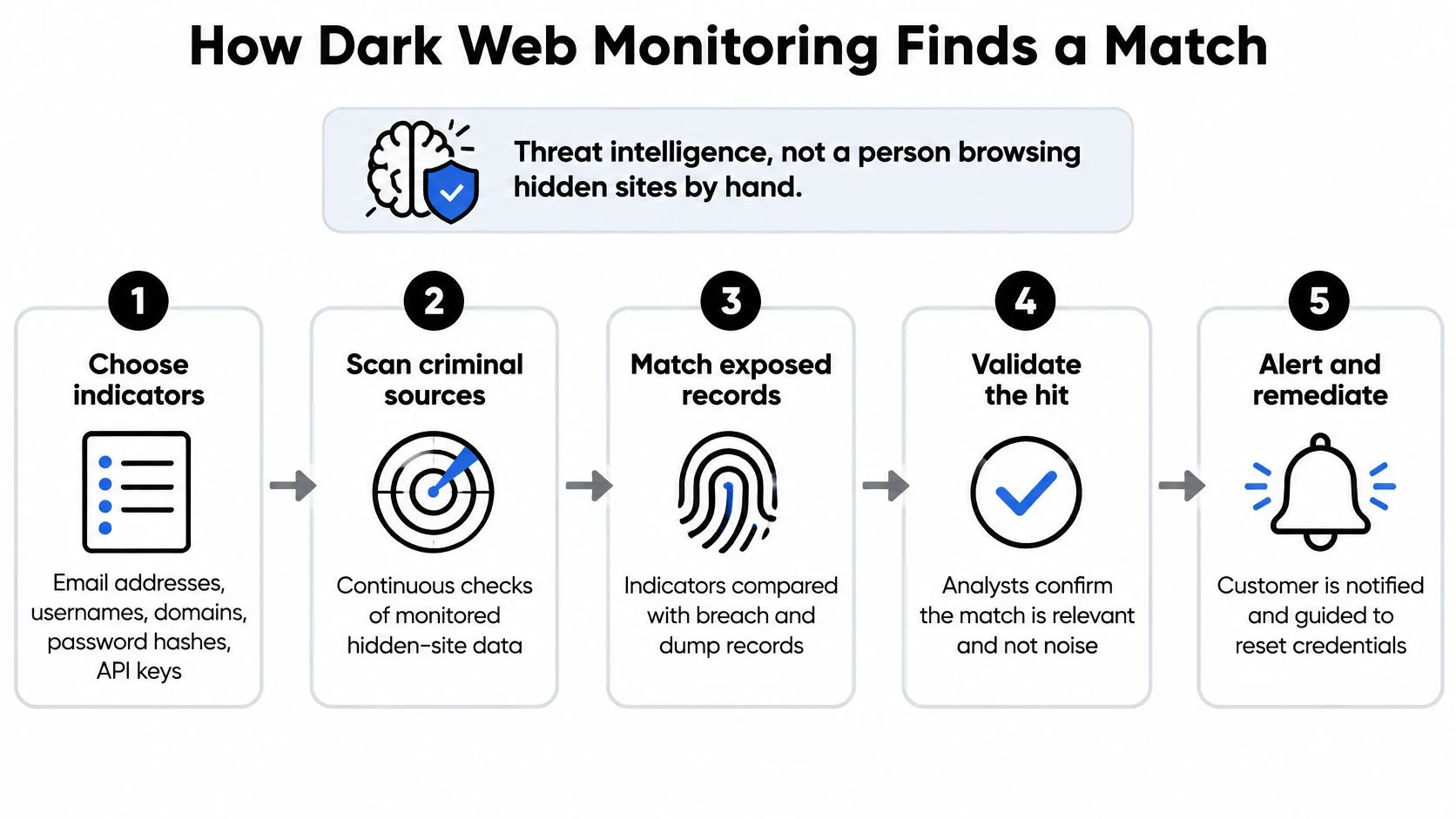
A reused email address can appear in a leaked database, while a similar address belongs to someone else. Monitoring systems compare indicators against collected records, then assess whether a match is relevant. The process is closer to sorting and checking records than to someone manually searching hidden sites.
Dark web monitoring can gather information from dark web locations, leak sites, forums, and related sources to identify exposed credentials and other signs of exposure. That description stands on its own; CISA's vulnerability assessment fact sheet concerns vulnerability assessments, not a definition of dark web monitoring.
A monitoring service works through a series of stages. Each one helps turn a possible match into an alert that has useful context.
- Choose indicators. Email addresses, usernames, domains, password hashes, API keys, and brand names are prepared as items to watch.
- Collect passively. Crawlers and data feeds gather material from dark web locations, leak sites, forums, and related repositories without announcing themselves.
- Match to an identity. Indicators are compared with breach and dump records to check whether a hit appears to concern you or someone with a similar address.
- Deduplicate and score. Repeated copies are grouped into one finding, and the system assigns a confidence value.
- Validate. An analyst or automated process checks whether the match is relevant rather than a coincidental string.
- Alert with context. A useful notification can include the source date, first-seen and last-seen timestamps, affected identity, breach context, credential type, and confidence level.
Why some beeps deserve a dig
A metal detector can beep for a coin or a bottle cap. Scoring helps distinguish the more relevant signal. A hit on an old dump tied to an email address you no longer use may deserve less attention than a hit involving a session cookie for a work account you still use.
Dark-web evaluation can also examine chatter or mentions about a target. A rise in activity may signal increased concern, but a mention alone does not establish that an attack will happen. Pairing this kind of analysis with passive checks for exposed credentials, insecure devices, suspected vulnerabilities, and domain impersonation can give organizations more context than monitoring alone.
Here is a video explaining the mechanics of a monitoring product.
Collected records can be incomplete, duplicated, stale, or fabricated, so an alert is a reason to investigate, not proof that an account is currently exploitable. Organizations can compare a match with their identity inventory and authentication logs. Individuals can check whether the email is theirs, when the record appeared, and whether the exposed item is a password, cookie, or card. A data breach monitoring service can help users follow potential exposures and decide what to check next.
What a Clean Monitoring Result Really Means
The most misleading sentence in this field is "you weren't found, so you're fine". A clean result means no matching exposure was found in the sources checked. It doesn't mean the account is safe, and it doesn't mean no record of you exists somewhere else.
Monitoring isn't the same as complete breach detection. Plenty of damaging data stays in closed forums, private channels, and infostealer marketplaces, or never gets published at all. A 2025 review of government-related credential exposure cautioned that publicly discoverable leaks represent only a subset of compromised accounts, because closed criminal communities aren't visible to ordinary monitoring.
| Common belief | What is actually true |
|---|---|
| A monitor sees every criminal database | Closed forums, private chats, and some infostealer markets stay invisible |
| No alert means the account is safe | It means no match was found in the sources checked |
| Any hit proves fraud is happening now | A hit can be stale, duplicated, incomplete, or fabricated |
| Deleting a leak removes the risk | Copies, reused passwords, and altered usernames can remain in circulation |
| Monitoring replaces multifactor authentication | It only shortens the time between exposure and action |
Where false confidence comes from
Two errors run in opposite directions, and both cost people money. False negatives appear when your data circulates under an altered username, a recycled password you no longer recognize, or an incomplete record tied to a different address. False alarms appear when a monitoring feed surfaces a decade-old dump with a dramatic headline attached.
Exposed credentials can stay useful to a stranger long after a listing disappears from view. A database taken down on Monday has been downloaded by Tuesday, and the buyer doesn't care that the original page is gone.
Monitoring can reduce uncertainty without eliminating it. Its value is a shorter gap between exposure and response, not a certificate that no compromise exists.
Build the fallback layer yourself: unique passwords per account, phishing-resistant multifactor authentication wherever it's offered, a habit of signing out old sessions, a malware scan when something feels wrong, and credit or account alerts that catch misuse the monitoring can't see. A narrow email-and-password search will also miss public profiles, reused usernames, and personal details that shape how a recruiter, a date, or a stranger reads you. If someone asks what is dark web monitoring after reading that, the honest answer is that it's a search, not a shield.
How Exposed Data Becomes Identity Theft
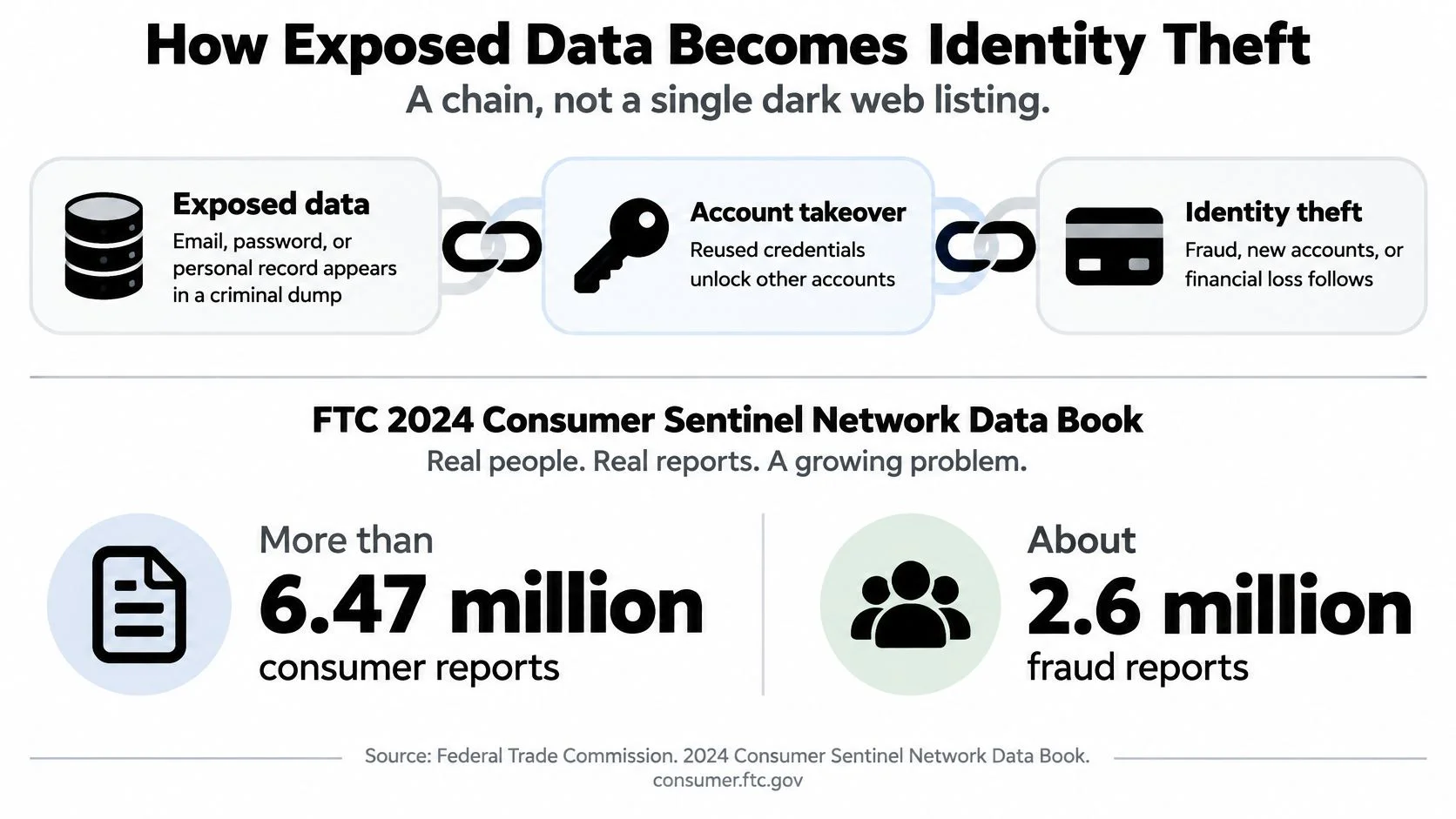
Identity theft is a chain, not a single listing. The U.S. Federal Trade Commission's 2024 Consumer Sentinel Network Data Book recorded more than 6.47 million consumer reports, with fraud at roughly 2.6 million reports, or 40% of the total, and identity theft at about 1.1 million reports, or 18%, according to the FTC Consumer Sentinel data book. Of the 1,135,291 identity-theft reports, 86% included the consumer's age.
None of those numbers counts dark web listings, and they shouldn't be read that way. They measure how much fraud and identity theft people report, which is the damage that compromised personal data feeds.
Three chains worth following
A gamer keeps a store password from a decade ago and reuses it on the mailbox that resets banking and social accounts. The store suffers a breach, the credentials land in a log, and the mailbox becomes reachable. Nothing about the gamer looked careless at the time.
A dating profile gets taken over after a reused password appears in a dump, and the thief messages matches asking for money. A home city listed on the profile turns an annoyance into a personal-safety problem, because someone now knows roughly where that person lives.
A job seeker's old work address shows up beside a 2018 breach. No recruiter verifies whether the password was unique before wondering about judgment. Reputation damage arrives before any facts do.
Why the chain keeps getting new links
Malware does much of the harvesting now. The 2025 Verizon Data Breach Investigations Report analyzed more than 22,000 security incidents and 12,195 confirmed breaches across 139 countries. Credential abuse remained the most common initial access vector, vulnerability exploitation accounted for 20% of breaches, and third-party involvement doubled from 15% to 30%, which is exactly why a breach at one service exposes an identifier you also use at work, in a shop, in a game, or on a dating app.
Verizon also found that 30% of compromised systems identified in credential logs were enterprise-licensed devices, and 46% of systems holding corporate logins were unmanaged devices carrying personal and business credentials together. One home laptop can expose both halves of a life.
Circulation is the other half of the story. SpyCloud's 2025 identity exposure report recorded the recapture of 53.3 billion distinct identity records in 2024, a 22% increase from 2023. The same firm reported 17.3 billion stolen session cookies circulating on the dark web in 2024, per SpyCloud's announcement. Cookies matter because they can impersonate a login without anyone typing a password, which is why a credential-stuffing attempt often starts with a stolen session rather than a stolen secret. Our explainer on how credential stuffing attacks work shows the sequence in detail.
Monitoring can reveal an indicator of exposure. Stopping or repairing identity theft needs account security, financial monitoring, credit protection, and reports to the right authorities.
How to Respond When Your Data Appears
The security value of monitoring is measured in time saved between exposure and action. Monitoring alone can't prevent account takeover, and CISA's ransomware guide treats compromised credentials as an initial-access vector, recommending credential-monitoring services that watch the dark web for exposed credentials.
Work the response in a fixed order, because skipping a step leaves a door open.
- Confirm the identity belongs to you. Check the address, username, or domain against your own accounts before you spend an hour on someone else's leak.
- Check whether the secret is still live. An old password on a deleted account is a history lesson. A session token, API key, or privileged login is an emergency.
- Revoke sessions and rotate the secret. Change the password, then end every signed-in session, because a thief holding a valid cookie stays inside after a password change.
- Turn on phishing-resistant multifactor authentication. NIST's Digital Identity Guidelines name authenticator theft as a threat and point to multifactor authenticators activated by a password or biometric, or a combination of authenticators including one of those.
- Review authentication logs before you relax. CISA highlights impossible-travel patterns, one IP address used across many accounts, unusual user agents, password spraying, dormant-account activity, and suspicious privileged use.
- Replace or freeze the financial item. A card gets replaced. A Social Security number gets a credit freeze and a look at tax and credit accounts.
- Report confirmed misuse. Tell the bank, then file at IdentityTheft.gov and follow the recovery plan it generates.
The chain you're trying to break
A leaked credential raises the chance of unauthorized access. Delay gives someone time to test that credential against a VPN, webmail, a cloud console, and the everyday apps tied to the same address. Fast revocation plus log review breaks the chain before privilege escalation or data theft.
For managers: measure mean time to validate an alert, mean time to revoke the exposed credential, the share of findings tied to an active identity, the false-positive rate, and confirmed incidents contained. If you can't report those five figures, you don't have a program yet.
For an individual, translate the same measures into something you can finish today: change the exposed password, open the session list and sign out everything you don't recognize, and write down which other accounts reused that secret so you can work down the list.
Urgency climbs when the affected account can reset others, or when it holds financial, work, dating, family, or gaming access. A username and password in a leak is only the detection stage. The same-day response is still to change the secret and strengthen authentication, not to treat the alert as proof of current misuse. Our step-by-step guide on what to do after a data breach walks through the order when several accounts are involved.
Scan Your Footprint Before the Next Alert
A job application, dating profile, or gaming account may use the same email address as an older account. Checking that identifier can help you spot where your information appears and respond sooner if a match points to an exposure.
Digital Footprint Check works in three steps: search a username or email, review potential matches, then use step-by-step guides to take action. Its continuous monitoring of data breaches and dark web activity alerts users to potential identity-theft risks. The service has generated 50,000+ reports.
Start with a free check, then review each result before acting. A match is a lead to investigate, not proof that someone has accessed your account. If a reused password may be exposed, change it and review accounts tied to the same identifier, including gaming, dating, and work profiles.
A broader footprint check can also surface public profiles an employer, client, or stranger may see. The guide to how to check your digital footprint explains how to look for those traces. For small businesses, size cyber limits for builders discusses insurance limits, a separate consideration from finding and addressing exposed credentials.
A clean result is not a certificate of safety. It means no match appeared in the sources checked. The practical benefit is reducing the time between a possible exposure and your response, while remembering that each alert still needs review.