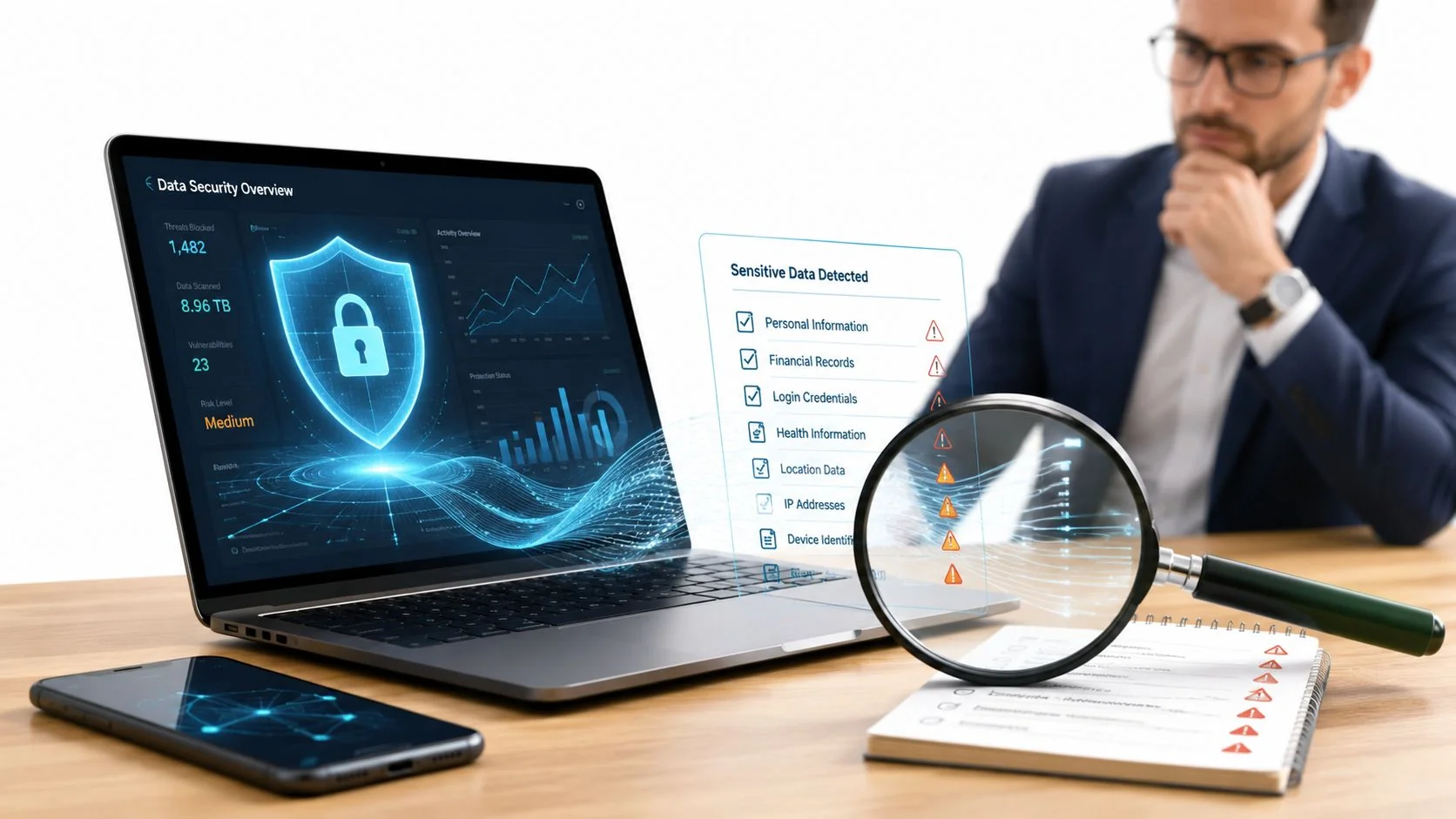
· Digital Footprint Check · Content Marketing · 15 min read
What Is Osint Used For? Identify Threats & Guard Data
Discover what is osint used for in 2026, from protecting identity to detecting fraud. Learn how OSINT works with real examples and enhance your security.

You've probably done OSINT already.
You meet someone on a dating app and search their name, photos, and username. You apply for a job and wonder what a recruiter might see if they search you. Your teenager starts gaming with a new online friend, so you check whether that profile shows up across other platforms. Those everyday checks all come from the same basic instinct: use public information to make a safer decision.
The professional term for that is OSINT, short for open source intelligence. It sounds technical, but the idea is simple. You gather information that's publicly and legally accessible, then connect it in a way that answers a real question. Is this person who they say they are? Is my private data too easy to find? Is this account a scam? Is my company exposed online?
Everyone Uses OSINT: You Just Might Not Know It Yet
A lot of people hear “intelligence” and picture spies, classified files, or advanced cyber tools. In practice, OSINT often starts with something ordinary: a search box, a social profile, a public record, or a breach notice. If you've ever checked a stranger's online footprint before meeting them, you've used a lightweight version of it.
That's why OSINT matters so much for regular people. It turns scattered clues into context. A dating profile by itself might look fine. A username reused across old forums, public posts, and inconsistent bios can tell a different story. A clean-looking resume might seem professional until you find public accounts that create a very different impression. If you've ever asked yourself what information is online about me, you're already asking an OSINT question.
From niche practice to everyday habit
OSINT didn't start as a mainstream consumer topic. Historically, it moved from a government and law-enforcement specialty into a mainstream business tool as the internet expanded, and that shift sped up as social media, public records, breach disclosures, and commercial databases became easier to search and cross-reference, as explained by CrowdStrike's overview of OSINT.
What changed wasn't human curiosity. What changed was the scale of public data.
Now a single person can leave traces across professional networks, gaming platforms, old forum accounts, wedding websites, real-estate listings, fundraising pages, code repositories, and social apps. None of that automatically means danger. But it does mean your digital footprint can say more about you than you intended.
Practical rule: OSINT isn't about snooping for its own sake. It's about using public clues to make better decisions before something goes wrong.
For personal safety, that might mean checking whether a new romantic interest has a consistent online identity. For job hunting, it might mean finding outdated or embarrassing public content before an employer does. For families, it might mean spotting where a child's username or photo appears in places it shouldn't.
That's the core “so what.” OSINT helps you reduce uncertainty.
What Is Open Source Intelligence Really
Open source intelligence means collecting and analyzing information from sources that are legally accessible to the public. The “open source” part doesn't mean software code. It means the information is open enough to be found without hacking, bypassing passwords, or tricking someone into handing over access.
A helpful way to think about it is this: OSINT is digital detective work.
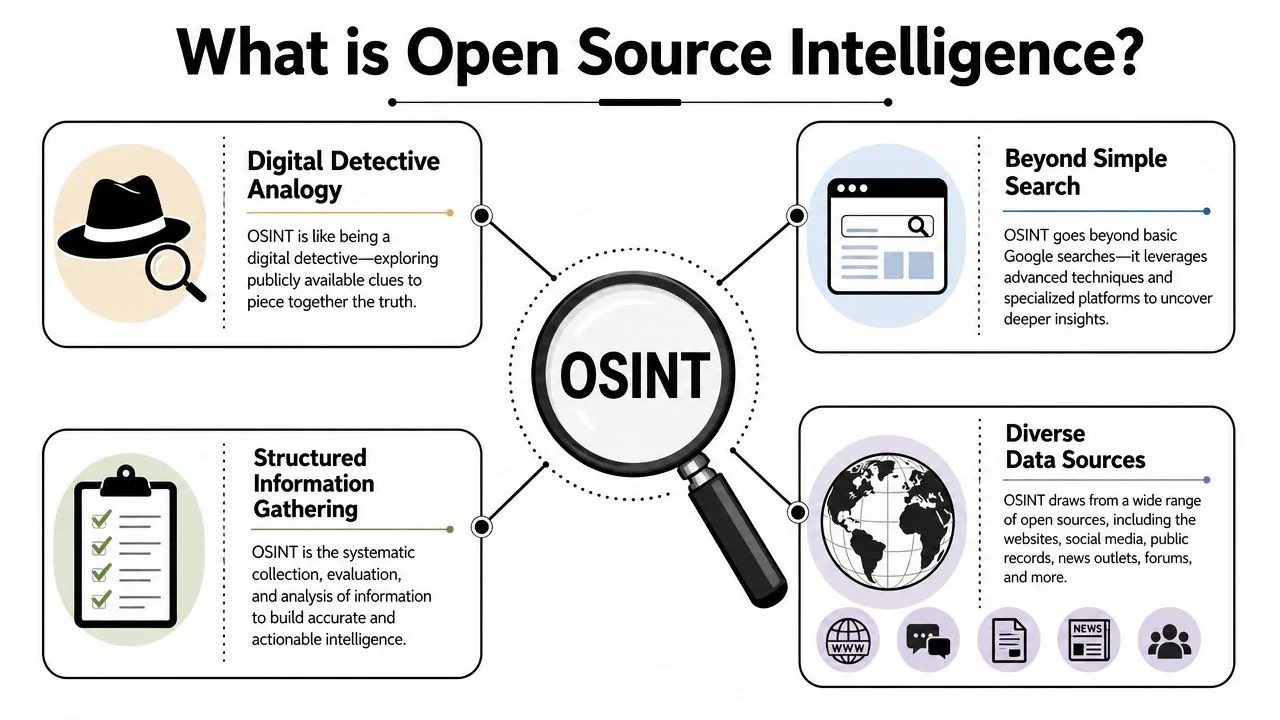
A detective doesn't just collect random facts. They ask a question, gather relevant clues, test whether those clues are reliable, and piece them together into a story that makes sense. OSINT works the same way online.
It's more than a Google search
Typing a name into Google is searching. OSINT starts when you move beyond simple searching and begin to verify, correlate, and interpret what you find. Tulane describes OSINT as structured investigations across legally accessible sources where analysts verify, correlate, and enrich raw data into actionable intelligence, using high-volume collection, source verification, and relationship mapping to reveal hidden accounts, behavioral links, and identity inconsistencies in its explanation of OSINT methods.
That's why two people can look at the same public information and reach very different conclusions. One sees a pile of profiles. The other sees timeline gaps, reused usernames, location overlaps, and signs that several accounts likely belong to the same person.
What counts as an open source
OSINT can include material from:
- Websites and blogs where people publish information about themselves or others
- Social media accounts that are visible without private access
- News coverage that adds names, dates, and context
- Public records that can confirm identity details or historical connections
- Academic and technical publications that reveal affiliations, expertise, or projects
- Forums and community platforms where people reuse usernames, habits, or language patterns
Readers often get confused about one point: if information was leaked, hacked, or obtained by breaking rules, that isn't the clean definition of OSINT. Ethical OSINT stays on the public side of the line.
Good OSINT is less like gossip and more like fact-checking. You compare sources, test whether details line up, and avoid treating one isolated result as proof.
The same skills also help you evaluate information for political analysis, because both tasks depend on source quality, context, and careful verification rather than quick assumptions.
Here's a short visual walkthrough of the concept:
The output isn't data. It's a usable answer
The most common mistake people make is thinking OSINT's purpose is to collect as much information as possible. That's not the finish line. The finish line is an answer to a practical question.
For example:
- A job seeker doesn't need every mention of their name online. They need to know what a hiring manager is likely to see first.
- Someone using dating apps doesn't need a giant file on a match. They need to know whether the profile looks consistent and real.
- A parent doesn't need every post tied to a child's gamer tag. They need to know whether that identity can be linked to real-world personal information.
That's why beginners often do better with guided platforms and workflows instead of random searching. If you want a clearer starting point, this guide to OSINT tools for digital footprint checking shows how these pieces fit together.
How OSINT Is Used in Everyday Life
Most articles answer “what is OSINT used for” with a list of industries. That's useful, but it misses the personal side. For individuals, OSINT is often a self-defense tool. It helps you spot risk before it becomes fraud, embarrassment, stalking, impersonation, or a painful conversation with an employer.
The key is not finding everything. The key is knowing what matters most.
Why context matters more than volume
Suppose you search yourself and find an old photo, a decade-old sports roster, your LinkedIn page, and an exposed email tied to a breach notice. Those results aren't equally urgent. An old team photo might be harmless. A breached email tied to reused usernames is more serious because it can feed phishing, impersonation, and account takeover attempts.
That same logic applies to online dating. A missing footprint doesn't always mean danger, because some people are private. But a profile that uses photos found under a different name, plus a phone number linked to unrelated identities, deserves attention. OSINT helps you separate “interesting” from “actionable.”
The smartest use of OSINT isn't collecting more clues. It's ranking the clues by risk.
Using OSINT for personal protection
| Persona | Goal | Example OSINT Action |
|---|---|---|
| Job seeker | Manage professional reputation | Search your name, old usernames, and public profiles to see what a recruiter could connect |
| Online dater | Reduce catfishing risk | Compare profile photos, usernames, and bio details across public platforms for consistency |
| Parent | Protect a child's privacy | Check whether a gamer tag or social username links back to real name, school, or location |
| Gamer | Prevent account targeting | Look for public posts that expose linked accounts, email handles, or trade history |
| Identity theft victim | Spot misuse early | Search emails, usernames, and profile photos for unfamiliar accounts or impersonation |
| Professional | Clean up public exposure | Review public posts, bios, comments, and archived mentions that shape first impressions |
Three everyday examples people care about
Job hunting
Recruiters and hiring managers often form quick impressions from public information. That doesn't mean you need to erase your personality. It means you should know what's visible and whether different parts of your online identity conflict with the image you want to present.
A practical starting point is to find a person on social media using the same identifiers an employer might use, including your full name, common usernames, and profile photos. When you do that on yourself, you're not being paranoid. You're rehearsing the search someone else will run.
Online dating
OSINT can't tell you whether someone is kind, honest, or emotionally available. It can tell you whether their public identity makes sense. Does their name appear anywhere else? Do their photos belong to the same person across platforms? Do timelines, cities, and work history line up?
That's often enough to catch the obvious problems early.
Personal safety and identity misuse
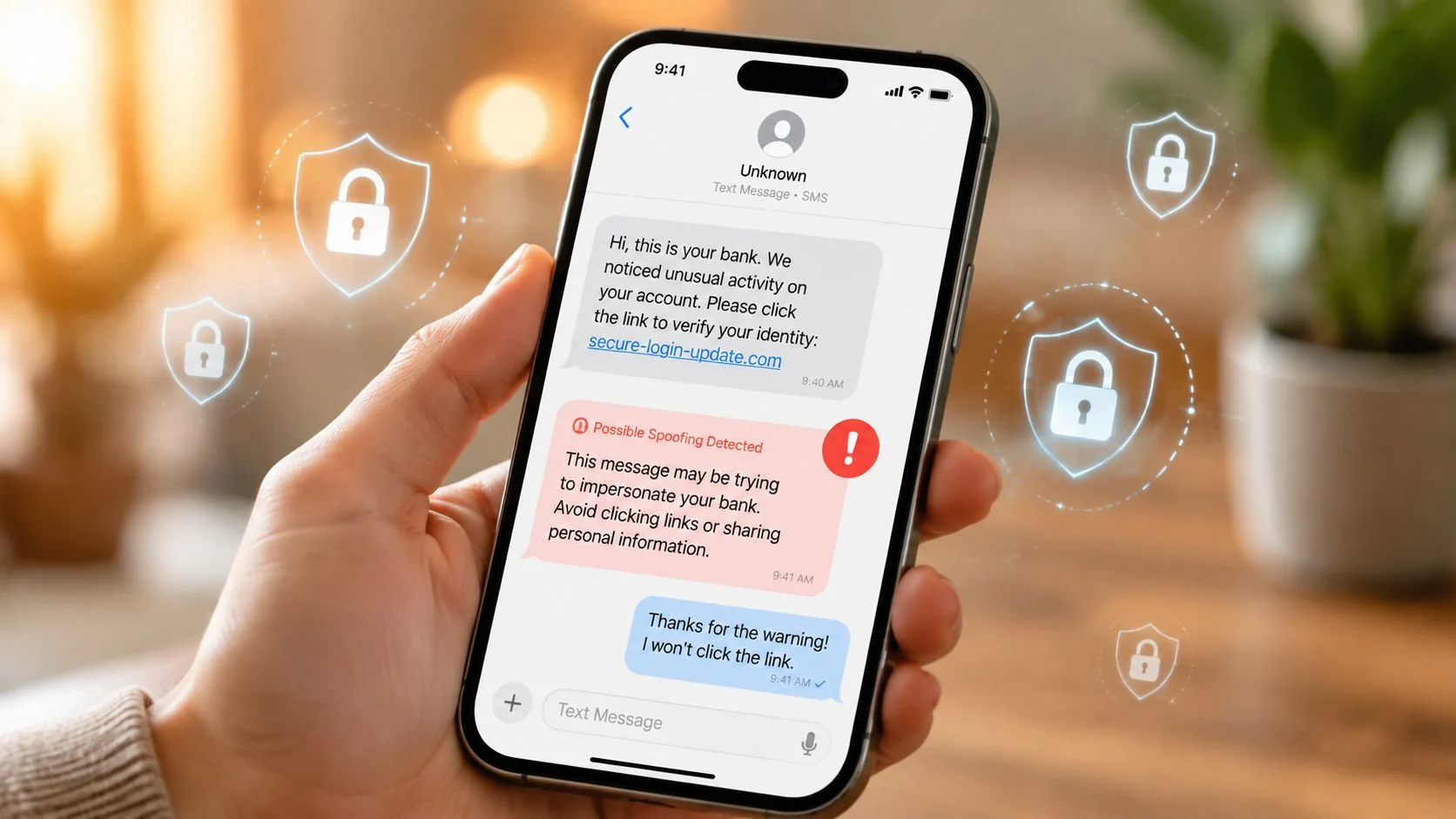
If your phone number, personal email, old usernames, and relatives can all be connected through public traces, a scammer has an easier time sounding convincing. They don't need your entire life story. They just need enough detail to make a message feel real.
OSINT gives you a preview of what an attacker, stalker, or scammer could piece together from the outside.
Professional Applications in Security and Business
For organizations, OSINT isn't a curiosity. It's an operational layer for risk reduction. Security teams, HR groups, fraud investigators, and compliance staff use it to answer one core question: what can outsiders learn or exploit from public signals?
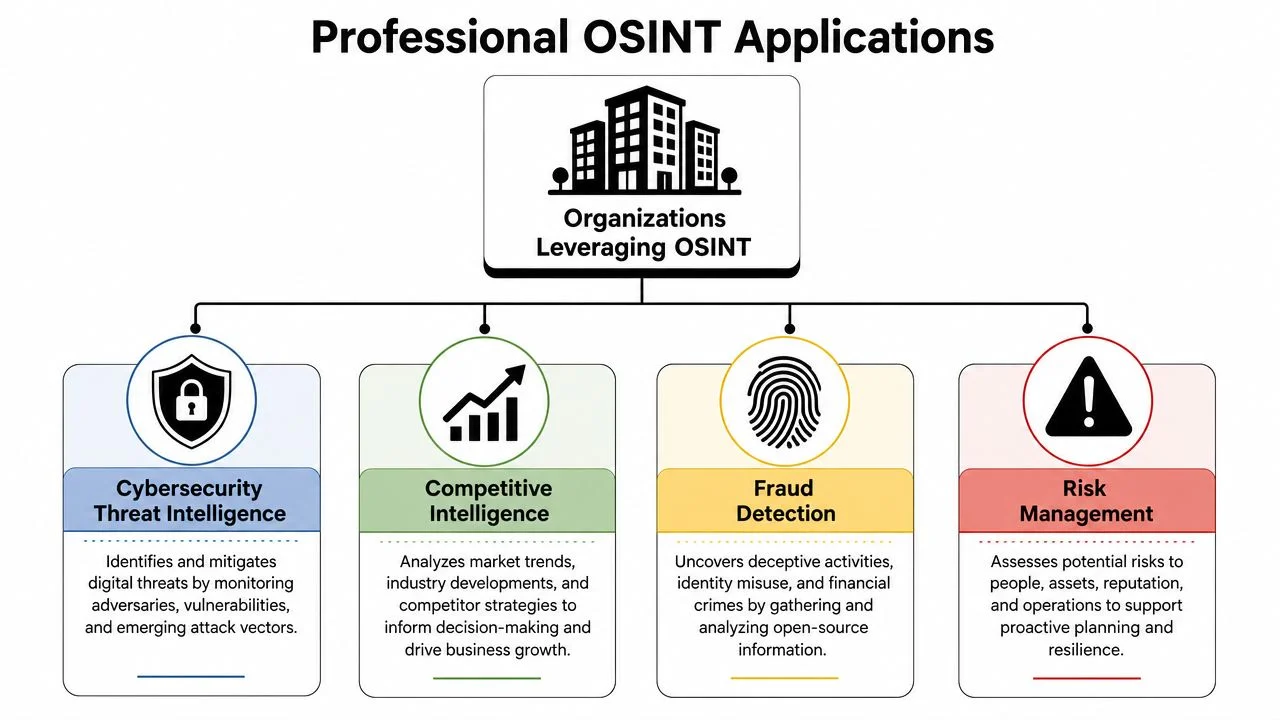
IBM notes that OSINT is used to assess threats, make decisions, and answer specific questions, and the business stakes are clear because the global average cost of a data breach reached $4.88 million in 2024 according to IBM's OSINT overview. When exposure can become that expensive, public-source intelligence becomes part of prevention, not just investigation.
Cybersecurity teams use OSINT as an early warning layer
In cybersecurity, OSINT helps defenders monitor what attackers can already see. That includes public infrastructure details, exposed assets, leaked credentials, impersonation attempts, and supplier exposure. Security teams don't want to discover these issues after a phishing campaign or intrusion starts. They want to find them while they're still just public clues.
A simple example is a company learning that employee credentials have surfaced in public breach-related discussions or that a lookalike domain is impersonating the brand. Both signals can appear before a direct attack lands.
HR and corporate investigations use it for context
Businesses also use OSINT in more human-centered work. HR teams may review public information to validate identity claims or understand whether a candidate's public presence raises concerns. Investigators use it to trace links among accounts, websites, business entities, and public-facing behavior that may matter in fraud reviews or reputational checks.
That work has to be careful and compliant. Public information can add context, but it still needs verification and fair interpretation. A result in a search engine is a lead, not a verdict.
Workplace lesson: In professional settings, OSINT is strongest when it narrows uncertainty. It shouldn't be used to fill gaps with assumptions.
Risk management is broader than security logs
Organizations often think about risk through internal systems alone. OSINT widens the lens. It can reveal how the company appears from the outside, what employees expose unintentionally, whether a vendor leaves public clues about weak practices, or whether public brand abuse is developing.
That's one reason many employers and compliance teams use specialized services for screening and research. If you want to see how structured public-record and online-presence review fits that process, these background check services for businesses provide a practical example.
An Overview of Common OSINT Tools
The OSINT tool array feels overwhelming until you group tools by job. Most of them do one of a few things: search broadly, search thoroughly, connect identities, or monitor exposure over time.
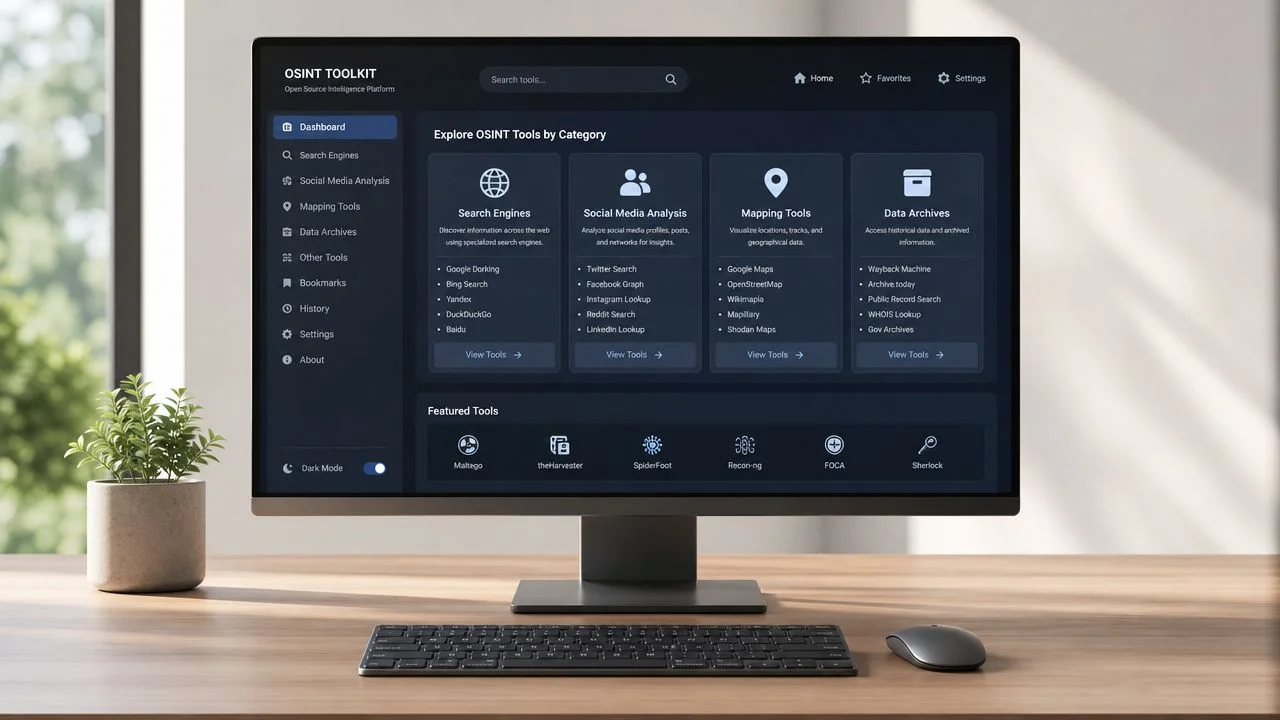
SecurityScorecard explains that in cybersecurity, OSINT tools are used to monitor public forums, breach disclosures, DNS records, and social media to identify leaked credentials, brand impersonation, typosquatting, and misconfigured infrastructure before attackers exploit them in its summary of OSINT in cybersecurity. Even if you're not on a corporate security team, that list gives you a useful mental model.
Categories that make OSINT easier to understand
- Search engines and advanced search operators help you find mentions, cached pages, niche documents, and forgotten profiles.
- Username and identity finders look for reused handles across social platforms, forums, and communities.
- Breach-checking resources help surface whether an email, username, or related account has appeared in public breach-related data.
- Social media analysis tools help compare bios, images, posting patterns, and connected accounts.
- Domain and website lookup tools help you understand who owns a site, when it appeared, and how it connects to other public signals.
If you're trying to understand site ownership and registration context, this essential guide for domain ownership is helpful because domain records often add useful context when you're checking whether a website or brand is legitimate.
Tools are only half the job
A tool can find ten accounts tied to the same username. It can't always tell you which one matters. That's where people get stuck. They collect screenshots and links but still don't know what to do next.
A more useful workflow looks like this:
- Start with strong identifiers such as a unique username, email, or profile image.
- Group results by risk, not by source. Ask which findings expose identity, credentials, location, or reputation.
- Verify before acting so you don't mistake a shared name or outdated profile for a real issue.
For beginners, guided platforms can simplify that process. One example is OSINT tools for beginners, which shows how different search methods fit together. A platform such as Digital Footprint Check can also aggregate searches across public websites, social media, breach data, gaming profiles, and records into one report, which is useful if you want a consolidated view instead of checking each source manually.
Navigating the Ethical and Legal Boundaries
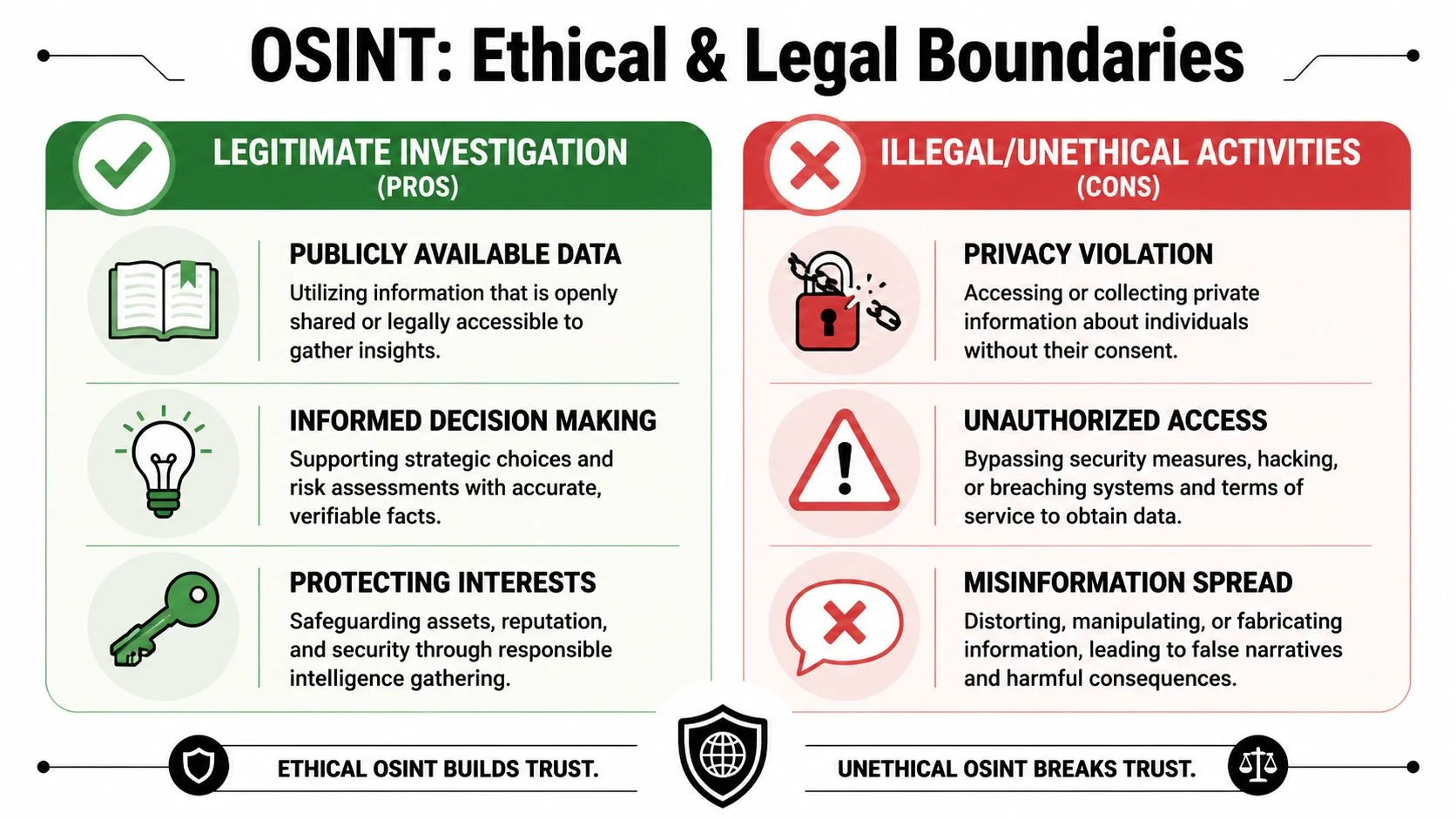
OSINT only works if you respect the line between public investigation and private intrusion.
That line is simpler than many people think. If you can see the information legally and without bypassing access controls, it may fall within OSINT. If you need a password, exploit a weakness, deceive someone into granting access, or ignore platform rules in a way that crosses into unauthorized access, you've left OSINT behind.
What ethical OSINT looks like
Ethical OSINT uses legally accessible data to answer a legitimate question. That could mean checking your own digital footprint, verifying whether a dating profile seems genuine, researching a public-facing business, or reviewing public exposure connected to an employee account as part of a lawful process.
It also means using restraint.
Just because information is visible doesn't mean every use of it is fair, wise, or harmless. Public records, family connections, old social posts, and location clues can be highly sensitive. Responsible investigators ask whether the search is proportionate to the reason for doing it.
Use the least invasive method that answers the question you actually have.
A practical do and don't list
-
Do verify identity carefully when names are common, photos are recycled, or accounts may belong to different people.
-
Do respect platform boundaries and terms of service when gathering information.
-
Do document your reasoning if you're using OSINT in hiring, compliance, or workplace decisions.
-
Don't harass people based on what you find.
-
Don't treat one result as proof of wrongdoing, dishonesty, or intent.
-
Don't access private accounts through borrowed credentials, deception, or technical workarounds.
Why legality isn't the only standard
Privacy laws and workplace rules vary by region and use case. If you're in HR, compliance, or corporate security, you may also need to think about discrimination risk, data minimization, retention, and rules around processing personal data. Concepts associated with privacy regulation matter here even when the information was originally public.
For individuals, the ethical takeaway is straightforward. Use OSINT to protect yourself, not to obsess over strangers. Use it to verify, not to stalk. Use it to reduce harm, not create it.
That approach also makes your results better. Ethical work is usually cleaner, more defensible, and less likely to confuse suspicion with evidence.
Take Control of Your Digital Footprint Today
So, what is OSINT used for?
At the simplest level, it's used to turn public information into practical decisions. For individuals, that can mean checking what a date, recruiter, scammer, or impersonator could learn from your online footprint. For organizations, it can mean spotting exposure before it becomes fraud, reputational damage, or a security incident.
The deeper value is prioritization. Moody's notes that the core value of OSINT is not just raw search volume, but turning scattered public traces into an actionable exposure ranking that supports identity theft prevention, HR review, and reputation management. In other words, it helps answer the question which exposures matter most in its discussion of OSINT methods and uses.
What to focus on first
If you want to use OSINT for your own protection, start with the exposures that create the most real-world risk:
- Identity clues such as email addresses, phone numbers, usernames, and profile photos that connect accounts together
- Reputation signals such as public posts, comments, or old profiles that employers or clients may find
- Safety risks such as overshared location details, family links, school references, or public routines
- Impersonation signs such as duplicate profiles, reused images, or accounts that appear to copy your identity
That's the mindset shift needed. Don't ask, “How much can I find?” Ask, “What could someone do with what's visible?”
Once you think that way, OSINT stops being an abstract cybersecurity term and becomes a personal safety habit. It helps with job hunting because you can see yourself the way an employer might. It helps with online dating because you can test whether a profile is consistent before trust gets expensive. It helps with privacy because you can spot public connections you never meant to expose.
The first step is simple. Check your own footprint before someone else does.
Want a simple way to see what's publicly connected to your identity? Try the free checker from Digital Footprint Check. It's a practical first step for reviewing your online exposure, spotting identity risks, and deciding what to clean up next.