· Digital Footprint Check · Content Marketing · 15 min read
Due Diligence Investigation: a Practical Osint Guide
Learn how to run a due diligence investigation using OSINT. Covers scope, sources, verification, risk scoring, and reporting for HR, employers, and individuals.

A hiring manager is reviewing a finalist who appears ideal on paper. The résumé is polished, references are positive, and the interview went well. A quick search, however, surfaces several profiles using the same name, an old company announcement that conflicts with the candidate’s timeline, and a public account linked to a different location. None of those findings proves misconduct. Each one does show why a due diligence investigation is more than casual Googling.
A professional review connects identity, records, context, and risk. It can protect job prospects, personal safety, gaming profiles, vendor relationships, dating decisions, and business reputation, but only when investigators separate verified facts from assumptions. The strongest process starts before a decision is made and continues after the decision, because a digital footprint can change long after an application, contract, or relationship begins.
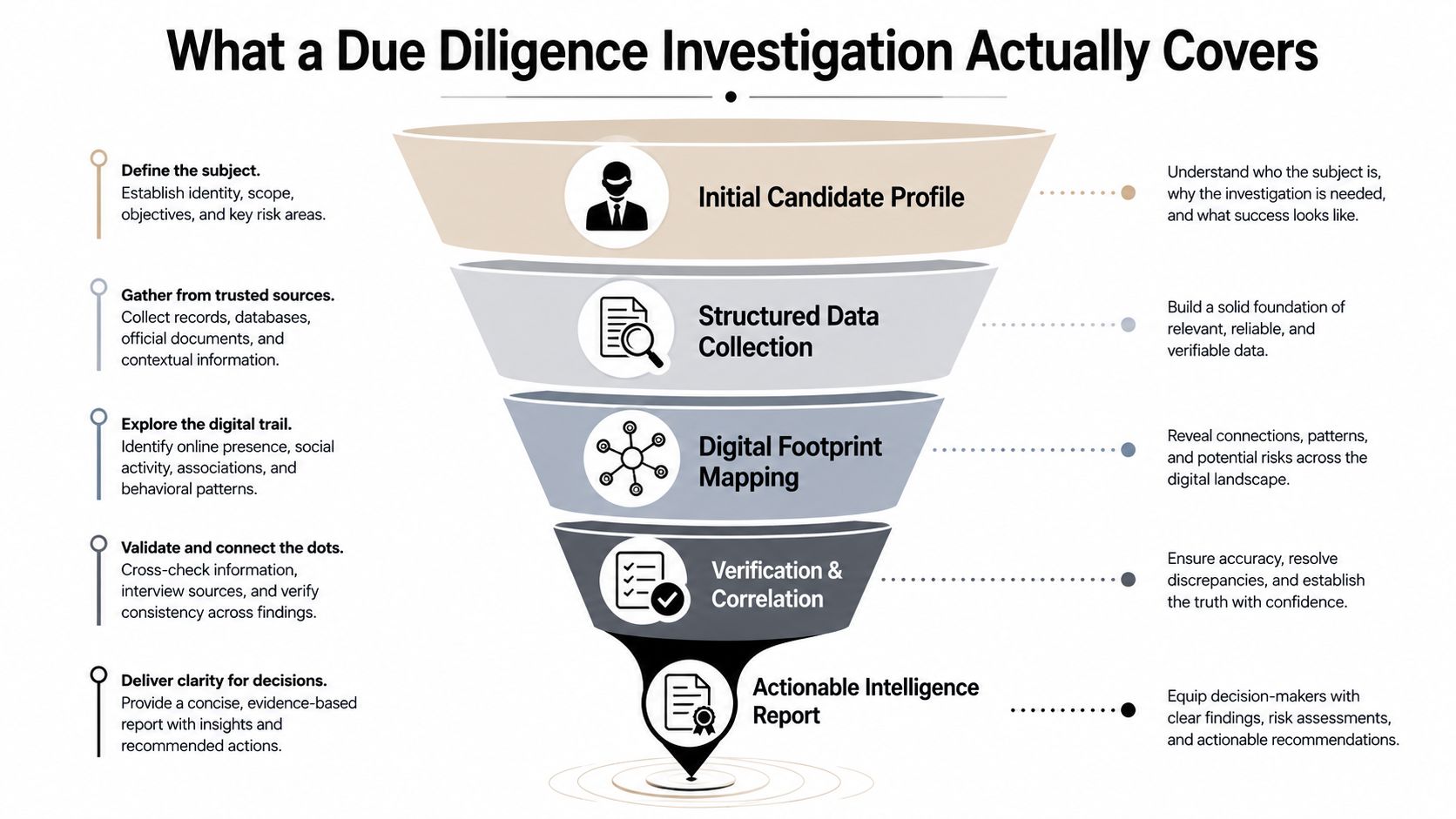
What a Due Diligence Investigation Actually Covers
A due diligence investigation is structured fact-finding that supports a decision. It combines relevant public records, corporate information, professional history, media coverage, social profiles, and other open-source intelligence, or OSINT. The purpose isn’t to collect everything available about a person or company. It’s to answer a defined question with evidence that another reviewer can understand and audit.
Casual Googling usually stops at the first page of results. A proper investigation defines the subject, records the search context, distinguishes identity matches from lookalikes, and verifies material claims through independent sources. It also differs from a background check conducted for employment purposes under the Fair Credit Reporting Act, or FCRA, and comparable rules in other jurisdictions. OSINT can support an investigation, but public availability doesn’t automatically make every use lawful or fair.
Four practical contexts
The same methods serve different decisions:
- HR pre-employment: Confirm identity, employment history, credentials, professional reputation, and potential conflicts while following consent and employment-screening requirements.
- Vendor and third-party screening: Examine ownership, control, sanctions exposure, adverse media, litigation, regulatory history, and cyber risk before granting access or authority.
- Individual self-investigation: Find exposed personal information, old accounts, impersonators, gaming profiles, breach references, and reputation risks that could affect work or safety.
- Licensed investigator casework: Build an evidence register, preserve sources, verify identities, and produce a report suitable for legal, compliance, insurance, or disciplinary review.
The workflow is simple to describe, although careful execution takes discipline: scope, source, verify, score, report, monitor. Start with a baseline risk. Identify what you don’t know, turn those gaps into targeted searches, and map every meaningful finding to a decision outcome. The Government of Canada’s open-source due diligence guidance emphasizes source documentation, controlled sequencing, and clear separation between verified facts and speculation.
For a useful operational overview, review this SMB background investigation guide, then compare its traditional screening perspective with a practical guide to conducting background checks. The difference matters: an OSINT-first review can identify questions before a formal records search begins, rather than treating digital evidence as an afterthought.
Practical rule: More results don’t mean better intelligence. A smaller set of source-cited, identity-matched findings is more useful than an unverified archive of search hits.
Defining Scope, Objectives, and Legal Boundaries
Don’t run a name search before writing down what the investigation must establish. A short scope memo prevents investigators from drifting into irrelevant personal information, and it gives HR, legal, compliance, or a client a defensible reason for each query.
Write the memo in plain language:
- Subject: State the person, company, domain, username, or related entity under review.
- Decision: Identify the hiring, vendor, investment, dating, safety, or reputation decision involved.
- Question: Phrase the issue as something evidence can answer, such as whether stated employment history aligns with public records.
- Time window: Define the relevant period and explain why older material matters or doesn’t.
- Sources and limits: List permitted source types, prohibited collection methods, access restrictions, and escalation points.
- Output: Specify who receives the report, how confidence is expressed, and how long evidence is retained.
Legal boundaries that change the method
Employment screening can trigger FCRA obligations and equivalent local regimes. Public records may be searchable, but an employer still needs a lawful purpose, appropriate notices, required authorization, accurate reporting, and a process for responding to disputes. Anti-discrimination rules also prohibit using protected characteristics or irrelevant personal details as hidden decision criteria.
For people in the European Union, GDPR proportionality and purpose limitation are central. Collect only information relevant to the stated decision, document the legal basis, protect access to the report, and avoid retaining material because it was easy to find. Pretexting, impersonation, bypassing access controls, purchasing unlawfully obtained data, and attempting to enter private accounts are not legitimate OSINT techniques.
This OSINT legality guide is a useful starting point, but counsel should assess the actual jurisdiction and use case.
| Jurisdiction/Regime | Core Obligation | Practical Implication |
|---|---|---|
| FCRA and equivalent employment rules | Use lawful purpose, authorization, accuracy, and dispute processes | Coordinate screening with HR and counsel before relying on a report |
| GDPR | Apply proportionality, purpose limitation, minimization, and secure handling | Limit collection about EU data subjects to relevant, documented questions |
| Anti-discrimination statutes | Don’t base decisions on protected or irrelevant characteristics | Exclude sensitive personal details that don’t answer the investigation question |
| Public-record access rules | Follow registry terms and applicable privacy restrictions | Preserve lawful source context and don’t assume public means unrestricted use |
| Criminal and cyber law | Don’t use deception, unauthorized access, or stolen credentials | Never test passwords, enter accounts, or contact people under false pretenses |
OSINT Data Sources and Digital Footprint Discovery
Digital-footprint discovery works best as a map, not a random sweep. Begin with known identifiers, then pivot carefully. A name can lead to a LinkedIn profile, a company page can lead to director records, and a reused username can connect a professional identity to an old gaming or forum account. Each pivot needs an identity check before it becomes evidence.
Where investigators look
LinkedIn can reveal employment sequences, company history, role descriptions, endorsements, and public announcements. X advanced search can expose conversations, date ranges, and recurring handles. Facebook may provide connection, group, event, and location context where those details are public. Instagram offers location tags, photo tags, captions, and comment patterns, while TikTok and Reddit can provide behavioral signals and community history, although sarcasm and pseudonyms make interpretation difficult.
Public records add a different layer:
- Corporate registries: Directors, registered addresses, filing dates, and entity relationships.
- Court dockets: Litigation, judgments, insolvency indicators, or disputes requiring context.
- Sanctions and PEP lists: Potential exposure that demands identity resolution, not automatic adverse conclusions.
- UBO filings: Ownership and control information where available.
- Professional licensing boards: Credential status, disciplinary records, and practice authorization.
Breach corpus awareness is also important. An investigator may find an email or username associated with an exposed credential set, but that doesn’t justify opening an account, testing a password, or publishing the data. Treat breach information as an exposure indicator, minimize what you retain, and direct the subject toward credential changes and account security.
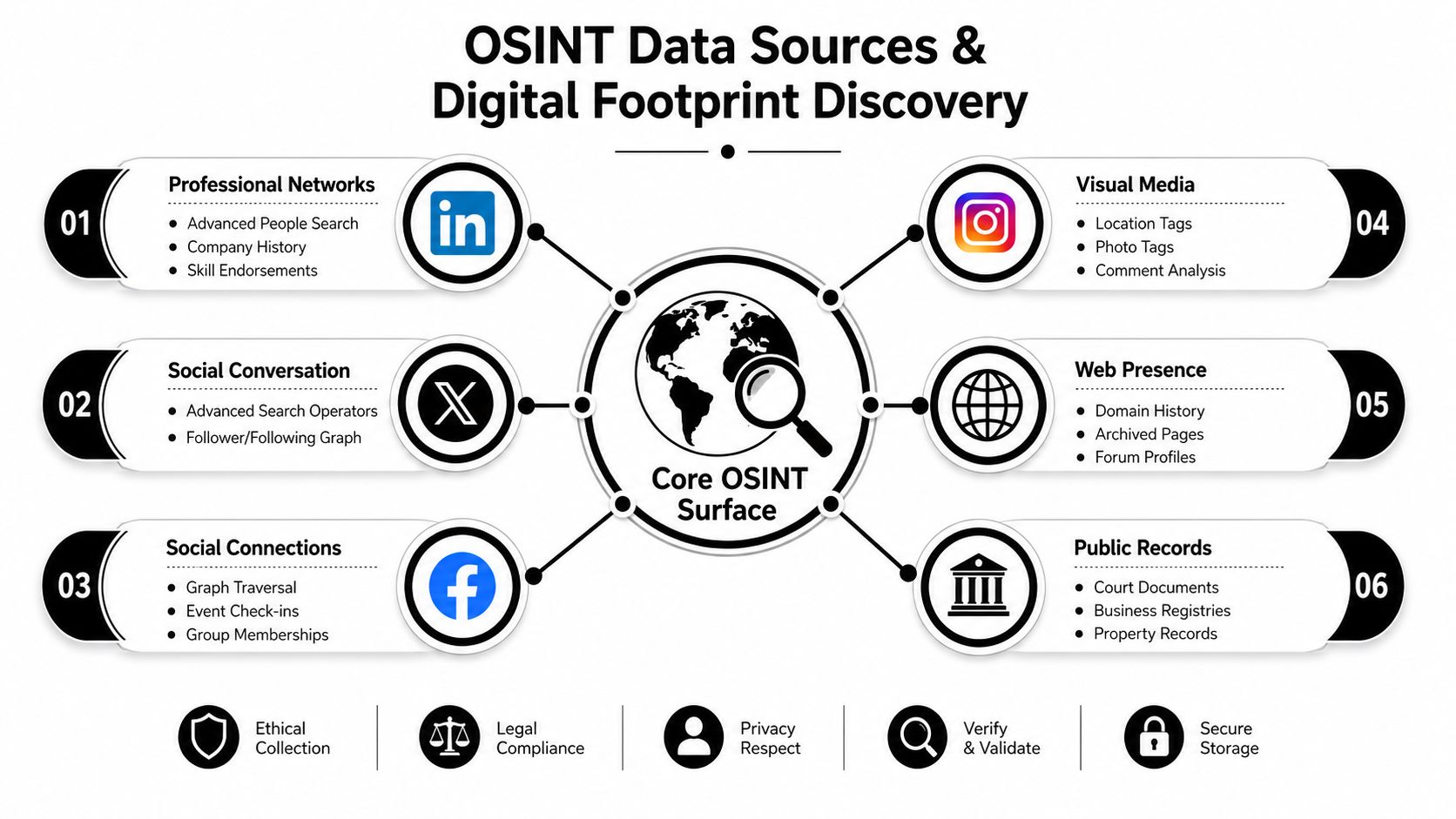
Search construction should be deliberate. Combine exact phrases, name variants, employers, locations, usernames, email syntax, and site-specific operators. Compare archived snapshots when a profile or company page changes, and use username enumeration across 500+ sources when the investigation requires broad identity discovery. Digital Footprint Check describes this type of surface as including social networks, gaming profiles, professional networks, breach databases, and public records. For a manual starting point, use this OSINT tools guide for beginners.
The dark web as an OSINT source requires particular care. Monitoring can identify exposure or references, but investigators must preserve privacy, avoid interacting with criminal infrastructure, and keep the result proportional to the decision.
Prioritize channels by subject and question rather than chasing maximum coverage. For an executive, corporate filings and licensing records may carry more weight than casual social posts. For a dating-safety review, cross-platform aliases, social profiles, and image reuse may be more useful than a generic search result. For a gamer, account recovery exposure and reused handles can matter more than professional-network activity.
Verification Methods That Separate Signal from Noise
Raw discovery creates hypotheses. Verification determines whether those hypotheses belong in a report. Start with identity correlation, using name variants, middle initials, usernames, email syntax, phone carrier context, known locations, employers, and profile photos. No single match should carry the conclusion, especially when the name is common or the account uses a pseudonym.
Reverse image search can test whether a dating profile photo, professional headshot, or gaming avatar appears elsewhere. Yandex, TinEye, and Google may produce useful matches, but a result only shows image reuse, not who controls the account. Use the reverse image search tool for people as one discovery step, then confirm the surrounding identity through independent evidence.
The verification ladder
Move upward only when the lower rung produces a plausible match:
- Identity correlation: Compare identifiers and note both matching and conflicting details.
- Cross-reference triangulation: Seek independent confirmation in registries, court records, sanctions lists, media archives, or professional databases.
- Timeline and consistency: Compare posting dates, employment claims, company filings, travel or location context, and account creation clues.
- Credibility and relevance: Rate the source and decide whether the finding matters to the defined decision.
- Actionable conclusion: State what is established, what remains uncertain, and what decision or follow-up is justified.
Posting cadence and language patterns can reveal a fabricated persona, but they remain indicators rather than proof. Metadata inconsistencies, mismatched time zones, recycled photographs, and abrupt changes in writing style deserve follow-up. They shouldn’t become a conclusion until another source supports the concern.
Evidence discipline: A contradiction is a question to resolve, not a verdict.
Timestamp pages with lawful archive snapshots and record the access date, source URL, search terms, account identifier, and relevant page text. EXIF analysis can help assess an image’s history when metadata remains available, but platforms often strip or alter it. Preserve original files only when you have a lawful basis, protect them from unnecessary distribution, and record who handled each item.
Every material claim should receive a reliability and confidence label. A high-confidence finding might combine a direct registry record with a matching company announcement and consistent identity markers. A low-confidence finding might rely on a single unattributed post. That distinction keeps an investigator from turning search noise into employment harm, reputational damage, or an unsafe personal decision.
Risk Scoring Frameworks and Red Flag Categories
A risk score supports a decision, but never replaces judgment. It converts verified findings into a consistent review of severity, likelihood, relevance, and next steps. The same fact can carry different weight across engagements. A public complaint about a failed delivery may matter to a logistics vendor, yet have little bearing on a candidate seeking an unrelated role.
Three models are practical:
- Weighted categorical scoring: Give greater influence to findings that are reliable and directly relevant, then record the reason for each weight.
- Severity and likelihood matrix: Assess potential impact alongside the probability that the risk is genuine or likely to recur.
- Traffic-light tiers: Use green for no material concern, amber for unresolved questions or mitigations, and red for verified issues requiring escalation.
Red flags need context
OSINT reviews may surface financial distress, regulatory action, adverse media, identity inconsistencies, sanctions or PEP exposure, reputational concerns, reused breached passwords, and exposed personal data. These signals require different treatment. Assess source reliability, recency, relevance, and corroboration depth, and record the reasoning beside the score.
| Category | Base Weight | Example OSINT Signal | Typical Source |
|---|---|---|---|
| Identity consistency | High | Employment dates or location conflict across authoritative profiles | Corporate filings, employer pages, professional records |
| Regulatory exposure | High | A confirmed enforcement action or licensing restriction | Regulator, licensing board, official filing |
| Ownership and control | High | Unclear beneficial ownership or conflicting director information | Corporate registry, UBO filing |
| Adverse media | Medium to high | Repeated, sourced reporting tied to the verified subject | Reputable media archive |
| Financial distress | Medium to high | Insolvency filing, judgment, or material dispute requiring review | Court docket, official registry |
| Digital hygiene | Context-dependent | Exposed email, reused handle, or breached credential indicator | Breach-monitoring source, public profile |
| Reputation | Context-dependent | Public conduct directly relevant to the role or relationship | Verified public account, documented media |
The same finding can justify different responses. A reused-password indicator creates a serious account-security concern for someone managing a payment platform, but it does not establish fraud in a personal relationship. A sanctions-list name match may require immediate escalation for a financial-services vendor. If identifiers disprove the connection, document the false positive and close it.
The financial-services context shows why structured review matters. Global penalties tied to anti-money laundering, sanctions, customer due diligence, and KYC obligations reached USD 6.6 billion in 2023, USD 4.6 billion in 2024, and USD 3.8 billion in 2025, according to Fenergo’s 2026 enforcement analysis. The analysis reports an 18% decline from 2024 in the 2025 total, while the remaining exposure is still substantial. See this financial-services compliance guidance for how structured review applies in regulated industries.
Use the score to trigger a defined action, such as requesting documentation, escalating to counsel, restricting access, or continuing monitoring. A numerical label must not conceal uncertainty. Reassess the score when new digital-footprint evidence appears, rather than treating the initial review as a permanent conclusion.
Tailored Checklists for HR, Employers, Individuals, and Investigators
A useful checklist changes with the decision. HR needs lawful, job-relevant verification. A company screening a supplier needs ownership and control intelligence. An individual needs exposure discovery and account protection, while a licensed investigator needs reproducible evidence and a client-ready report.
HR and employers
For pre-employment screening, confirm the candidate’s identity using consented information, compare employment dates across the résumé and public professional profiles, verify credentials with the issuing institution, and review professional reputation for role-relevant issues. Search combinations such as the candidate’s name with an employer, role, city, or credential, but don’t infer protected characteristics from photos, groups, or personal posts. Route any report through the applicable FCRA or local compliance process.
For vendors and partners, identify directors and beneficial owners, compare registry addresses, check sanctions and PEP lists, review adverse media, examine litigation and financial-stability indicators, and ask about cybersecurity controls. A vendor’s public breach history or exposed employee credentials can justify a security questionnaire or access restriction, but it doesn’t establish that the vendor caused an incident.
Individuals and investigators
An individual self-audit should search known email addresses, phone numbers, usernames, gaming aliases, social profiles, and public-record references. Look for impersonator accounts, exposed contact details, old posts that affect professional reputation, and recovery information that could help an attacker. Change reused credentials through the account provider, enable multi-factor authentication, remove unnecessary public details, and report impersonation through the platform.
A professional investigator’s case kit should include:
- Scoping document: Decision, questions, jurisdictions, time window, and collection limits.
- Source register: URL, source type, access date, reliability assessment, and identifier used.
- Evidence log: File name, hash value where appropriate, timestamp, handler, and storage location.
- Verification ladder: Correlation, triangulation, consistency, credibility, and conclusion.
- Risk sheet: Category, rationale, confidence, severity, and recommended action.
- Deliverable template: Executive summary, findings, limitations, supporting evidence, and client instructions.
For online dating safety, don’t rely solely on dating-app verification badges. FTC data says 40% of romance scams begin on social media and 19% begin on a dating site or app, according to FTC romance scam data summarized by CatfishFinder. Cross-platform aliases, reverse-image checks, friend-network inconsistencies, refusal to video chat, and requests for money are practical signals to investigate carefully, without contacting or confronting a suspected scammer.
Reporting Templates, Action Plans, and Continuous Monitoring
A defensible report lets a reader distinguish facts, interpretation, uncertainty, and action. Start with a concise executive summary, then provide the subject profile, methodology, findings, source references, limitations, and recommended response. Attach supporting screenshots or archived material only when lawful and necessary.
| Report Section | Purpose |
|---|---|
| Executive summary | State the decision question, material findings, confidence, and immediate recommendation |
| Subject profile | Explain the identifiers used and how the subject was distinguished from namesakes |
| Methodology | Record sources, search logic, date range, exclusions, and legal limits |
| Findings | Present each claim with severity, confidence, source, and corroboration |
| Evidence register | Preserve URLs, timestamps, file references, archive context, and hash values where appropriate |
| Limitations | Identify unavailable records, ambiguous matches, deleted pages, and unresolved questions |
| Action plan | Specify immediate decisions, short-term mitigation, and monitoring responsibilities |
Pair every report with a tiered action plan. Immediate actions might include pausing a hire, withholding vendor access, requesting clarification, protecting a dating-app user, or securing an exposed account. Short-term actions can include credential resets, enhanced documentation, legal review, reference checks, contract controls, or a deeper forensic examination. Ongoing tasks should assign an owner to saved searches, adverse-media alerts, corporate-record changes, credential-leak notifications, and reputation shifts.
Continuous monitoring is the practical answer to the limits of one-time screening. A company can change directors, a professional can acquire a new public profile, a gaming account can be exposed, and an impersonator can appear after an initial review. Monitoring should remain proportional to the original purpose, with retention limits and access controls that prevent an old investigation from becoming permanent surveillance.
The regulatory context reinforces that discipline. The U.S. Treasury says CFIUS handled 342 notices and declarations in 2023, cleared 66% of distinct transactions without mitigation in initial review periods, and issued four civil monetary penalties for mitigation violations, twice the number previously issued across nearly 50 years, as reported in its CFIUS annual report. Those figures show why cross-border reviews need documented ownership analysis, source preservation, and clear escalation rather than a checkbox exercise.
Identity and scam exposure also justify personal monitoring. The FTC reports that imposter scams generated more than 1 million reports and USD 3.5 billion in reported losses in 2025, with losses up nearly 20% year over year, in its consumer alert on imposter scams. The FTC also reports that Americans lost USD 304 million to romance scams in the last year, while nearly 60% of people who lost money in 2025 said the scam began on social media rather than a dating app, in its online dating safety guidance. These are reasons to monitor exposure and verify identities, not invitations to invade private accounts.
A due diligence investigation becomes valuable when every conclusion answers a defined question, survives verification, and leads to a proportionate action. Before you hire, sign, invest, date, or publish, run a focused digital-footprint review at Digital Footprint Check, which can help identify public profiles, exposed information, breach references, gaming accounts, and other signals that deserve verification. Use the results as a starting point for lawful follow-up, then return to the report as part of an ongoing privacy, cybersecurity, and reputation-management process.