· Digital Footprint Check · Content Marketing · 11 min read
Infidelity Digital Investigation: Ethical Osint Methods
Learn the ethical OSINT methods for infidelity digital investigation. Discover how to gather evidence responsibly and legally in 2026.

Most advice about catching a cheating partner is too simple. It assumes that if someone is hiding something, a phone check or a quick scroll through social media will expose it. In real cases, more digital activity doesn’t make proof easier, it usually creates more noise, more legal risk, and more false leads.
An effective infidelity digital investigation is closer to evidence correlation than snooping. The job is to compare messaging patterns, app traces, location clues, account behavior, and timing, then separate suspicion from something you can document. If the relationship is already under strain, it can help to read a thoughtful infidelity recovery guide while you’re deciding whether you need facts, support, or both.
Why Modern Infidelity Investigations Are Harder Than They Look
The old assumption was that cheating left a neat trail. In practice, modern secrecy is fragmented across ephemeral messages, auto-delete settings, secondary accounts, and devices that sync in the background. That means one suspicious text or a deleted chat rarely tells the whole story, and it can be easy to mistake a red flag for proof.
The problem with isolated clues
A single screenshot can be real and still be misleading. It may show contact, but not the larger pattern of when, how often, or from which account that contact happened. The better approach is to look for convergence, when multiple weak signals point to the same person, place, or time window.
That’s the big shift in this field. The evidence ecosystem moved from traditional surveillance toward digital review long ago, and a 2010 survey by the American Academy of Matrimonial Lawyers found that 81% of divorce attorneys had seen more social-media-related cases over the previous five years, showing that online activity had become routine evidence in family disputes (source summary). A modern investigation now has to assume that messaging apps, social platforms, and cloud backups may matter as much as physical observation.
Practical rule: If a clue stands alone, treat it as a lead, not a conclusion.
Why emotional fallout and evidence gathering collide
People rarely investigate infidelity from a calm distance. They’re angry, scared, or trying to preserve a marriage, which makes over-reading a deleted history or a late-night notification tempting. That’s also why timing matters, because an early confrontation can push accounts private, wipe messages, or trigger a change in behavior that erases the trail.
The work is not to “catch” someone in a dramatic moment. It’s to build a record that survives scrutiny if the findings later matter in mediation, counseling, or a legal dispute. That distinction changes everything about what you collect, how you store it, and how much you trust your first instinct.
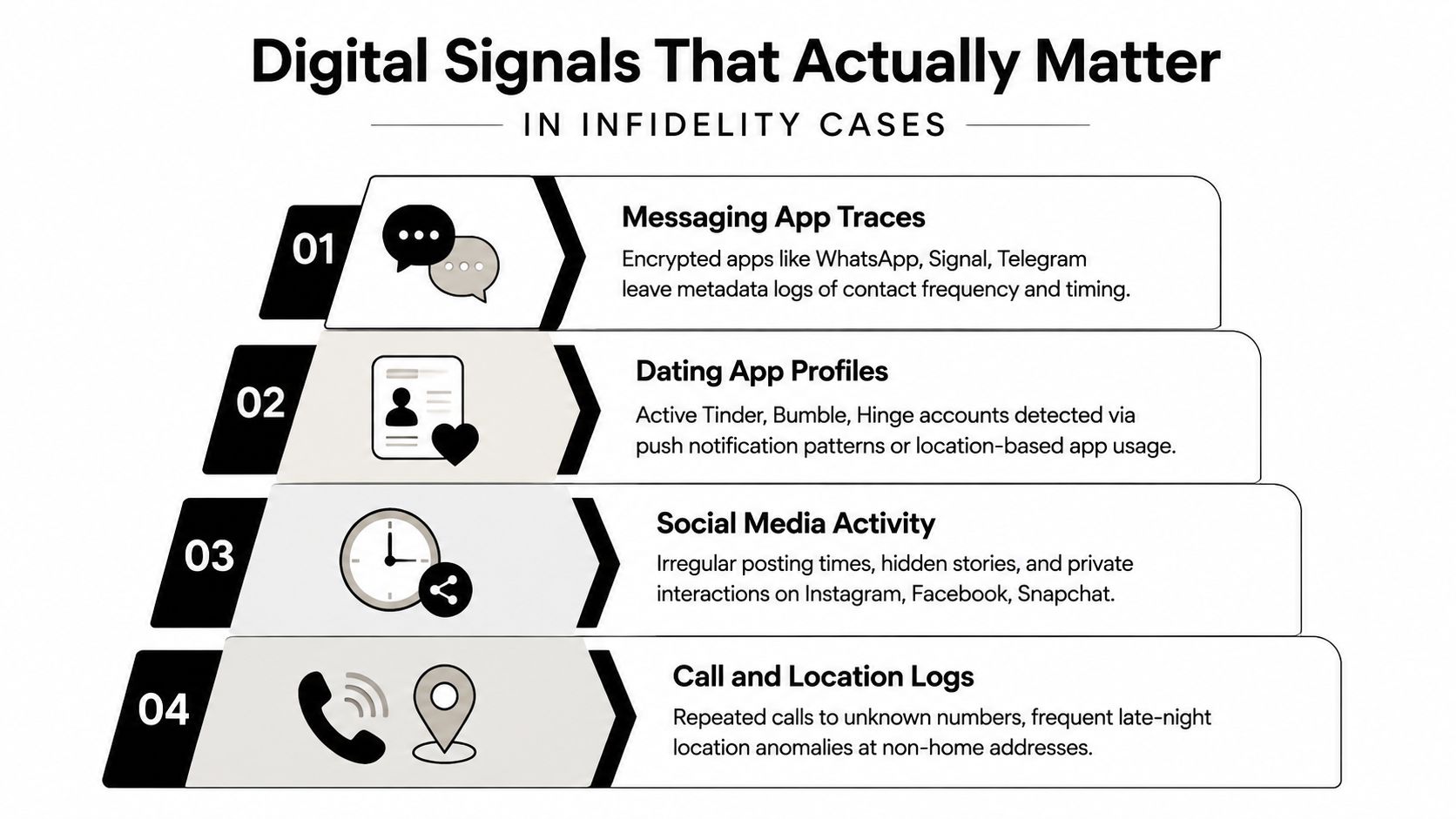
Digital Signals That Actually Matter in Infidelity Cases
The strongest cases usually don’t come from one obvious reveal. They come from cross-correlation across artifacts that, by themselves, might look ordinary. Messages, app usage, browser history, photo metadata, and location traces become meaningful when they line up on the same schedule or contact pattern.
Build a normal pattern first
Start by mapping ordinary routines. Note work hours, commute timing, regular app use, and the places or people that show up repeatedly. Once you have that baseline, anomalies become easier to spot, especially when they happen at odd hours or repeat in a way that doesn’t match the person’s usual habits.
Messaging traces matter because they show contact frequency and timing, even when the content is hidden or only partially visible. Dating-app traces matter because account activity can reveal whether an app was active around the same periods as unusual location behavior. Social interactions matter too, particularly if stories, follows, or private replies appear in patterns that don’t fit the public-facing profile.
The most persuasive cases usually involve a cluster of signals rather than one flashy item. A hidden chat, a browser session at a strange hour, and a location anomaly to the same neighborhood is more useful than a dozen random screenshots.
Red flags are not proof
Frequent messaging-app use can mean cheating, or it can mean a group chat, work communication, or family coordination. Cleared browsing history can suggest concealment, but it can also reflect normal privacy habits. That’s why investigators don’t stop at the first suspicious detail.
A good review asks whether independent artifacts agree. If the same time window appears in a message thread, a log-in trace, and a location note, the evidentiary value rises. If they don’t line up, the story stays incomplete.
For a practical example of how phone-related traces can be interpreted without overclaiming, see this internal guide on tracking by phone number. The point isn’t that one method solves everything, it’s that digital traces should be read together, not in isolation.
OSINT Data Sources and How to Search Them
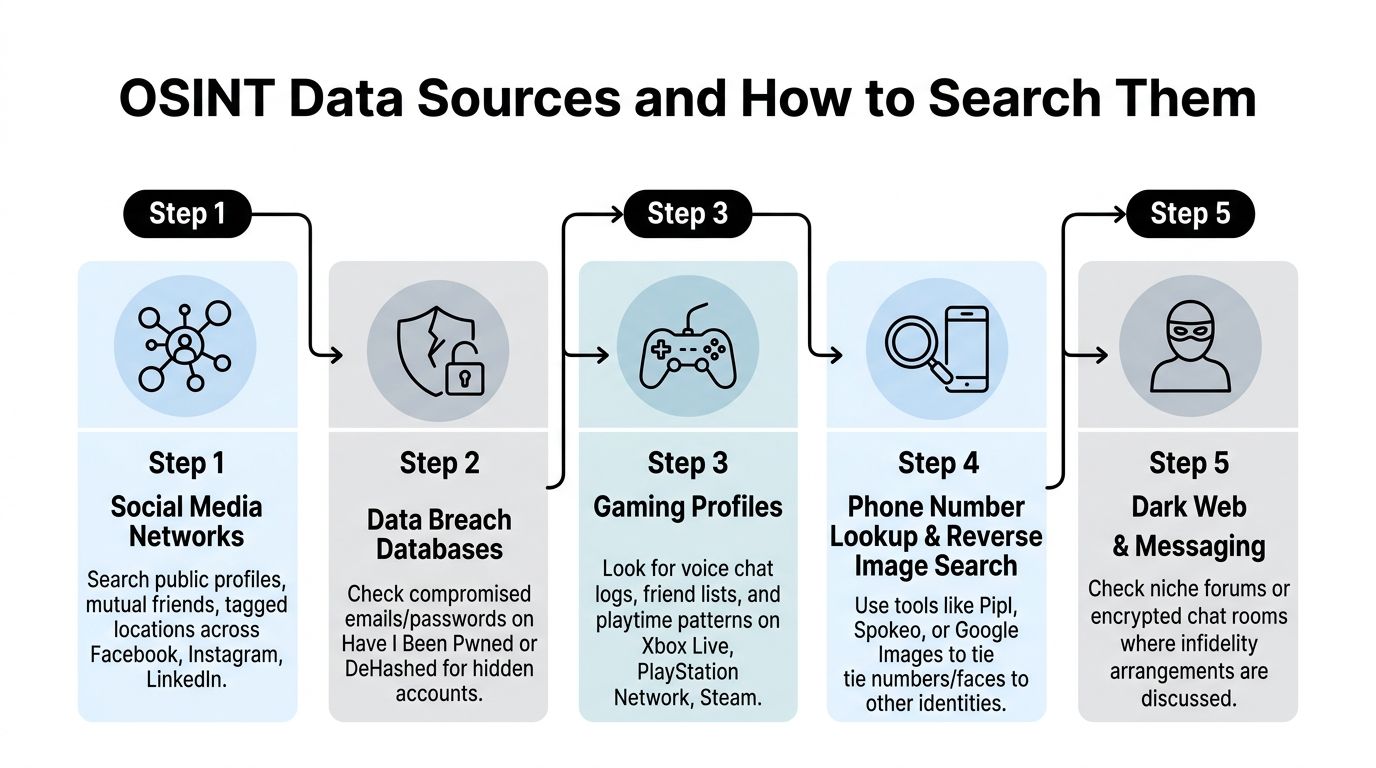
A useful OSINT search begins with identity, not accusation. Start with usernames, email addresses, phone numbers, profile photos, and recurring nicknames, then look for where those identifiers repeat across platforms. The goal is to find hidden or compartmentalized accounts without jumping to conclusions about what they mean.
Search where identity leaks repeat
Public social profiles often leak more than people realize. Mutual friends, tagged locations, old usernames, and profile-photo reuse can expose a second account or a dating profile that wasn’t obvious at first glance. Gaming networks can do the same thing, especially when friend lists, voice chat behavior, and playtime patterns repeat across usernames.
Breached credential databases are another useful lead source. If an email address appears in a compromise list, that can hint at accounts a person forgot about or never disclosed, although it doesn’t prove anything by itself. Reverse phone and email lookups can also help connect a contact method to other identities, and reverse image search can tie a face or avatar to other profiles.
Practical rule: Treat every OSINT hit as a pointer to a source, not as final proof of conduct.
Use broad search, then narrow manually
Manual searching still matters. Search a username on social platforms, then check whether the same handle appears on gaming accounts, forums, and old public bios. If a photo appears in multiple places, compare dates, captions, and visible context before assuming it belongs to the same person.
Digital Footprint Check is one option for this kind of broad discovery work, because it scans 500+ platforms across public-facing sources and reporting categories. Used properly, a tool like that can shorten the time it takes to find repeat identifiers, but the investigator still has to interpret the results carefully and stay within lawful collection limits.
For a basic workflow on search methods, the internal guide on OSINT tools for beginners is a useful companion. It helps frame the search as a process, not a guessing game.
The embedded video below offers a quick visual of how these search layers fit together.
Preserving Evidence So It Holds Up Legally
Finding something suspicious is the easy part. Preserving it so a lawyer, mediator, or court can evaluate it is where many amateur efforts collapse. Screenshots alone are usually not enough, because they can leave out context, omit metadata, and fail to show how the evidence was obtained.
Work in the right sequence
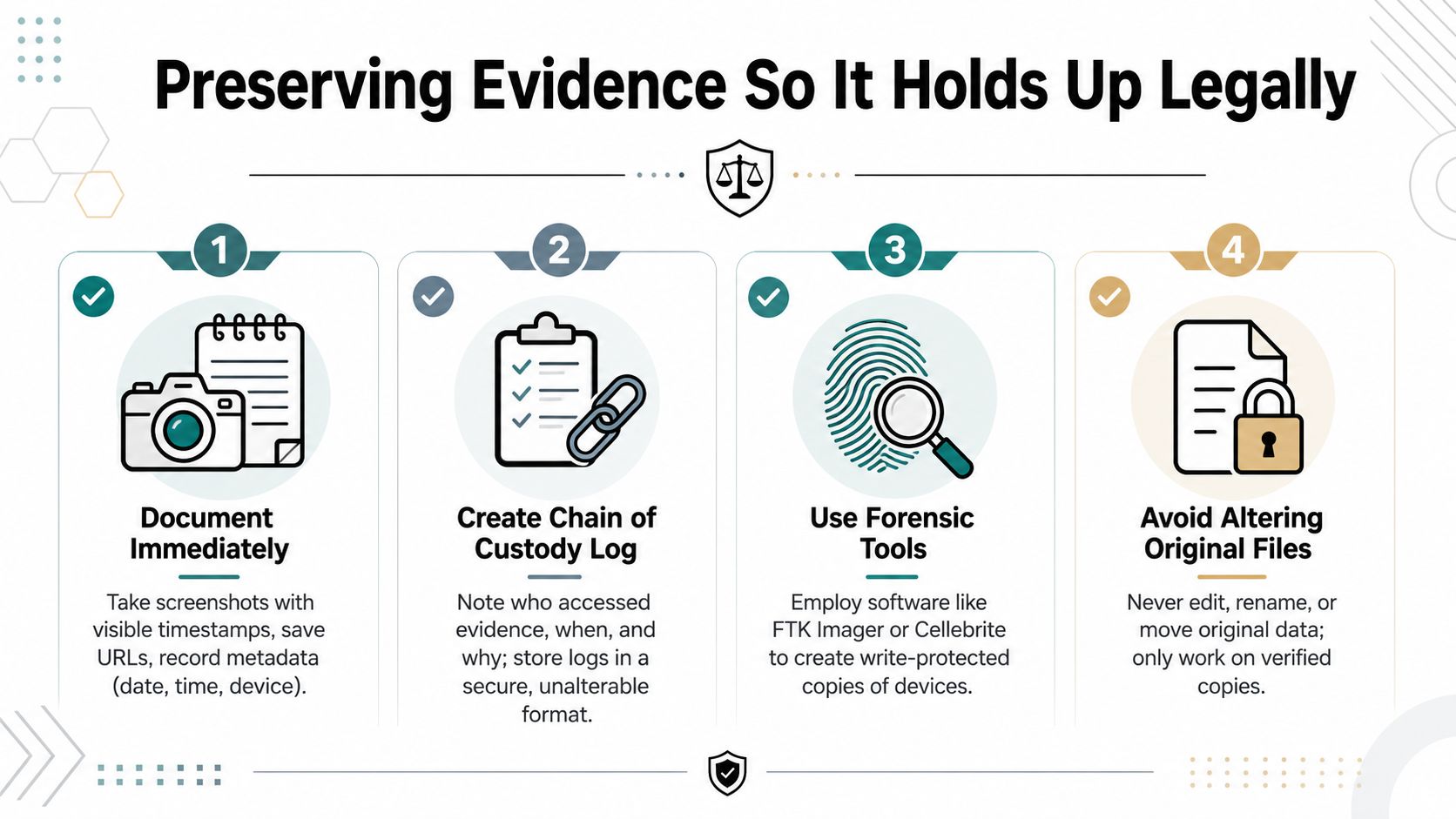
Professional digital investigations usually follow four stages, assessment and identification, acquisition, analysis, and reporting. First, define what you’re allowed to look at and what sources might matter. Then preserve the original state of the device or account before you do any deeper review.
The technical reason this matters is simple. If evidence is opened, copied, or synchronized incorrectly before preservation, timestamps, metadata, and file integrity can change. Once that happens, a finding can still be suspicious, but it’s weaker and harder to defend.
Key point: Preserve first, interpret second.
Document what you touched and how
If you’re dealing with chat evidence, one published forensic approach recommends keeping the device unchanged, exporting the chat with the app’s built-in export function, calculating a SHA-256 hash of the exported archive, and preparing a Section 63(4) BSA certificate that identifies the device, describes the export process, includes the IMEI and account details, and records the hash value (peer-reviewed article). That’s much stronger than a casual screenshot folder.
A good chain-of-custody record should note who handled the evidence, when they handled it, and why they accessed it. That record doesn’t have to be elaborate, but it does have to be clear. If the matter is serious, use a forensic copy and keep the original untouched.
For a practical refresher on preserving account traces, the internal guide on checking deleted history fits well with this stage of the process.
Different sources need different handling
NIST’s review of digital investigation techniques emphasizes that digital forensics is device- and platform-dependent, so the same extraction method won’t work everywhere (NIST IR 8354). A smartphone, a cloud account, and a desktop browser each call for different preservation steps.
That’s why “just save the screenshots” is weak advice. Use screenshots as support, not as the entire record. The actual file, the export trail, the hash, and the access log are what make the evidence more durable.
Legal Boundaries and Ethical Limits You Cannot Cross
The line between investigation and interception is narrower than many people think. A matrimonial-law analysis notes that the Electronic Communications Privacy Act and related state statutes make it a criminal offense to intercept a spouse’s texts, emails, or other electronic communications without consent (AAML analysis). In other words, wanting the truth doesn’t authorize access.
What you can look at versus what you can’t
Publicly available information is fair game. So are OSINT searches on indexed profiles, public posts, publicly visible check-ins, and shared device histories that you’re already allowed to review. That’s the lane for ethical digital investigation work.
By contrast, password-protected accounts, spyware, and private communications are a different category entirely. Installing monitoring software, bypassing credentials, or intercepting messages can create legal exposure fast, even if your motive feels understandable. If a device or account isn’t yours to access, don’t treat curiosity as consent.
For anyone trying to keep the process lawful, the background check consent forms resource is a useful reminder that permission matters. Consent is not a box to check after the fact, it’s the boundary that keeps the work defensible.
When the law and the emotion diverge
People often ask whether a suspected affair justifies more aggressive collection. It doesn’t change the law. It may change what questions you ask, who you hire, and whether you should stop collecting and speak with counsel instead.
If you want a practical discussion of hiring a licensed investigator in a divorce setting, the Law Office of Bryan Fagan, PLLC has a helpful overview of the ethical issues involved. That kind of guidance matters because privacy and computer misuse rules vary sharply by jurisdiction, and a tactic that seems harmless in one place can cause serious problems in another.
The safest rule is blunt. Search what’s public, document what you’re allowed to document, and stop before you cross into private access. If the evidence matters enough to shape a legal decision, it matters enough to collect correctly.
Your Next Steps After Gathering Digital Evidence
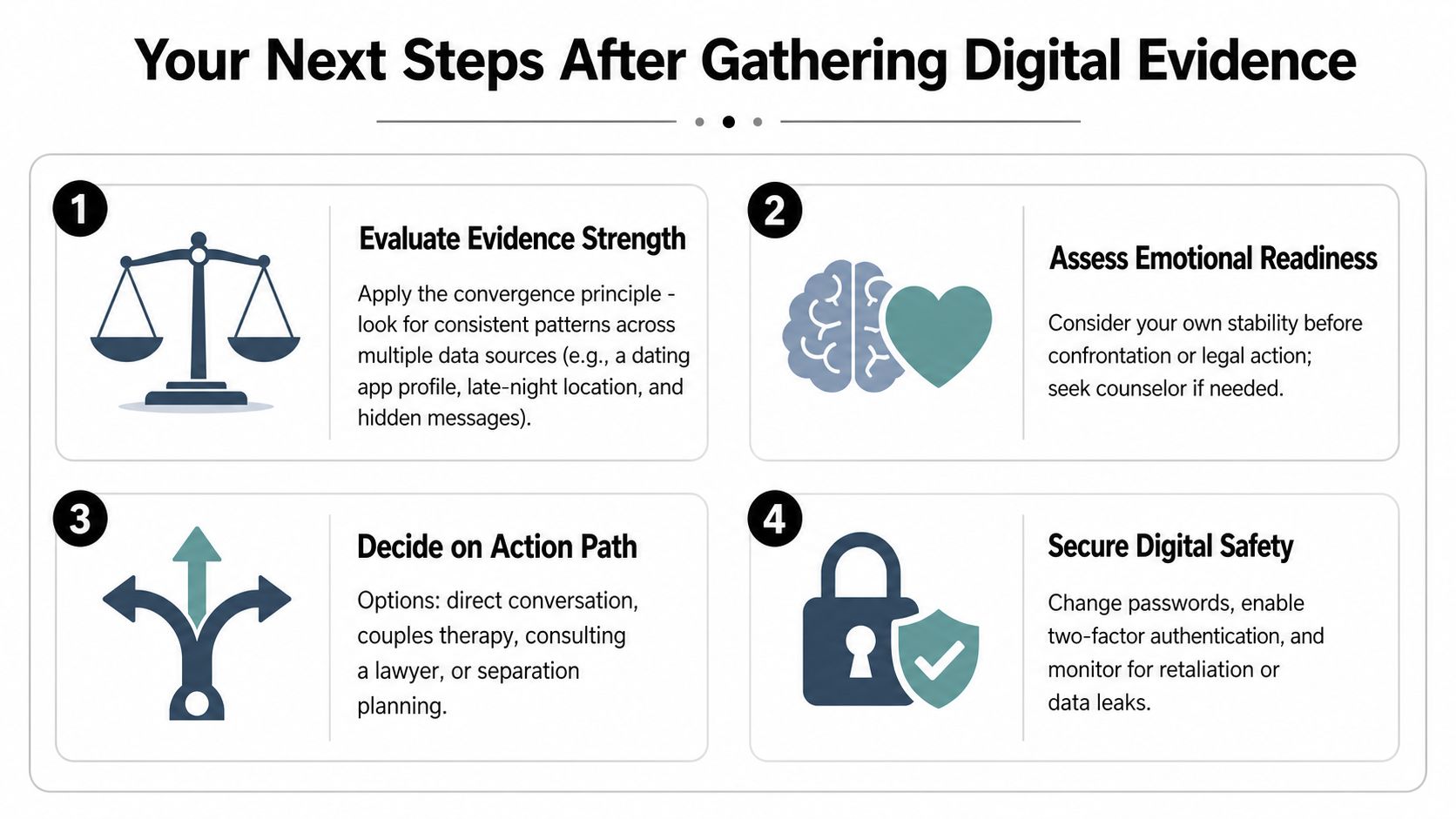
Once the pieces are collected, judge the case by convergence, not by outrage. A dating profile, a location anomaly, and a hidden message thread that all point to the same window are stronger than a single suspicious notification. If the signals don’t align, keep investigating or step back before you act.
Make the next decision with a cool head
If the evidence is thin, don’t confront based on one item. If the evidence is strong and lawful, think about whether you need a private investigator for deeper forensic review, a family law attorney for admissibility questions, or a therapist if the emotional load is too heavy to manage alone. A direct conversation only works when you already know what you can stand behind.
It also helps to secure your own accounts before anyone feels threatened. Change passwords, enable two-factor authentication, and check for shared access or recovery-email exposure. That step protects you from retaliation, accidental deletions, and data leaks.
If you’re in Texas and want a legal perspective on how infidelity can affect divorce, the infidelity divorce legal grounds Austin resource is worth reviewing before you make a final move. If you want to audit your own digital footprint first, the internal guide on data broker removal can help reduce exposed personal information while you decide what comes next.
The cleanest path is simple. Verify what you can, preserve it properly, and act on evidence that holds together.
If you want to start with a lawful, structured review of your own online footprint, visit Digital Footprint Check and use the free checker to surface publicly visible accounts, data exposures, and other traces that matter in an infidelity digital investigation. It’s a practical first step if you need clarity before you confront, preserve, or escalate.