· Digital Footprint Check · Content Marketing · 14 min read
Online Dating Background Check: a Practical Guide
Learn how to run an online dating background check with proven OSINT techniques, red flag checks, and legal tips to verify any match before you meet.

You’ve got a first-date message thread that feels promising, but there’s still that small knot in your stomach. The photos look current, the conversation is easy, and the plan is to meet somewhere public. Before you go any further, an online dating background check can give you a clearer read on whether the person behind the profile is who they say they are, without pretending it can remove every risk.
A good check is a vetting tool, not a verdict. It helps you reduce avoidable risk by comparing what someone claims with what’s publicly visible, and it works best when you already know your boundary for walking away.
Before You Search Anything
The safest checks start before a browser tab opens. If you’re sitting on the couch with a date scheduled for Friday, the core question isn’t whether you can dig up everything about them, it’s whether you need enough information to decide if the meeting stays on the calendar. That distinction matters, because a background check in this context means reviewing publicly available information for consistency, not pretending you’ve built a complete character profile from the internet.
If you want a quick grounding point on your own side of the process, staying secure on dating sites is a useful companion read for the broader safety habits that come before any search. The legal and ethical line is simple, you can review public information and your own notes, but you shouldn’t cross into harassment, impersonation, or using data in ways the platform or law doesn’t allow. If you want consent language and cleanup practices for your own records, the internal guide on consent forms for background checks is relevant if you’re thinking about how to document a vetted interaction.
Start with the real question
A check works best when you know what would change your mind. Maybe you’re looking for obvious catfishing, maybe you want confidence that the job title and city are real, or maybe you’re deciding whether a phone call is enough before you meet in person. That’s a boundary, not paranoia.
Write down what you already know, the name, the profile photos, the app handle, the claimed city, and any contact detail they’ve shared. Set a time limit before you start, because open-ended searching turns into spiraling. If the point is safety, not obsession, you need an end point before the first search result loads.
Practical rule: if you can’t say what would make you stop, you’re not vetting anymore, you’re collecting.
A clean result doesn’t mean a person is safe. It means you didn’t find anything that changed the current decision, and that’s a very different thing. That mindset keeps the check useful instead of turning it into a false sense of certainty.
The Staged OSINT Workflow That Saves Time
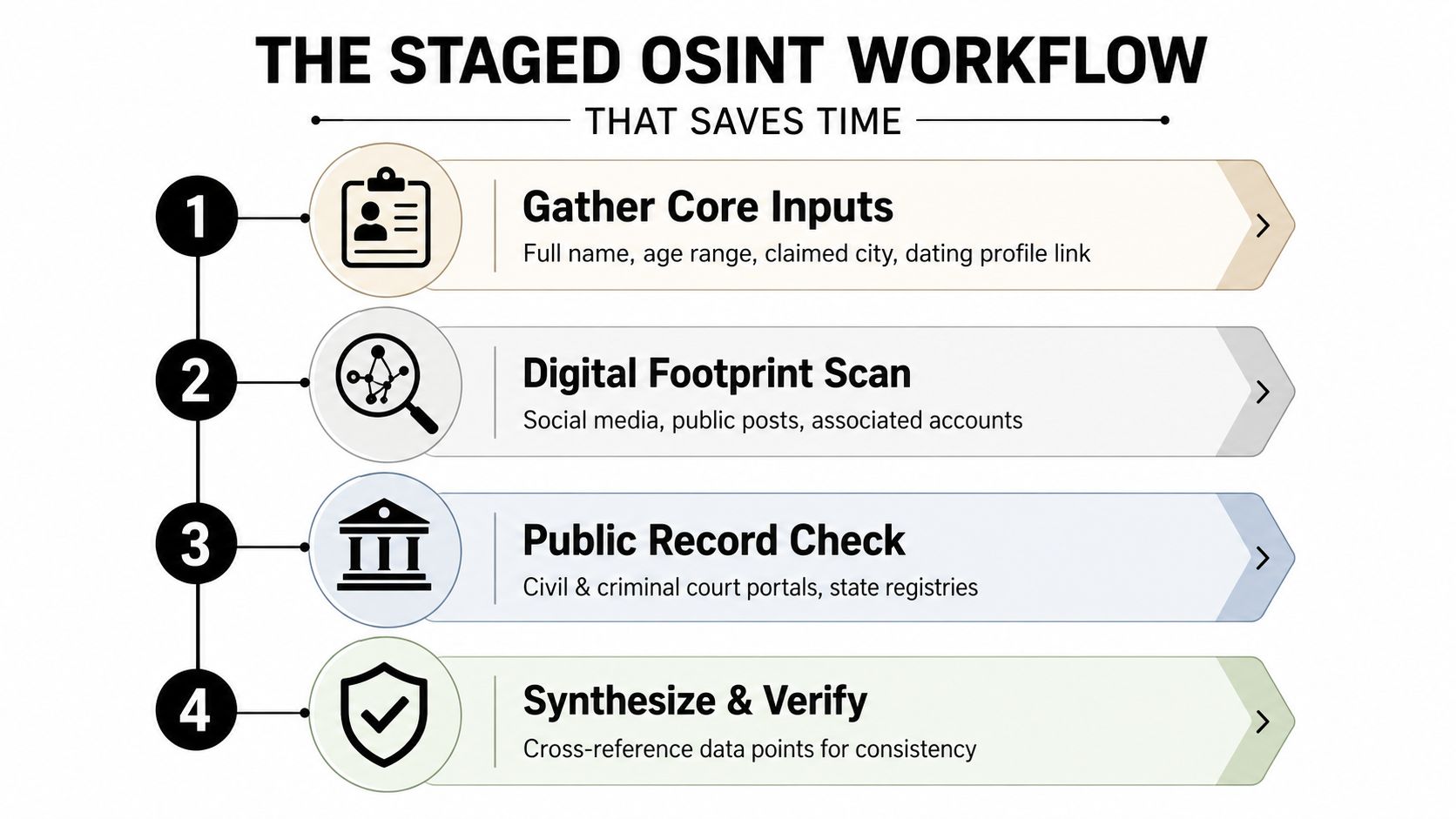
The fastest mistake people make is jumping straight to court records. That feels serious, but it wastes time and can produce confusing results before you’ve even confirmed the basics. Practitioners usually start with identity inputs, then check whether the digital footprint fits, and only then move into public records if something needs clarification.
Gather the inputs that matter
Start with the full name, approximate age range, claimed city, phone number, email address, and any usernames tied to the dating profile. If the profile has a linked Instagram, a Snapchat handle, or a gaming alias, keep those too. The internal workflow guide on OSINT tools for beginners is a practical companion if you’re building a repeatable process instead of improvising every time.
Those inputs matter because every later search gets sharper when you have more anchors. A name alone is noisy. A name plus city and a contact point gives you a better chance of separating the match from other people with the same name.
Move from consistency checks to public records
Check whether the social footprint agrees on the basics, job, city history, age clues, and photo continuity. Then look at usernames and contact details before you touch court portals. In practitioner guidance, consistency across photos, job history, age, city, and public footprint is usually more revealing than a criminal search done too early, and one consumer workflow notes that a focused triage can be done in roughly 10 to 15 minutes when you’re deciding whether to keep talking or pause the plan (SpouseBusters).
Reverse-image results usually surface obvious fraud faster than court portals, which is why image checks sit before public records. County and state systems can be slow, fragmented, and jurisdiction-specific, so save them for the point where you need a decision, not for curiosity. That order keeps you from spending an hour chasing records when the profile photo already tells you enough to ask better questions.
Social Media, Usernames, and Contact Lookups
The meat of most checks lives here, not in a courthouse portal. A person’s claimed name can be common, but their social footprint usually leaves some pattern behind, and that pattern either lines up or it doesn’t. I’ve found that the best results come from cross-checking details across several places instead of treating any single profile as decisive.
Search the footprint, not just the name
Look up the person’s name plus claimed city and employer on LinkedIn, Facebook, Instagram, and X. Don’t send friend requests just to get access, that creates awkward signals and can tip the person off before you’ve finished a basic vetting pass. Compare the profile details against the dating profile, especially job title, city history, photos, and any age clues that show up in bios or public posts.
A single inconsistency doesn’t prove anything. Maybe the LinkedIn profile is stale, maybe the dating app is vague, or maybe the person recently moved. Multiple mismatches across platforms, though, are harder to ignore. If the app says one city, Instagram says another, and the work history doesn’t fit either, you’re dealing with a pattern, not a typo.
Use usernames and contact points as cross-checks
Take the handle from the dating profile and search it on Instagram, Reddit, TikTok, and gaming platforms. Usernames often repeat in places people forget to hide, and that’s where hidden accounts or alternate personas show up. A handle that’s used on a dating app, a gaming profile, and a public forum can connect the same identity faster than a search on the name.
Email and phone lookups help too. Free people-search engines, Gravatar, and carrier lookup tools can reveal whether a contact point shows up in more than one public context, but you have to separate signal from common-name noise. A phone number attached to a professional profile is more useful than a random listing, and a profile photo on Gravatar can help confirm whether the same person uses that address elsewhere. The internal guide on finding a person on social media fits neatly here if you want to push the profile and contact lookups into one workflow.
Practical rule: one oddity is a question, several oddities across name, city, and contact data are a reason to pause.
The YouGov polling in the brief shows this kind of informal screening is already routine, including social profile searches and name lookups before meeting, so you’re not doing something unusual when you check for consistency (YouGov). The difference is whether you use the results calmly and in sequence, or let the search become a scavenger hunt.
Reverse Image Search That Actually Catches Catfishing
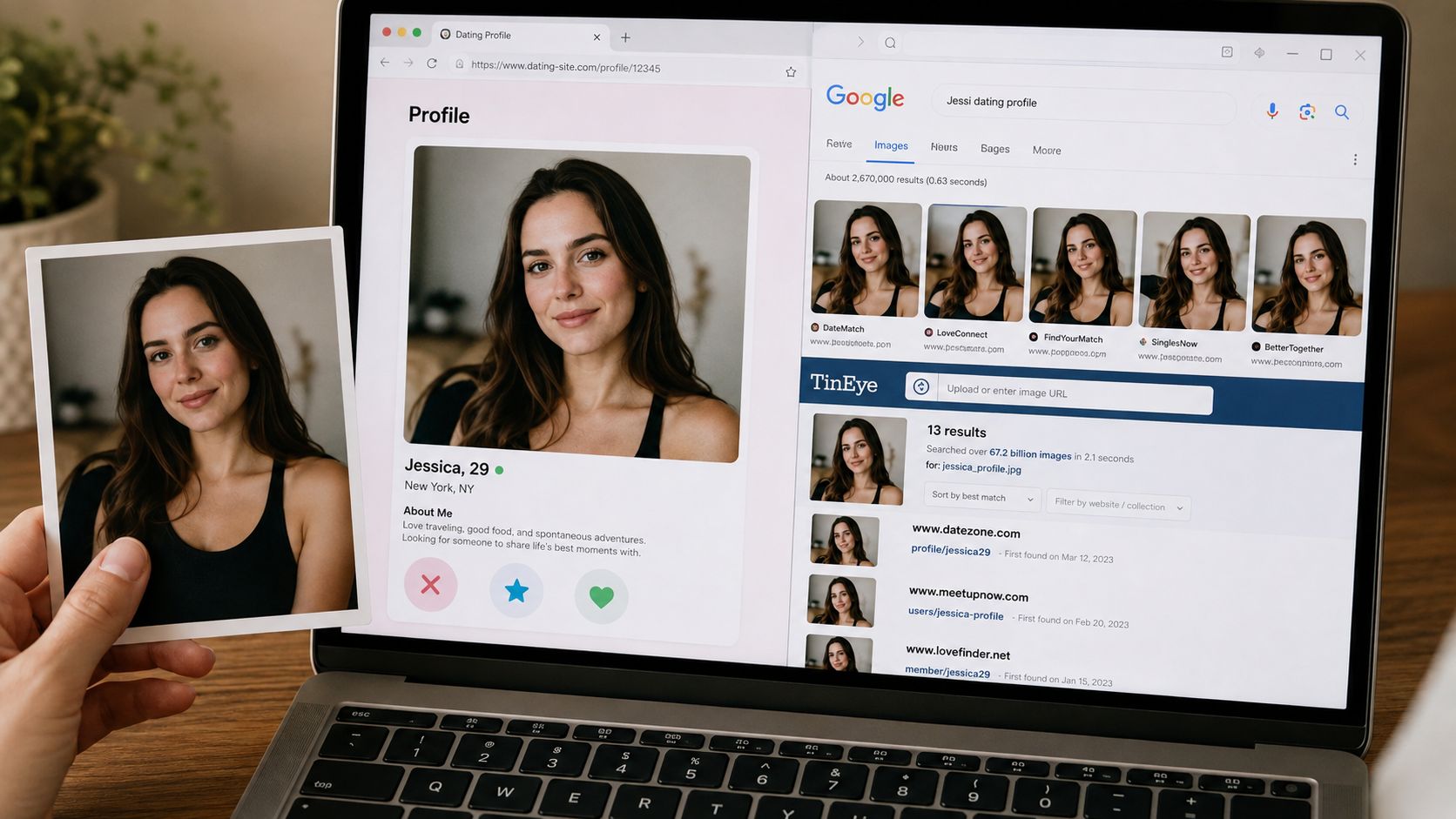
Photos are where a lot of scams break first. If someone lifted a picture from another profile, reused influencer content, or pasted a stock image into a dating account, reverse image search usually catches the trail faster than any other method. The key is to treat every photo as evidence, not decoration.
Search the same image in more than one engine
Save the original profile photo untouched, then upload it to Google Images, TinEye, Yandex, and Bing Visual Search. Different engines index different corners of the web, so one clean result doesn’t mean the image is original. The internal guide on reverse image search for people is helpful if you want a quick refresher on how to compare hits without overreading them.
A photo of the same person in different settings is normal. A beach shot on one site and a wedding photo on another doesn’t raise a problem by itself. A photo that appears attached to multiple names, ages, or cities is a very different pattern, and that’s where the risk starts to look like a copied identity rather than a real person with a messy internet trail.
Read the hits like an investigator, not a tourist
If the image result leads to a stock-photo library, an influencer page, or a model portfolio that has nothing to do with the dating profile, stop. That’s a hard red flag. Scammers often use one unique image on the dating app and then rely on the fact that many users won’t check it further, so you should reverse-search more than one profile photo, not just the most polished one.
If the photo was shared directly, inspect the file for EXIF data. Sometimes metadata includes camera or device clues, though many apps strip that out, and that’s normal. Missing metadata doesn’t prove anything, it just means the image was processed somewhere along the way.
The YouTube walkthrough embedded below can help if you’re more comfortable watching a process once before you do it yourself.
A clean image search is not proof of safety. It’s one signal in a longer chain, and it matters because it either clears an obvious fraud pattern or it forces a more careful conversation before you meet.
Public Records, Court Portals, and Registry Checks
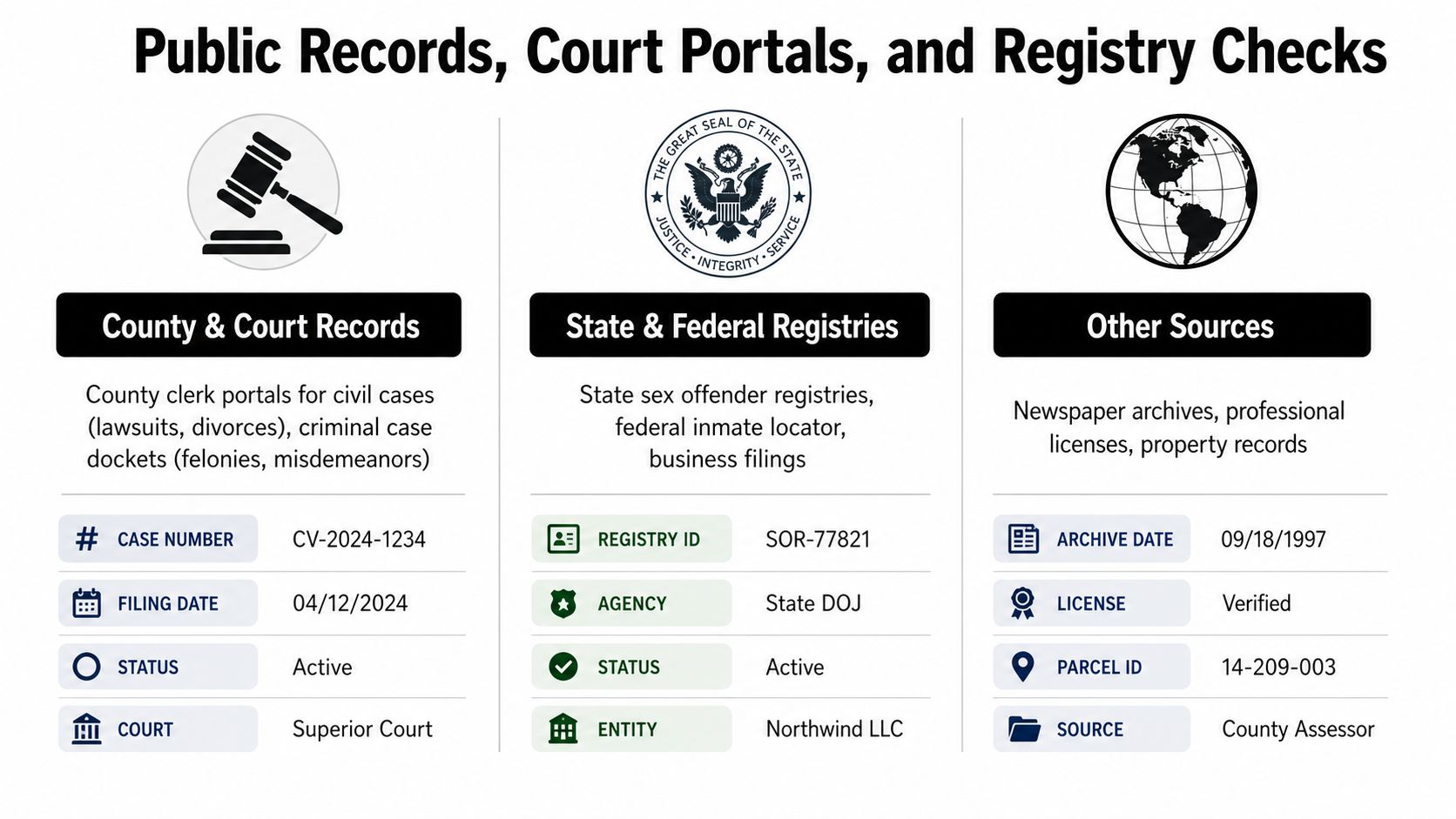
This is the part many expect to be simple, and it usually isn’t. Court and registry access is fragmented by county, state, and federal systems, so the same person can look clear in one place and have records sitting somewhere else entirely. A clean result can mean a clean record, or it can mean the record wasn’t indexed where you searched.
Search where the record would actually live
Start with county clerk and court portals for civil and criminal cases, then move to state court networks, and only then look at federal systems like PACER if the facts call for it. The Dru Sjodin National Sex Offender Public Website matters because it’s a national registry touchpoint, but it still doesn’t replace local record coverage. If earlier steps already show a strong match with the profile and no obvious safety questions, you may not need to push deeper just because you can.
Search all known aliases and prior cities. People who’ve moved across counties often leave records in places that won’t surface from a current city search, and name mismatches can hide a relevant case behind a different spelling or an old surname. The brief’s jurisdiction note is the key practical point here, a “no result” is only meaningful when you know the search covered the right places.
Separate meaningful hits from noise
Dismissed cases, expunged records, and sealed matters can be confusing because they’re legally present, partially present, or visible in some systems and not others. A hit isn’t automatically a stop sign, but it is a reason to slow down and understand what the record says. A clean result from one county portal doesn’t clear a person everywhere, and a vague result from a public search can be missing context rather than proving bad behavior.
That’s why public records are decision support, not a yes or no seal. They help you ask whether the match is consistent, whether the jurisdictions make sense, and whether the profile details line up with where the person has lived. If you’re using a broader records workflow for your own privacy or reputation cleanup, the internal note on background check removal service sits in the same ecosystem of record management, though the dating use case is usually about interpretation rather than removal.
Privacy, Consent, and the Cost to the Person Being Checked
A dating background check is a one-way mirror. The person being searched doesn’t get a say in whether their public records, old disputes, or scattered online traces get pulled together into a profile of suspicion. That’s why the ethical question isn’t only, “Can I find it?”, but also, “Does finding it make this interaction safer?”
Public doesn’t always mean fair
Public records can include addresses, legal filings, old arrests, and other details that are legally accessible but context-light. Someone may have an old issue that doesn’t predict current behavior, or a sealed or expunged matter that still leaves enough residue in fragmented systems to create confusion. If you want a legal background on how expunged material can still show up in some contexts, the Fiscella Law expungement guide is a useful reference point for understanding why a search result may not tell the whole story.
This matters especially for marginalized users and people who deserve a true fresh start after a past incident. It also matters for people whose records reflect old circumstances that have nothing to do with current dating behavior. The broader privacy critique is straightforward, background checks can improve safety, but they can also widen surveillance by making sensitive information easier to aggregate, reinterpret, and spread.
Use a personal rule for when to stop
A good rule is to stop digging when the next layer no longer changes the safety decision. If the profile is consistent, the photos check out, and there’s no real record concern, deeper searching can become moralized curiosity. If the search starts feeling like punishment rather than precaution, you’ve moved past the point where it’s helping.
TransUnion’s findings in the brief show that most users want platforms to verify basics like age, recency of photos, and location, and that many are open to background checks at some level (TransUnion). That support doesn’t erase the privacy cost, it just shows the market is trying to balance safety with information control. Your own boundary should be the last filter, not the first excuse to keep searching.
Reading Your Results and Deciding What to Do Next
The point of the search is a decision, not a dossier. Once you’ve checked the name, contact points, image trail, and any relevant records, the right next step usually falls into one of three buckets, green, yellow, or red. That framework keeps you from overreacting to harmless noise and underreacting to actual warning signs.
| Vetting Signal | What It Means | Recommended Action |
|---|---|---|
| Green | Profile details stay consistent, photos check out, no meaningful public-record concern surfaces | Proceed with a public first date, keep it short, and share your plan with a friend |
| Yellow | Small inconsistencies, older or ambiguous records, hidden accounts, or incomplete footprint | Ask direct questions, suggest a phone or video call, and slow the meeting down |
| Red | Stolen photos, refusal to video chat, clear mismatch across identity details, or a strong safety hit in records | Cancel and move on, don’t negotiate with the red flags |
Green means proceed, not relax completely
A green result means the check didn’t reveal anything that changes the plan. It does not mean you should meet in a secluded place or ignore normal dating precautions. Keep the first meeting public, tell a friend where you’re going, and stay alert to whether the in-person version matches the profile version.
Yellow means ask, then verify again
Yellow is where a lot of real-world dating lives. Maybe the person has a hidden social account, maybe one record is old and unclear, maybe the job history doesn’t quite fit the timeline. That’s the moment for a direct question, not an accusation. A short video call can clear up a lot, and if the answer gets defensive or evasive, the uncertainty is part of the answer.
Red means walk away
A stolen photo, a fake identity pattern, or a refusal to do basic verification is enough to stop. If a court hit ties the person to violence or fraud, or if a sex-offender match creates a proximity issue, don’t try to bargain with your instincts. End the conversation and move on.
Bottom line: no check can guarantee safety. It can only shift the odds by making lies, mismatches, and obvious fraud harder to hide.
If you want to consolidate the email, phone, username, and platform-search steps into one pass, visit www.digitalfootprintcheck.com/free-checker before your next date. A focused search won’t replace judgment, but it can save you from guessing when the profile, the footprint, and the story don’t quite line up.
If you want a faster way to vet a match before you meet, Digital Footprint Check pulls together public-facing signals across social profiles, usernames, contact points, and records so you can spot red flags without bouncing across a dozen sites. Use it to make your next online dating background check more organized, then go into the date with clearer eyes and a firmer boundary.