· Digital Footprint Check · Content Marketing · 14 min read
Tiktok Privacy Concerns Explained and How to Stay Safe
Worried about TikTok privacy concerns? Learn what data TikTok collects, real risks and fines, plus actionable steps to protect your identity and footprint.

You open TikTok for a quick break, watch a few cooking videos, pause on a local news clip, and send a joke to a friend. Nothing feels sensitive. Yet those small actions can help form a profile of your interests, routines, relationships, and possible location patterns. TikTok privacy concerns matter because exposure doesn't require a dramatic post or a stolen password. Passive viewing, device permissions, public visibility, and links between services can reveal more than many expect.
Introduction to TikTok Privacy Concerns Today
The uncomfortable part is that privacy risk often looks like convenience. TikTok remembers what keeps your attention, recommends similar clips, and makes it easy to find people you know. Those features improve the experience, but they also turn ordinary actions into signals that can be stored, compared, and used for inference.
A parent might worry about a child appearing in searches. A job seeker might wonder whether a public username connects a personal account to a professional identity. Someone using dating apps may discover that a public TikTok profile exposes a workplace, neighborhood, or relationship history. A gamer may use the same handle across TikTok, Twitch, Discord, and game platforms, making separate accounts easy to connect through open-source intelligence, or OSINT, techniques.
Regulatory actions show that these aren't only theoretical concerns. Ireland's Data Protection Commission fined TikTok €345 million on 15 September 2023 over violations connected to children's privacy, including age verification and privacy settings used in 2020. The same regulator later imposed a separate €530 million fine in 2025 over remote access to EU user data from China, showing that scrutiny expanded from youth settings to international data governance (BBC reporting on TikTok's enforcement history).
Public unease is also measurable. A survey summary found that 47% of surveyed American TikTok users were concerned about personal data collection, while 50% had changed privacy settings to limit it (survey findings on views of TikTok privacy). This guide connects the invisible data exchange to practical risks, explains what TikTok can collect, separates documented enforcement from speculation, and gives you a layered audit you can complete without treating uninstalling as a complete solution.
What Data TikTok Collects and How It Is Used
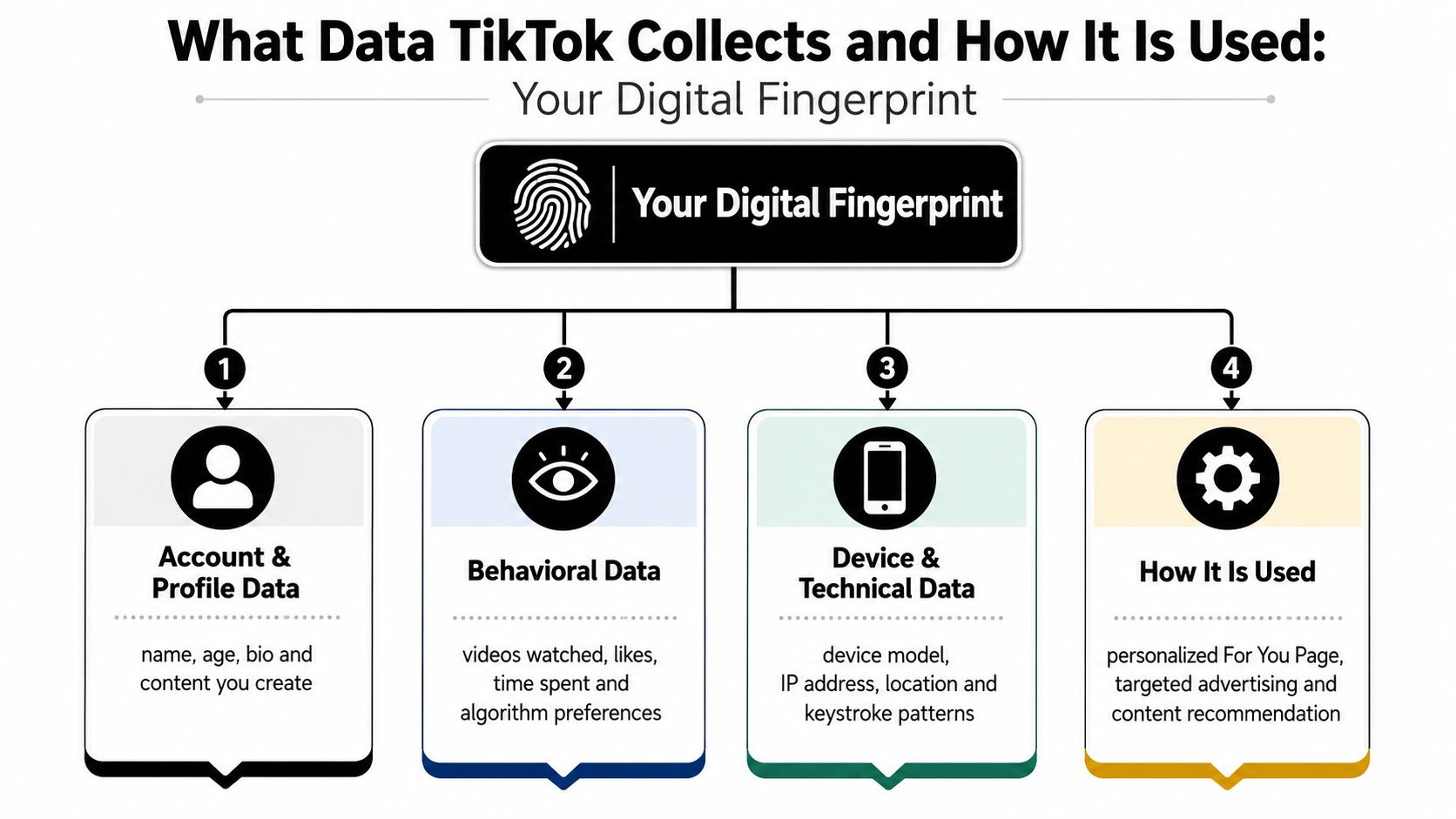
Think of your TikTok profile as a digital fingerprint assembled from puzzle pieces. One piece may be a video you upload. Another may be your device model. A third may be the amount of time you spend watching a particular topic. No single piece always identifies you, but the combined pattern can become highly distinctive.
The four main data layers
Account and content data starts with information you provide, such as a name, age, biography, messages, comments, purchases, and videos. Content can reveal faces, voices, rooms, workplaces, school uniforms, landmarks, and other people in the background. Even when you don't publish a location, a street sign or familiar bus route can provide a useful clue.
Device and network data can include an IP address, GPS data, device model, operating system, and related technical signals. A 2025 investigation by Canada's privacy regulator described TikTok's collection of user-provided data, device information, behavioral signals, and social graph data, including contacts and linked profiles (BBC analysis of TikTok's tracking and privacy controls). These signals help connect activity to a device and distinguish one session from another.
Behavioral data includes content viewed, watch time, likes, comments, purchases, and interaction patterns. You don't need to upload a video for this layer to exist. Repeatedly watching relocation advice, fitness content, local events, or relationship videos can indicate interests and life circumstances even when you never state them directly.
Social graph data maps relationships between contacts, linked profiles, followers, and people whose content you interact with. This can make identity matching easier. If the same username appears on TikTok and a gaming profile, and both use the same profile photo, an observer may connect the accounts without accessing private messages.
Why passive viewing still matters
TikTok can combine these layers to infer age, interests, location patterns, and relationship networks. That doesn't mean every inference is correct. It means the system can make predictions from metadata and interaction logs, which increases profiling and re-identification risk for adults and minors.
Persistent identifiers add another concern. If device, network, and cross-session signals remain connected, reinstalling an app may not erase the broader pattern. A practical permission audit can reduce the information available for correlation. Use TikTok app permission management to review access across your device, not only inside TikTok.
Some users also separate personal and public accounts with different contact details. If you're considering phone verification, review the privacy and security implications first, and consult this guide on how to secure TikTok with a virtual number. The aim isn't to create false identities or evade safeguards. It's to understand what information you attach to an account and whether you need every available connection.
A short visual explanation can make the data flow easier to follow:
Real Incidents and Research Behind TikTok Privacy Concerns
The strongest way to assess TikTok privacy concerns is to separate documented events from assumptions. Regulators and technical reviewers have identified specific issues involving children, permissions, tracking, and international access. Those findings don't prove every allegation made online, but they do establish that privacy failures have produced formal enforcement.
A pattern of enforcement
On 15 September 2023, Ireland's Data Protection Commission fined TikTok €345 million for violations tied to children's privacy, including age verification and privacy settings applied in 2020 (BBC coverage of the Irish enforcement action). The significance wasn't limited to the amount. The decision showed that default visibility and age-related design choices can create regulatory exposure at platform scale.
Ireland's regulator imposed a separate €530 million fine in 2025 after finding that TikTok didn't adequately protect EU user data accessed remotely from China. The case shifted attention from what children could see to how an organization governs cross-border access.
On 2 May 2025, the Irish Supervisory Authority split that later penalty into €485 million for an unlawful international data-transfer basis under GDPR Article 46(1), and €45 million for inadequate information about transfers to China under Article 13(1)(f). The European Data Protection Board announcement also described corrective measures connected to suspending those transfers.
What technical reviews add
Regulatory cases address legal duties. Technical reviews examine how software behaves. A source-code review cited by Radio Free Asia described TikTok's permissions and device-information gathering as “overly intrusive” and not necessary for core functionality (Radio Free Asia report on TikTok permissions).
A later BBC investigation highlighted tracking concerns that can continue when the app isn't actively being used. An app ecosystem can involve browser activity, advertising tools, and device-level signals, not just the visible feed. The practical lesson is that deleting the app may reduce exposure without eliminating every associated data trail.
Evidence rule: Treat a documented regulator finding as evidence of a specific failure, not proof that every fear about the platform is true.
Parents and high-risk users should also check whether spyware or unwanted monitoring exists elsewhere on a phone. A phone spyware detection guide can help distinguish ordinary app tracking from malicious software installed by another person.
Geopolitical and Regulatory Issues Shaping TikTok Privacy
Geopolitics attracts attention because data may be accessed across borders. The everyday privacy question is more concrete: who can access the information, under what legal mechanism, and what can the platform infer from it?
Cross-border access is a governance problem
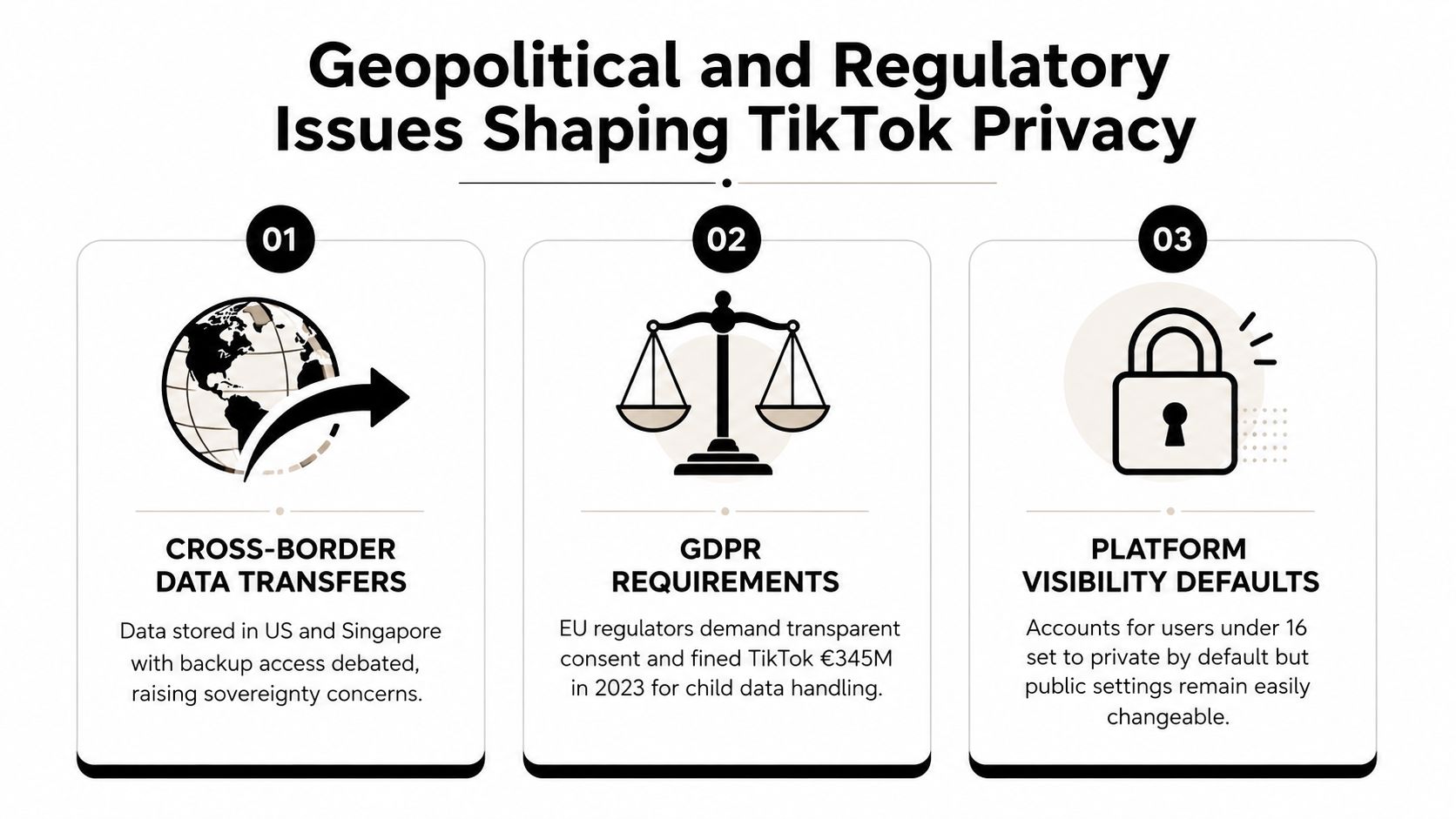
A company may store information in one country while allowing authorized staff or service providers in another country to access it. Storage location and access location aren't always the same. Under the GDPR, an organization needs a lawful basis and appropriate safeguards for certain international transfers, and it must explain relevant transfers to users.
The 2025 Irish decision demonstrates why disclosure alone isn't enough. A privacy notice can tell users that data moves internationally, but the transfer still needs a valid legal mechanism. That distinction affects anyone whose account includes messages, contacts, location signals, or viewing patterns.
Visibility is a privacy control
The European Commission announced preliminary findings in July 2026 that TikTok hadn't adequately protected minors' privacy under the Digital Services Act because minors' accounts and content remained too visible to adults and people without TikTok accounts (European Commission findings reported by Jurist). This frames privacy as more than collection. Who can discover a profile matters just as much as what the platform stores.
Recent EU and Brazil enforcement actions also focused on children whose accounts could be viewed by adults, discovered through follower or following lists and profile photos, or used through logged-out browsing without effective age verification. Brazilian regulators estimated that TikTok may have processed data for at least 8 million children and imposed a fine of nearly $30 million (Euronews report on children's account privacy).
Brazil's data-protection authority later fined TikTok $30 million in August 2026, citing privacy-law breaches involving logged-in accounts and guest browsing sessions. The Al Jazeera report on Brazil's decision highlighted how logged-out feeds can let minors browse without creating accounts, weakening age-gating controls.
After the 2026 U.S. ownership restructuring, TikTok's updated privacy policy reportedly says it may collect precise location data, depending on settings, whereas earlier wording referred to approximate location data (BBC report on TikTok's location policy). The practical question isn't only which country owns an asset. It's whether your location history, visibility settings, and account connections expose more than you intended.
For a broader explanation of why users should understand control and access rights, review this guide to ownership of data.
Personal and Organizational Risks From TikTok Exposure
A public TikTok profile can become an OSINT starting point. An observer may combine a username, profile photo, comments, visible followers, background details, and posting times with information from other platforms. The observer doesn't need a breach or private access. Public fragments can be enough.
Four everyday exposure paths
Employment and reputation: An employer or recruiter may encounter a public account connected to your real name. A joke, political argument, or personal disclosure may be taken out of context, especially when the profile also displays your workplace or professional field. Privacy settings can't control every screenshot, so separating personal and professional identifiers reduces accidental linkage.
Personal safety: A video filmed outside your home can expose a building entrance, regular commute, school, or gym. Repeated posts at similar times can reveal routines. Precise location access makes this more serious because location history can create a map of where you spend time, even when individual posts look harmless.
Dating and romance scams: A match may use a TikTok profile to appear authentic, or a scammer may use your public content to tailor a believable story. Compare usernames, dates, profile photos, and claimed locations across services, but don't treat matching content as proof of identity. A real person can have a copied profile, and a convincing account can still belong to someone else.
Gaming and account security: Reusing a handle across TikTok, Steam, Discord, Twitch, and gaming forums lets others connect your social life to your gaming identity. That connection can reveal a school, timezone, voice clips, or friends. Use unique usernames where practical, remove unnecessary public links, and keep recovery email addresses private.
| Exposure vector | What an observer may infer | Safer habit |
|---|---|---|
| Watch patterns | Interests or life changes | Treat viewing history as sensitive |
| Public followers | Social connections | Review follower and following visibility |
| Background details | Places, routines, or affiliations | Crop or blur before posting |
| Reused usernames | Cross-platform identity links | Separate handles and profile photos |
| Location access | Movement patterns | Disable precise access unless needed |
Organizations face a related problem. Employees may reveal offices, badges, travel schedules, or internal tools in short videos. A public post can help a social engineer sound credible when contacting a colleague. The risk isn't limited to TikTok. It grows when TikTok details correlate with public company pages, gaming accounts, dating profiles, or data-broker listings.
Practical rule: Ask what a stranger could reconstruct from your profile, not only what you intentionally wrote.
How to Protect Your Privacy on TikTok Step by Step
Privacy protection works best as a series of smaller reductions. You don't need to make one dramatic decision. Reduce permissions, limit discoverability, separate identities, and check the device and browser around the app.
Start inside TikTok
-
Set the account to private. This limits who can view content and follow you, although it doesn't prevent screenshots or copying. For a teenager, review the setting with a parent rather than assuming the default is sufficient.
-
Review discoverability controls. Disable options that suggest your account to contacts, Facebook friends, or people who open or send links, where available. Check follower and following visibility, profile photo visibility, direct messages, comments, and downloads.
-
Clear or limit activity data. Treat watch history, search history, likes, and saved content as sensitive records. Delete old activity where TikTok provides the option, and avoid assuming that clearing a screen instantly removes every server-side record.
-
Turn off contact syncing. Contact lists expose relationship information and can help connect an account to people you know. If syncing was previously enabled, look for the option to remove previously synced contacts as well as disabling future access.
Reduce the device data surface
Open your phone's operating-system permission manager and inspect TikTok individually. Disable precise location, contacts, microphone, camera, photo-library, and tracking permissions unless you need them for a specific action. A permission audit is more reliable than trusting an app's broad default request.
For location-specific instructions, use this guide to turn off location access. Remember that approximate location can still be inferred from network signals and activity, so permission changes reduce exposure without creating perfect anonymity.
Cover the surrounding ecosystem
Uninstalling TikTok may remove the app, but it doesn't necessarily erase information already collected or stop related browser and advertising signals. Use a privacy-focused browser such as Firefox, Safari, Brave, or DuckDuckGo Browser, and consider reputable tracker-blocking tools such as uBlock Origin, Privacy Badger, or Ghostery. Install extensions cautiously because a privacy tool gets extensive access to browsing activity.
Limit ad tracking at the operating-system level, review browser cookies, and avoid using the same email address, phone number, profile image, and username everywhere. Those repeated identifiers make correlation easier even when each individual service has reasonable settings.
Finish with a verification pass:
- Account: Confirm private status, discoverability, comments, messages, downloads, and visibility.
- Permissions: Check location, contacts, camera, microphone, photos, and tracking access.
- History: Review search, watch, likes, saved items, and synced contacts.
- Browser: Block trackers, clear unnecessary cookies, and limit ad personalization.
- Identity: Search your username and profile photo across public platforms.
Take Control of Your Digital Footprint Beyond TikTok
TikTok is one part of a larger identity trail. Your public username may appear on social networks, gaming profiles, professional sites, forums, dating platforms, breach databases, and public records. A setting can also drift after an app update, a new device, or a change in how a platform handles logged-out visitors.
An OSINT-style review starts with identifiers. Search your current and old usernames, email addresses, phone numbers, profile photos, and distinctive phrases. Check whether a TikTok profile appears under a username you use elsewhere, whether public content exposes a location or employer, and whether an old account still connects your personal and professional identities.
A service such as Digital Footprint Check's data-broker removal guidance can support the cleanup process. For people facing a higher physical-security concern, specialist services such as TSCM bug sweeps in Birmingham address a different problem, detecting potential surveillance devices rather than reviewing public online exposure.
Build a repeatable routine. Review public profiles, rotate reused passwords, enable multi-factor authentication, check breach notifications, and remove unnecessary account links. Gamers should audit linked accounts and recovery details. Job seekers should review public posts and profile photos. Parents should check visibility and discoverability with children, without turning privacy into a one-time settings exercise.
The objective isn't perfect invisibility. It's knowing what others can find, reducing unnecessary signals, and responding quickly when exposure changes.
Digital Footprint Check scans public information across 500+ platforms, including social, professional, gaming, breach, and public-record sources, and its free checker can help identify whether a TikTok profile and related accounts appear under your identifiers. Visit Digital Footprint Check to run a free check, see what your online identity may reveal, and take the next practical step toward reducing unwanted exposure.