· Digital Footprint Check · Content Marketing · 17 min read
Top Social Media Profiles: 7 Examples Worth Copying
Explore seven top social media profiles across platforms, with analysis of what makes each effective and tactics to emulate for reputation management.
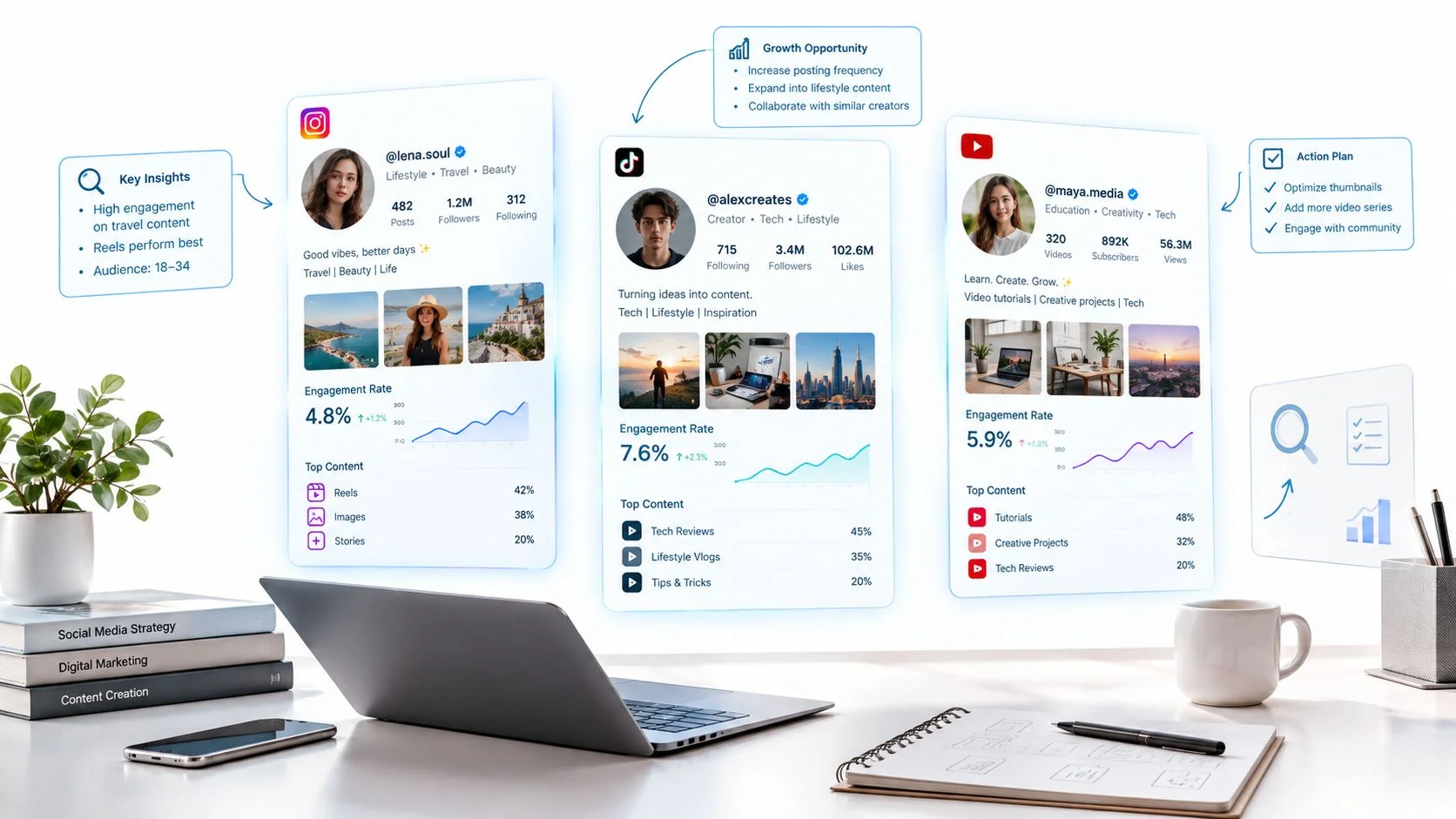
A hiring manager opens your LinkedIn profile, checks Instagram, and then finds an old public post on X. The search takes only a few minutes, but those results shape the first impression of your reputation. A date, recruiter, client, or potential business partner may follow the same path, moving between polished profile details, casual photos, old opinions, and accounts you forgot were still public.
The strongest top social media profiles handle that first look deliberately. They make identity easy to verify, keep public information consistent, and use privacy controls without making the account impossible to understand. This list breaks down seven profiles that do that well, explains why each one works, and identifies one practical habit you can copy. For broader content planning ideas, see this guide to creative content inspiration for marketers.
1. Facebook
Facebook remains one of the most useful places to audit a person's public identity because it often contains the longest history. A profile may include older photographs, family connections, employment details, local groups, event activity, Marketplace listings, and public comments. That depth helps a recruiter or date understand context, but it also creates more opportunities for outdated information or accidental oversharing.
A well-managed Facebook profile separates identity from exposure. Your name, current role, and a clear profile image can remain visible while personal posts, tagged photos, birthdays, friend lists, and location details stay limited to trusted audiences. Pages and Groups add another layer. A small-business owner may use a Page for public credibility, while a hobbyist may want group participation hidden from casual searches.
Facebook's broad settings can be useful, but they're spread across several menus. The account also connects with Instagram and other Meta services through a unified Meta Account, so a security or privacy review shouldn't stop at the Facebook timeline. Check linked accounts, active sessions, recovery methods, and applications with account access.
Practical rule: Keep the profile easy to verify, but make the timeline difficult to exploit.
A useful routine is to view the profile as a stranger. Look for public posts, old profile images, tagged content, contact details, check-ins, and Marketplace activity. Then use this Facebook privacy guide to reduce exposure without deleting the account.
Facebook works best when it provides credible context without functioning as a personal archive for everyone. Its main weakness is historical clutter. Old public posts can continue to affect reputation long after your priorities have changed, so review them periodically instead of relying on one privacy change.
Visit Facebook to review your profile and account settings.
2. Instagram
Instagram communicates a person's lifestyle faster than most text-first networks. A recruiter may see your current work, interests, travel habits, social circles, and personal boundaries before reading the bio closely. A date may form an impression from the profile image, recent grid, Stories, tagged posts, and the accounts you interact with.
The best profiles use a clear visual identity. The name field should make the person or business understandable, while the handle should be memorable and consistent with other networks where possible. A short bio can explain the person's role, location at a broad level, and purpose for the account. That structure helps genuine visitors distinguish an active account from a copied or abandoned one.
Instagram's public format creates a timing problem. Stories, Reels, and location references can reveal where someone is or what routine they follow. DMs can also expose relationship patterns, especially when the profile displays frequent interactions with unfamiliar accounts. Creator and business tools help measure activity, but they don't replace a privacy review.
What a strong Instagram profile makes obvious
A stranger should quickly understand:
- Who runs the account: Use a recognizable image, consistent name, and links that connect to an official site or another established profile.
- What the account is for: Separate a professional portfolio from a private personal account when the audiences and risks differ.
- What is safe to publish: Avoid real-time location details, visible travel plans, documents, home identifiers, and images that expose other people without consent.
- How to contact the owner: Use a controlled business email or platform message rather than publishing a personal phone number.
Instagram's connection to Threads and other Meta apps can improve discovery, but it can also spread identity signals across services. Review linked accounts and the audience for older posts. This guide to Instagram privacy settings is useful when you want to keep the account discoverable without making every detail public.
The replicable habit is simple: review the profile as a visual story, not as a collection of individual posts. If the first screen suggests a different person, purpose, or lifestyle from your LinkedIn and website, fix the mismatch before adding more content.
Visit Instagram to inspect your bio, linked accounts, public posts, and story controls.
3. X, formerly Twitter
X is where old opinions can remain more visible than people expect. A profile may expose years of posts, replies, reposts, Lists, Communities, Spaces activity, and public conversations. Even deleted material may survive through screenshots, quoted posts, search indexes, or third-party archives.
That makes X valuable for reputation research and risky for casual posting. A recruiter can learn how someone communicates under pressure, responds to disagreement, and discusses employers or clients. A date may find political views, recurring arguments, or personal information that never appears on a polished profile. A company may use the account to publish announcements, customer support responses, and public positions.
The strongest profiles define their public role. A professional account can state a field of expertise, link to a current website, and avoid confusing personal and employer statements. A personal account can remain personal, but it still benefits from a recognizable identity boundary. If anonymity matters, don't combine a pseudonymous handle with identifiable workplace, location, family, and routine details.
Use the timeline as an audit trail
Start with the oldest visible posts and search for your name, employer, former usernames, and recurring topics. Review replies as carefully as original posts. Replies often reveal tone and relationships more clearly than carefully edited announcements.
Premium tiers and changing product features can affect visibility and account behavior, so don't assume that a badge proves identity or trustworthiness. Confirm the account through a linked official website, another established profile, or a company page. You can use this guide to find people on Twitter when checking whether several usernames belong to the same person, but stay within public and ethical research.
Public posting creates a reputation record, even when the account feels temporary.
One useful habit is to write a short account policy for yourself. Decide which subjects you'll discuss, which personal details you'll never publish, and when you'll move a sensitive conversation to a private, verified channel. That small boundary prevents impulsive posts from defining the profile.
Visit X to review your public timeline, replies, media, Lists, and account security.
4. TikTok
TikTok profiles reveal behavior through movement, voice, sound, surroundings, comments, duets, and recurring routines. A person may disclose more in a short video than in a written bio. Background signs, school or workplace references, neighborhood clues, and posting patterns can make identity easier to connect across platforms.
The strongest TikTok profiles control context. The bio establishes the account's purpose, while pinned videos explain the creator's main topic or professional value. A business can use product demonstrations and customer education. A job seeker might use the platform to show communication skills, teaching ability, or technical knowledge without exposing private routines.
TikTok's recommendation system can also connect viewers to adjacent accounts through sounds, hashtags, comments, and duets. That discovery is useful for creators, but it can expose relationships and interests that the owner didn't intend to make central. LIVE streams and in-app Shop activity add more identity and activity signals.
Separate reach from safety
A public video can travel far beyond the creator's intended audience. Before posting, check reflections, documents, vehicle plates, house numbers, school logos, work badges, and live location clues. Review comments for attempts to extract personal information. Don't treat a private account as invisible, especially if approved followers include people you don't know well.
- Pin useful context: Make the first visible videos explain who you are and what the account offers.
- Remove accidental clues: Crop or edit backgrounds that reveal addresses, schedules, or confidential work material.
- Review interactions: Check duets, mentions, comments, and linked accounts for unintended exposure.
- Control contact routes: Use a separate business email or platform inbox for collaborations and inquiries.
This TikTok privacy guide can help identify common exposure points. For creators focused on professional networking, an AI-powered LinkedIn growth tool may support a separate professional channel, but it shouldn't replace manual privacy and identity checks.
The habit worth copying is to watch your own profile without sound. If the account still reveals your identity, location, and purpose through visuals alone, it's communicating more than you may realize.
Visit TikTok to review public videos, mentions, direct messages, and account visibility.
5. LinkedIn
LinkedIn is usually the clearest professional profile in a name search. Recruiters look for a coherent work history, current role, location, education, skills, recommendations, and evidence that the person exists beyond a single account. Clients and business partners often use the same signals to decide whether to respond.
A strong LinkedIn profile doesn't try to sound impressive everywhere. It makes claims specific and consistent. Job titles match the person's résumé and company history. Dates, certifications, portfolio links, and recommendations support the central story. A headline explains the work in plain language instead of stacking vague adjectives.
Company Pages add useful context because they connect employees, leaders, and organizational claims. That also creates a verification opportunity. If a profile says someone works for a company, check whether the company lists the person, whether the website links back to the profile, and whether the employment history makes sense.
What recruiters notice first
The first-minute test is practical:
- Identity: Does the name, photograph, location, and current role match other public profiles?
- Evidence: Do featured projects, publications, recommendations, or portfolio links support the claims?
- Maintenance: Is the profile current, or does it show an outdated employer and abandoned headline?
- Contact: Is there a professional route for follow-up without exposing unnecessary personal details?
LinkedIn Premium offers career, business, sales, recruiting, and learning features, but a paid plan doesn't verify every claim in a profile. Treat endorsements as supporting signals, not proof. Search across public sources and compare the details. A tool such as LinkedIn search by phone number can help locate possible profiles, but identity matching requires more than one shared detail.
The replicable habit is to update LinkedIn whenever your role changes, then check your other public profiles for the same change. Consistency strengthens credibility. It also reduces confusion when someone searches your name before offering an interview, contract, or introduction.
Visit LinkedIn to review your headline, featured work, employment history, recommendations, and public profile visibility.
6. Reddit
Reddit shows a different side of online identity. Most users rely on pseudonyms, and many communities reward detailed discussion rather than polished personal branding. That can make the platform more candid, but it also makes attribution difficult. A username alone doesn't prove who operates an account.
A Reddit profile can still affect reputation. Public comments may reveal technical skills, hobbies, political views, personal struggles, workplace frustrations, or recurring disputes. An older account provides a longer behavioral record, while a new account offers less context. Karma and subreddit participation can help explain whether an account is an established contributor or a throwaway identity, but neither proves expertise or good intentions.
The best approach is to treat Reddit as context, not identity proof. If a username appears on Instagram, YouTube, a gaming profile, or a personal website, compare public signals carefully. Look for consistent interests, writing style, time patterns, and linked references. Don't assume that similar usernames belong to the same person, and don't expose a pseudonymous user's real identity merely because you can find clues.
Protect the separation
Reddit is useful when you deliberately choose what belongs to a public professional identity and what doesn't. Keep sensitive questions in communities where the privacy expectations are clear. Remove identifying details from posts about health, family, travel, employment disputes, or financial problems. Remember that screenshots can travel outside the original subreddit.
Moderation quality varies across communities, and a comment that seems harmless in one context may look alarming when detached from its thread. Review your own public history with that context removed. If a recruiter or date saw only the account page, would the profile suggest thoughtful participation or repeated hostility?
One strong habit is to maintain separate handles for separate purposes, without cross-linking them through the same email, image, biography, or distinctive personal details. Separation isn't a license to deceive. It's a way to reduce unnecessary identity linking.
Visit Reddit to review public posts, comments, profile details, and account privacy choices.
7. YouTube
A YouTube channel works as a public profile, portfolio, and searchable archive. The banner, avatar, channel description, playlists, video titles, thumbnails, captions, links, Community posts, Shorts, and live streams all contribute to the first impression. A recruiter may use it to assess presentation and subject knowledge. A customer may use it to judge whether a business can explain its product clearly.
The strongest channels make the owner's expertise easy to verify. The banner and About section state the purpose. Playlists organize work by audience or topic. Descriptions link to official sites and relevant profiles. Titles explain the value of each video instead of relying on inside references. Consistent thumbnails help a visitor understand that the channel is active and intentional.
YouTube also carries unusual historical weight. The platform's most-subscribed position has changed hands repeatedly since May 2006, with 12 different channels holding that position. PewDiePie held it during four separate runs, including one lasting 1,920 days, while his shortest run lasted four days. Across those periods, he accumulated 2,017 days as the leader, according to the historical record of YouTube's most-subscribed channels. The lesson for reputation work is clear. Visibility changes, but archived content and old associations can remain discoverable.
Build a channel that survives the first click
As of September 2025, every channel in YouTube's top 100 had more than 49 million subscribers, and every channel in the top 50 had exceeded 65 million, according to the list of the most-subscribed YouTube users. Fourteen channels had surpassed 100 million subscribers, three had exceeded 200 million, two had passed 300 million, and one had crossed 400 million. The same source records a global language mix, with 32 of the top 100 channels primarily producing content in English and 30 primarily producing content in Hindi.
Those figures matter less as popularity targets than as a reminder to verify scale and identity carefully. A large subscriber count doesn't prove that a channel is official, active, safe, or relevant to the person you're researching. Check linked websites, channel history, descriptions, contact details, and duplicated content before trusting an account.
The habit to copy is to audit your channel as a landing page. A visitor should know who you are, what you publish, why the material is credible, and where to verify you elsewhere. Delete or unlist content that creates avoidable risk, but preserve useful evidence of expertise through organized playlists and accurate descriptions.
Visit YouTube to review your channel layout, videos, descriptions, playlists, Community posts, and public links.
Top 7 Social Media Profiles Comparison
| Platform | Implementation Complexity 🔄 | Resource Requirements ⚡ | Expected Outcomes 📊 | Ideal Use Cases 💡 | Key Advantages ⭐ |
|---|---|---|---|---|---|
| Moderate, many features & privacy settings 🔄 | Moderate, ongoing content + privacy audits ⚡ | Broad reach; rich personal & local signals 📊 | Community engagement, reputation monitoring, local business presence 💡 | Massive U.S. reach; granular privacy controls ⭐ | |
| Low–Moderate, visual-first workflows & creator tools 🔄 | High, consistent visual content and curation ⚡ | Strong visual narrative; high discoverability 📊 | Personal branding, creator portfolios, lifestyle marketing 💡 | Visual storytelling; mature creator safety tools ⭐ | |
| X (formerly Twitter) | Low, fast, lightweight posting; frequent changes 🔄 | Low, short posts but active monitoring needed ⚡ | Rapidly indexed public statements; timeline reconstruction 📊 | Breaking news, thought leadership, stance analysis 💡 | Public-by-default networking; chronological clarity ⭐ |
| TikTok | Moderate, short-form video creation & trend tracking 🔄 | High, frequent creative output and archiving ⚡ | High virality; rich behavioral and trend signals 📊 | Trend discovery, youth/creator audiences, viral campaigns 💡 | Best-in-class recommendation engine; strong engagement ⭐ |
| Low, structured professional profiles & tools 🔄 | Low–Moderate, profile upkeep; premium costs for advanced features ⚡ | High trust signals for identity and professional credibility 📊 | Recruiting, B2B outreach, career branding, verification checks 💡 | Strong real-name verification; high SERP relevance ⭐ | |
| Low, pseudonymous community participation; variable rules 🔄 | Low, text-focused research but time-intensive analysis ⚡ | Authentic topic-centric insights; long behavioral histories 📊 | Niche research, sentiment analysis, corroboration of claims 💡 | Candid discussions and deep topical threads ⭐ | |
| YouTube | High, channel production, metadata management, moderation 🔄 | High, video production, editing, consistent cadence ⚡ | Strong SEO visibility; credible portfolios and expertise signals 📊 | Tutorials, portfolios, long-form brand building, demonstrations 💡 | Highly visible in search; rich metadata for verification ⭐ |
From Profile Examples to Your Own Reputation Audit
The best top social media profiles aren't necessarily the accounts with the largest audiences. They're the profiles that make identity clear, communicate a consistent purpose, and expose only the information the owner intends to share. A polished page can still create risk if it reveals a home address, personal phone number, predictable routine, private relationship details, or account-recovery clues.
Choose two platforms from this list that match where you spend the most time. Review them as a stranger would. Start with the profile image, name, bio, and recent content. Then inspect older posts, tagged media, comments, linked accounts, usernames, and public contact details. Ask whether a recruiter, client, parent, date, or scammer would reach the same conclusion about you after seeing both profiles.
Consistency matters because people and automated systems connect profiles through repeated signals. Similar usernames, identical photos, matching bios, shared workplaces, and linked email addresses can make separate accounts easy to associate. That can help a legitimate recruiter confirm your identity, but it can also help an impersonator build a convincing copy or target you with phishing.
Security should sit beside reputation management. The FBI's 2024 Internet Crime Report recorded 859,532 complaints of suspected internet crime and losses exceeding $16 billion, a 33% increase from 2023. A public profile won't cause every incident, but exposed usernames, email addresses, phone numbers, work details, and personal routines can make impersonation and social engineering easier.
Protect the accounts that control your identity first. NIST's multifactor authentication guidance defines MFA as two or more different evidence types, such as something you know, something you have, or something you are. NIST recommends enabling MFA where available and warns that SMS and one-time passwords can be vulnerable to phishing. Use an authenticator app, passkey, or hardware security key where supported, especially for email.
Your password strategy matters just as much. NIST's password guidance recommends MFA first and says passwords should be at least 15 characters when a password is required. Use a password manager, create a unique password for every important account, review active sessions, and remove unknown recovery methods. Email deserves priority because access to it can grant social, professional, gaming, shopping, and dating accounts.
Dating profiles need an even more cautious review. Pew Research Center found that 50% of online dating users believe fake accounts created to scam people are very common, rising to 57% among women and 44% among men, according to its research on online dating experiences. Use reverse image checks, compare public usernames, ask consistent questions, and pause when someone requests money, credentials, or a rapid move away from the platform. Never publish private information about another person while investigating a suspected catfish.
Start with a free scan at Digital Footprint Check to see which accounts and public details appear first. Then fix the three highest-risk items this week, such as an exposed email address, an abandoned account, a reused username, or a public post that reveals too much. For a broader process, read this guide on how to manage your online reputation.
Digital Footprint Check can help you discover accounts and exposed information across social networks, professional platforms, gaming profiles, breach databases, and other public sources. Visit Digital Footprint Check to examine your digital footprint, verify which profiles connect to your identity, and turn scattered search results into practical privacy and reputation actions.